Mostrando entradas con la etiqueta The Solar Wind. Mostrar todas las entradas

viernes, 12 de mayo de 2017

ESA : When Swarm met Steve .- Cuando Swarm conoció a Steve

http://www.esa.int/Our_Activities/Observing_the_Earth/Swarm/When_Swarm_met_Steve

Meet Steve
 
21 April 2017
Thanks to social media and the power of citizen scientists chasing the northern lights, a new feature was discovered recently. Nobody knew what this strange ribbon of purple light was, so … it was called Steve. a vuelo
ESA’s Swarm magnetic field mission has now also met Steve and is helping to understand the nature of this new-found feature.
Speaking at the recent Swarm science meeting in Canada, Eric Donovan from the University of Calgary explained how this new finding couldn’t have happened 20 years ago when he started to study the aurora.
While the shimmering, eerie, light display of auroras might be beautiful and captivating, they are also a visual reminder that Earth is connected electrically to the Sun. A better understanding of the aurora helps to understand more about the relationship between Earth’s magnetic field and the charged atomic particles streaming from the Sun as the solar wind.
“In 1997 we had just one all-sky imager in North America to observe the aurora borealis from the ground,” said Prof. Donovan.
 
All-sky imagers and satellites

“Back then we would be lucky if we got one photograph a night of the aurora taken from the ground that coincides with an observation from a satellite. Now we have many more all-sky imagers and satellite missions like Swarm so we get more than 100 a night.”
And now, social media and citizen scientists also have an increasingly important role.
For instance, the Aurorasaurus website makes it possible for a large number of people to communicate about the aurora borealis. It connects citizen scientists to scientists and trawls Twitter feeds for instances of the word ‘aurora’. In doing so, it does an excellent job of forecasting where the aurora oval will be.
At a recent talk, Prof. Donovan met members of another social media group on Facebook: the Alberta Aurora Chasers. The group attracts members of the general public who are interested in the night sky and includes some talented photographers.
Looking at their photographs, Prof. Donovan came across something he hadn’t seen before. The group called this strange purple streak of light in the night sky captured in their photographs a ‘proton arc’ but for a number of reasons, including the fact that proton aurora are never visible, he knew this had to be something else.
 
Aurora borealis

However, nobody knew what it actually was so they decided to put a name to this mystery feature: they called it Steve.
While the Aurora Chasers combed through their photos and kept an eye out for the next appearances of Steve, Prof. Donovan and colleagues turned to data from the Swarm mission and his network of all-sky cameras.
Soon he was able to match a ground sighting of Steve to an overpass of one of the three Swarm satellites.
Prof. Donovan said, “As the satellite flew straight though Steve, data from the electric field instrument showed very clear changes.
“The temperature 300 km above Earth’s surface jumped by 3000°C and the data revealed a 25 km-wide ribbon of gas flowing westwards at about 6 km/s compared to a speed of about 10 m/s either side of the ribbon.
 
Swarm
 
“It turns out that Steve is actually remarkably common, but we hadn’t noticed it before. It’s thanks to ground-based observations, satellites, today’s explosion of access to data and an army of citizen scientists joining forces to document it.
“Swarm allows us to measure it and I’m sure will continue to help resolve some unanswered questions.”
ESA’s Swarm mission scientist, Roger Haagmans, added, “It is amazing how a beautiful natural phenomenon, seen by observant citizens, can trigger scientists’ curiosity.
“The ground network and the electric and magnetic field measurements made by Swarm are great tools that can be used to better understand Steve. This is a nice example of society for science.”
ESA
Guillermo Gonzalo Sánchez Achutegui


Inscríbete en el Foro del blog y participa : A Vuelo De Un Quinde - El Foro!

viernes, 25 de marzo de 2016

NASA : Solar Storms Ignite X-ray "Northern Lights" on Jupiter .- De rayos X solares tormentas Ignite "Luces del Norte" en Jupiter

Hola amigos: A VUELO DE UN QUINDE EL BLOG., Las tormentas solares están provocando auroras de rayos X en Júpiter que son cerca de ocho veces más brillante de lo normal en una amplia zona del planeta y cientos de veces más energía que la Tierra "luces del norte", de acuerdo con un nuevo estudio usando datos de Chandra X de la NASA Observatorio de rayos. Este resultado es la primera vez que las auroras de Júpiter han sido estudiados a la luz de rayos X cuando una tormenta solar gigante llegó al planeta.
More information....

jupiter
Solar storms are triggering X-ray auroras on Jupiter that are about eight times brighter than normal over a large area of the planet and hundreds of times more energetic than Earth’s "northern lights," according to a new study using data from NASA’s Chandra X-ray Observatory. This result is the first time that Jupiter's auroras have been studied in X-ray light when a giant solar storm arrived at the planet.
 
The Sun constantly ejects streams of particles into space in the solar wind. Sometimes, giant storms, known as coronal mass ejections (CMEs), erupt and the winds become much stronger. These events compress Jupiter's magnetosphere, the region of space controlled by Jupiter's magnetic field, shifting its boundary with the solar wind inward by more than a million miles. This new study found that the interaction at the boundary triggers the X-rays in Jupiter's auroras, which cover an area bigger than the surface of the Earth.
These composite images show Jupiter and its aurora during and after a CME's arrival at Jupiter in October 2011. In these images, X-ray data from Chandra (purple) have been overlaid on an optical image from the Hubble Space Telescope. The left-hand panel reveals the X-ray activity when the CME reached Jupiter, and the right-hand side is the view two days later after the CME subsided. The impact of the CME on Jupiter's aurora was tracked by monitoring the X-rays emitted during two 11-hour observations. The scientists used that data to pinpoint the source of the X-ray activity and identify areas to investigate further at different time points. They plan to find out how the X-rays form by collecting data on Jupiter's magnetic field, magnetosphere and aurora using Chandra and ESA’s XMM-Newton.
A paper describing these results appeared in the March 22, 2016 issue of the Journal of Geophysical Research. The authors on the paper are William Dunn (UCL), Graziella Branduardi-Raymont (UCL), Ronald Elsner (NASA's Marshall Space Flight Center), Marissa Vogt (Boston University), Laurent Lamy (University of Paris Diderot), Peter Ford (Massachusetts Institute of Technology), Andrew Coates (UCL), Randall Gladstone (Southwest Research Institute), Caitriona Jackman (University of Southampton), Jonathan Nichols (University of Leicester), Jonathan Rae (UCL), Ali Varsani (UCL), Tomoki Kimura (JAXA), Kenneth Hansen (University of Michigan), and Jamie Jasinski (UCL).
NASA's Marshall Space Flight Center in Huntsville, Alabama, manages the Chandra program for NASA's Science Mission Directorate in Washington. The Smithsonian Astrophysical Observatory in Cambridge, Massachusetts, controls Chandra's science and flight operations.
Image credit: X-ray: NASA/CXC/UCL/W.Dunn et al, Optical: NASA/STScI
For more Chandra images, multimedia and related materials, visit:

Megan Watzke
Chandra X-ray Center, Cambridge, Mass.
617-496-7998
mwatzke@cfa.harvard.edu
Molly Porter
Marshall Space Flight Center, Huntsville, Ala.
256-544-0034
molly.a.porter@nasa.gov

Last Updated: March 23, 2016
Editor: Jennifer Harbaugh
NASA
Guillermo Gonzalo Sánchez Achutegui
Inscríbete en el Foro del blog y participa : A Vuelo De Un Quinde - El Foro!

domingo, 5 de julio de 2015

NASA : Lights of an Aurora From the International Space Station .- Luces de la Aurora desde la Estación Espacial Internacional...............

Hola amigos: A VUELO DE UN QUINDE EL BLOG., la Agencia del Espacio NASA, nos hace llegar esta hermosa fotografía de luces de  la Aurora terrestre, observada desde la La Estación Espacial Internacional. Las luces danzantes de la aurora ofrecen espectaculares vistas sobre el terreno, sino también captar la imaginación de los científicos que estudian la energía entrante y partículas del sol. Aurora es uno de los efectos de tales partículas energéticas, lo que puede acelerar fuera  de El Sol tanto en un flujo constante llamado el viento solar y debido a erupciones gigantes conocidas como eyecciones de masa coronal o CME.

MORE INFORMATION...........
http://www.nasa.gov/image-feature/lights-of-an-aurora-from-the-international-space-station

Aurora in green and red from International Space Station
NASA Astronaut Scott Kelly captured this photo of an aurora from the International Space Station on June 23, 2015.
The dancing lights of the aurora provide spectacular views on the ground, but also capture the imagination of scientists who study incoming energy and particles from the sun. Aurora are one effect of such energetic particles, which can speed out from the sun both in a steady stream called the solar wind and due to giant eruptions known as coronal mass ejections or CMEs.
Image Credit: NASA
Last Updated: July 5, 2015
Editor: Sarah Loff
Tags:  Expedition 44, Image of the Day, International Space Station, One-Year Crew
 NASA
Guillermo Gonzalo Sánchez Achutegui
ayabaca@gmail.com
ayabaca@hotmail.com
ayabaca@yahoo.com
Inscríbete en el Foro del blog y participa : A Vuelo De Un Quinde - El Foro!

domingo, 30 de junio de 2013

NASA - NASA Launches Satellite to Study How Sun's Atmosphere is Energized


Back to Gallery 
 Download Links


NASA's Voyager 1 Explores Final Frontier of Our 'Solar Bubble'
June 27, 2013
Artist concept of NASA's Voyager spacecraft. Image credit: NASA/JPL-Caltech
Artist concept of NASA's Voyager spacecraft.
Image Credit: 
NASA/JPL-Caltech
PASADENA, Calif. -- Data from Voyager 1, now more than 11 billion miles (18 billion kilometers) from the sun, suggest the spacecraft is closer to becoming the first human-made object to reach interstellar space. Research using Voyager 1 data and published in the journal Science today provides new detail on the last region the spacecraft will cross before it leaves the heliosphere, or the bubble around our sun, and enters interstellar space. Three papers describe how Voyager 1's entry into a region called the magnetic highway resulted in simultaneous observations of the highest rate so far of charged particles from outside heliosphere and the disappearance of charged particles from inside the heliosphere.
Scientists have seen two of the three signs of interstellar arrival they expected to see: charged particles disappearing as they zoom out along the solar magnetic field, and cosmic rays from far outside zooming in. Scientists have not yet seen the third sign, an abrupt change in the direction of the magnetic field, which would indicate the presence of the interstellar magnetic field.
"This strange, last region before interstellar space is coming into focus, thanks to Voyager 1, humankind's most distant scout," said Ed Stone, Voyager project scientist at the California Institute of Technology in Pasadena. "If you looked at the cosmic ray and energetic particle data in isolation, you might think Voyager had reached interstellar space, but the team feels Voyager 1 has not yet gotten there because we are still within the domain of the sun's magnetic field."
Scientists do not know exactly how far Voyager 1 has to go to reach interstellar space. They estimate it could take several more months, or even years, to get there. The heliosphere extends at least 8 billion miles (13 billion kilometers) beyond all the planets in our solar system. It is dominated by the sun's magnetic field and an ionized wind expanding outward from the sun. Outside the heliosphere, interstellar space is filled with matter from other stars and the magnetic field present in the nearby region of the Milky Way.
Voyager 1 and its twin spacecraft, Voyager 2, were launched in 1977. They toured Jupiter, Saturn, Uranus and Neptune before embarking on their interstellar mission in 1990. They now aim to leave the heliosphere. Measuring the size of the heliosphere is part of the Voyagers' mission.
The Science papers focus on observations made from May to September 2012 by Voyager 1's cosmic ray, low-energy charged particle and magnetometer instruments, with some additional charged particle data obtained through April of this year.
Voyager 2 is about 9 billion miles (15 billion kilometers) from the sun and still inside the heliosphere. Voyager 1 was about 11 billion miles (18 billion kilometers) from the sun Aug. 25 when it reached the magnetic highway, also known as the depletion region, and a connection to interstellar space. This region allows charged particles to travel into and out of the heliosphere along a smooth magnetic field line, instead of bouncing around in all directions as if trapped on local roads. For the first time in this region, scientists could detect low-energy cosmic rays that originate from dying stars.
"We saw a dramatic and rapid disappearance of the solar-originating particles. They decreased in intensity by more than 1,000 times, as if there was a huge vacuum pump at the entrance ramp onto the magnetic highway," said Stamatios Krimigis, the low-energy charged particle instrument's principal investigator at the Johns Hopkins University Applied Physics Laboratory in Laurel, Md. "We have never witnessed such a decrease before, except when Voyager 1 exited the giant magnetosphere of Jupiter, some 34 years ago."
Other charged particle behavior observed by Voyager 1 also indicates the spacecraft still is in a region of transition to the interstellar medium. While crossing into the new region, the charged particles originating from the heliosphere that decreased most quickly were those shooting straightest along solar magnetic field lines. Particles moving perpendicular to the magnetic field did not decrease as quickly. However, cosmic rays moving along the field lines in the magnetic highway region were somewhat more populous than those moving perpendicular to the field. In interstellar space, the direction of the moving charged particles is not expected to matter.
In the span of about 24 hours, the magnetic field originating from the sun also began piling up, like cars backed up on a freeway exit ramp. But scientists were able to quantify that the magnetic field barely changed direction -- by no more than 2 degrees. "
A day made such a difference in this region with the magnetic field suddenly doubling and becoming extraordinarily smooth," said Leonard Burlaga, the lead author of one of the papers, and based at NASA's Goddard Space Flight Center in Greenbelt, Md. "But since there was no significant change in the magnetic field direction, we're still observing the field lines originating at the sun."
NASA's Jet Propulsion Laboratory, in Pasadena, Calif., built and operates the Voyager spacecraft. California Institute of Technology in Pasadena manages JPL for NASA. The Voyager missions are a part of NASA's Heliophysics System Observatory, sponsored by the Heliophysics Division of the Science Mission Directorate at NASA Headquarters in Washington.
For more information about the Voyager spacecraft mission, visit:
http://www.nasa.gov/voyager
and
 http://voyager.jpl.nasa.gov .
Jia-Rui C. Cook
818-354-0850
Jet Propulsion Laboratory, Pasadena, Calif.
jccook@jpl.nasa.gov
Steve Cole
202-358-0918
NASA Headquarters, Washington
stephen.e.cole@nasa.gov
NASA
Guillermo Gonzalo Sánchez Achutegui
ayabaca@gmail.com
ayabaca@hotmail.com
ayabaca@yahoo.com
Inscríbete en el Foro del blog y participa : A Vuelo De Un Quinde - El Foro!

martes, 4 de diciembre de 2012

NASA - NASA Voyager 1 Probe Encounters New Region in Deep Space

PASADENA, Calif. -- NASA's Voyager 1 spacecraft has entered a new region at the far reaches of our solar system that scientists feel is the final area the spacecraft has to cross before reaching interstellar space.
Scientists refer to this new region as a magnetic highway for charged particles because our sun's magnetic field lines are connected to interstellar magnetic field lines. This connection allows lower-energy charged particles that originate from inside our heliosphere -- or the bubble of charged particles the sun blows around itself -- to zoom out and allows higher-energy particles from outside to stream in. Before entering this region, the charged particles bounced around in all directions, as if trapped on local roads inside the heliosphere.
The Voyager team infers this region is still inside our solar bubble because the direction of the magnetic field lines has not changed. The direction of these magnetic field lines is predicted to change when Voyager breaks through to interstellar space. The new results were described at the American Geophysical Union meeting in San Francisco on Monday.
"Although Voyager 1 still is inside the sun's environment, we now can taste what it's like on the outside because the particles are zipping in and out on this magnetic highway," said Edward Stone, Voyager project scientist based at the California Institute of Technology, Pasadena. "We believe this is the last leg of our journey to interstellar space. Our best guess is it's likely just a few months to a couple years away. The new region isn't what we expected, but we've come to expect the unexpected from Voyager."
Since December 2004, when Voyager 1 crossed a point in space called the termination shock, the spacecraft has been exploring the heliosphere's outer layer, called the heliosheath. In this region, the stream of charged particles from the sun, known as the solar wind, abruptly slowed down from supersonic speeds and became turbulent. Voyager 1's environment was consistent for about five and a half years. The spacecraft then detected that the outward speed of the solar wind slowed to zero.
The intensity of the magnetic field also began to increase at that time.
Voyager data from two onboard instruments that measure charged particles showed the spacecraft first entered this magnetic highway region on July 28, 2012. The region ebbed away and flowed toward Voyager 1 several times. The spacecraft entered the region again Aug. 25 and the environment has been stable since.
"If we were judging by the charged particle data alone, I would have thought we were outside the heliosphere," said Stamatios Krimigis, principal investigator of the low-energy charged particle instrument, based at the Johns Hopkins Applied Physics Laboratory, Laurel, Md. "But we need to look at what all the instruments are telling us and only time will tell whether our interpretations about this frontier are correct."
Spacecraft data revealed the magnetic field became stronger each time Voyager entered the highway region; however, the direction of the magnetic field lines did not change.
"We are in a magnetic region unlike any we've been in before -- about 10 times more intense than before the termination shock -- but the magnetic field data show no indication we're in interstellar space," said Leonard Burlaga, a Voyager magnetometer team member based at NASA's Goddard Space Flight Center in Greenbelt, Md. "The magnetic field data turned out to be the key to pinpointing when we crossed the termination shock. And we expect these data will tell us when we first reach interstellar space."
Voyager 1 and 2 were launched 16 days apart in 1977. At least one of the spacecraft has visited Jupiter, Saturn, Uranus and Neptune. Voyager 1 is the most distant human-made object, about 11 billion miles (18 billion kilometers) away from the sun. The signal from Voyager 1 takes approximately 17 hours to travel to Earth. Voyager 2, the longest continuously operated spacecraft, is about 9 billion miles (15 billion kilometers) away from our sun. While Voyager 2 has seen changes similar to those seen by Voyager 1, the changes are much more gradual. Scientists do not think Voyager 2 has reached the magnetic highway.
The Voyager spacecraft were built and continue to be operated by NASA's Jet Propulsion Laboratory, in Pasadena, Calif. Caltech manages JPL for NASA. The Voyager missions are a part of NASA's Heliophysics System Observatory, sponsored by the Heliophysics Division of the Science Mission Directorate at NASA Headquarters in Washington.
For more information about the Voyager spacecraft, 
 
 
Jia-Rui C. Cook 818-354-0850
Jet Propulsion Laboratory, Pasadena, Calif.
jccook@jpl.nasa.gov

Dwayne Brown 202-358-1726
NASA Headquarters, Washington
dwayne.c.brown@nasa.gov
This still image and set of animations show NASA's Voyager 1 spacecraft exploring a new region in our solar system called the

 This still image and set of animations show NASA's Voyager 1 spacecraft exploring a new region in our solar system called the "magnetic highway." Image credit: NASA/JPL-Caltech › Full image and caption       › Image gallery

Download Image

› Full Size


 Artist's concept of NASA's Voyager 1 spacecraft in solar wind
 › Full image and caption
› Teleconference images

Download Image

› Full Size 

NASA
Guillermo Gonzalo Sánchez Achutegui
ayabaca@gmail.com
ayabaca@hotmail.com
ayabaca@yahoo.com

 Inscríbete en el Foro del blog y participa : A Vuelo De Un Quinde - El Foro!

domingo, 28 de octubre de 2012

ESA - Space Science - Earth’s magnetosphere behaves like a sieve


Solar wind entry at low latitudes
Download:
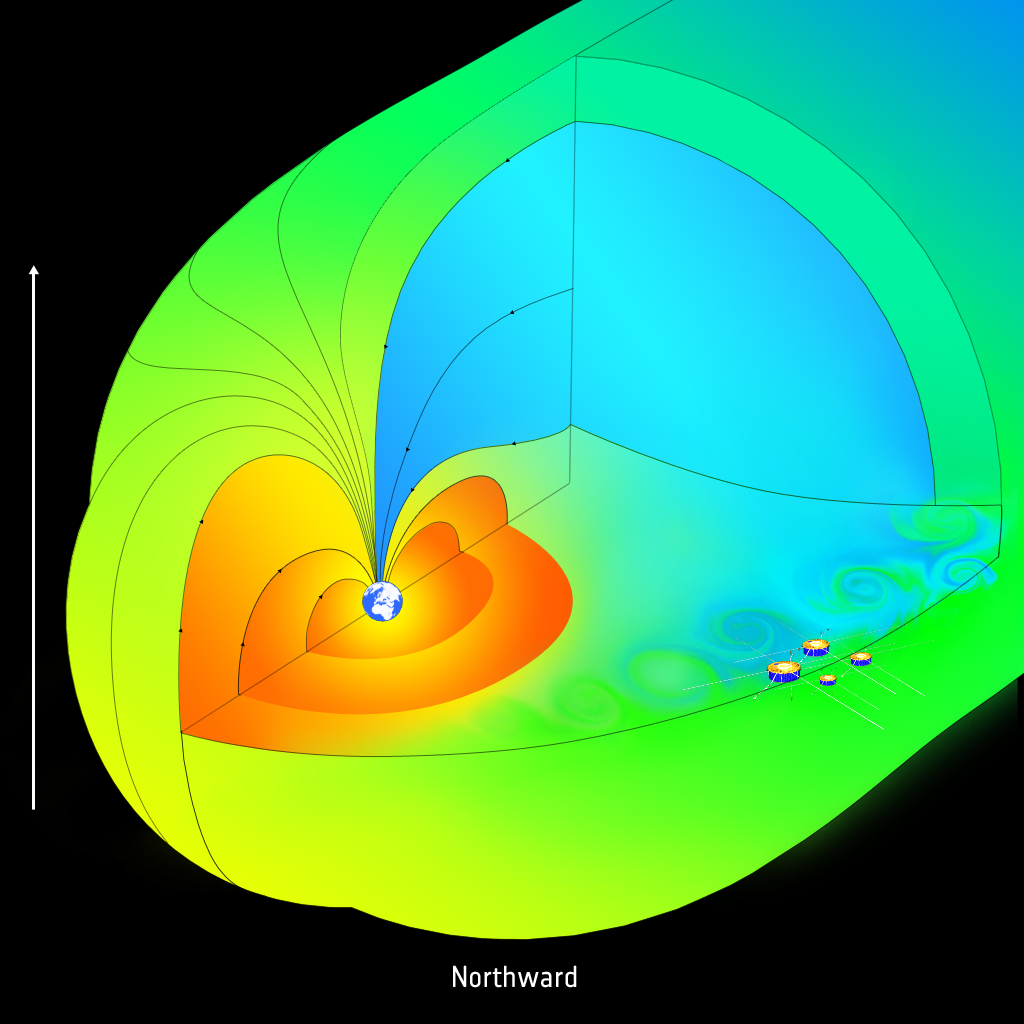
 When Earth’s magnetic field and the interplanetary magnetic field are aligned, for example in a northward orientation as indicated by the white arrow in this graphic, Kelvin–Helmholtz waves are generated at low (equatorial) latitudes. 
Credits: AOES Medialab

ESA’s quartet of satellites studying Earth’s magnetosphere, Cluster, has discovered that our protective magnetic bubble lets the solar wind in under a wider range of conditions than previously believed.

Earth’s magnetic field is our planet’s first line of defence against the bombardment of the solar wind. This stream of plasma is launched by the Sun and travels across the Solar System, carrying its own magnetic field with it.
Depending on how the solar wind’s interplanetary magnetic field – IMF – is aligned with Earth’s magnetic field, different phenomena can arise in Earth’s immediate environment.
One well-known process is magnetic reconnection, where magnetic field lines pointing in opposite directions spontaneously break and reconnect with other nearby field lines. This redirects their plasma load into the magnetosphere, opening the door to the solar wind and allowing it to reach Earth.
Under certain circumstances this can drive ‘space weather’, generating spectacular aurorae, interrupting GPS signals and affecting terrestrial power systems.  
Solar wind entry at high latitudes
Download:
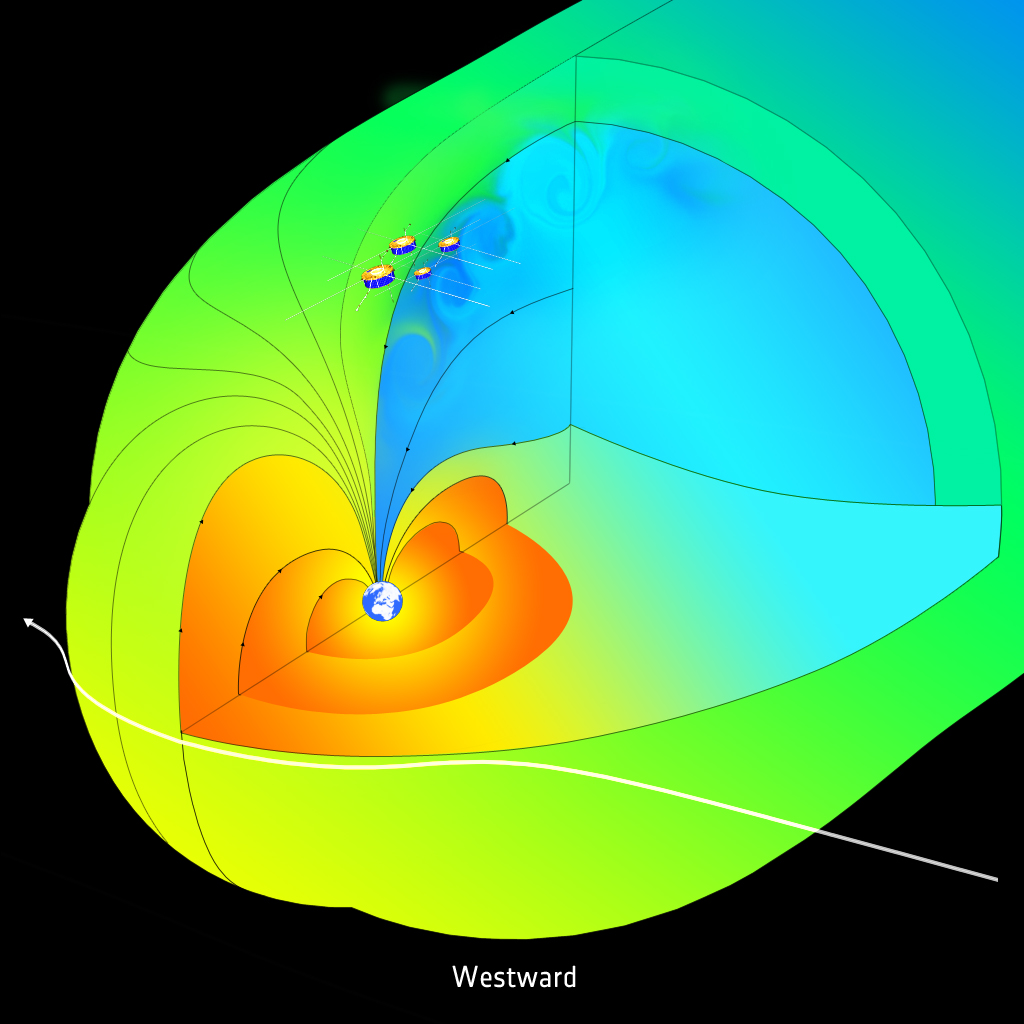
When the interplanetary magnetic field, indicated by the white arrow, is oriented westward (dawnward) or in the opposite, eastward (duskward) direction, magnetopause boundary layers at higher latitude become most subject to Kelvin–Helmholtz instabilities. 
Credits: AOES Medialab

In 2006, Cluster made the surprising discovery that huge, 40 000 km swirls of plasma along the boundary of the magnetosphere – the magnetopause – could allow the solar wind to enter, even when Earth’s magnetic field and the IMF are aligned.
These swirls were found at low, equatorial latitudes, where the magnetic fields were most closely aligned.
These giant vortices are driven by a process known as the Kelvin–Helmholtz (KH) effect, which can occur anywhere in nature when two adjacent flows slip past each other at different speeds.
Examples include waves whipped up by wind sliding across the surface of the ocean, or in atmospheric clouds.
Analysis of Cluster data has now found that KH waves can also occur at a wider range of magnetopause locations and when the IMF is arranged in a number of other configurations, providing a mechanism for the continuous transport of the solar wind into Earth’s magnetosphere.
“We found that when the interplanetary magnetic field is westward or eastward, magnetopause boundary layers at higher latitude become most subject to KH instabilities, regions quite distant from previous observations of these waves,” says Kyoung-Joo Hwang of NASA’s Goddard Space Flight Center and lead author of the paper published in the Journal of Geophysical Research.
“In fact, it’s very hard to imagine a situation where solar wind plasma could not leak into the magnetosphere, since it is not a perfect magnetic bubble.”
The findings confirm theoretical predictions and are reproduced by simulations presented by the authors of the new study.
“The solar wind can enter the magnetosphere at different locations and under different magnetic field conditions that we hadn’t known about before,” says co-author Melvyn Goldstein, also from Goddard Space Flight Center.
“That suggests there is a ‘sieve-like’ property of the magnetopause in allowing the solar wind to continuously flow into the magnetosphere.”
The KH effect is also seen in the magnetospheres of Mercury and Saturn, and the new results suggest that it may provide a possible continuous entry mechanism of solar wind into those planetary magnetospheres, too.
“Cluster’s observations of these boundary waves have provided a great advance on our understanding of solar wind – magnetosphere interactions, which are at the heart of space weather research,” says Matt Taylor, ESA’s Cluster project scientist.
“In this case, the relatively small separation of the four Cluster satellites as they passed through the high-latitude dayside magnetopause provided a microscopic look at the processes ripping open the magnetopause and allowing particles from the Sun direct entry into the atmosphere.”
 

Notes for Editors
ESA
Guillermo Gonzalo Sánchez Achutegui
ayabaca@gmail.com
ayabaca@hotmail.com

Mi lista de blogs