Mostrando entradas con la etiqueta NASA's Voyager 1 spacecraft. Mostrar todas las entradas

sábado, 24 de septiembre de 2016

NASA en Español : ¿Cuán lejos está la estrella más cercana al Sol?

http://eduardogarciallama.lanasa.net/?p=1044
La semana pasada se anunció que la estrella más cercana a nuestro sistema solar, Próxima Centauri, posee un planeta de masa algo mayor que la de la Tierra que gira a su alrededor a una distancia que le permitiría tener agua líquida. El hecho de que exista un planeta de estas características en la estrella más cercana a nosotros fuera del Sistema Solar a buen seguro supondrá un gran aliciente para intentar enviar algún tipo de sonda que lo investigue de cerca; sin embargo, no es previsible que esto pueda suceder en el futuro inmediato ni a medio plazo ya que Próxima b -nombre que se ha dado al exoplaneta- está tremendamente lejos de nosotros, tanto que es difícil de concebir.

La semana pasada se anunció que la estrella más cercana a nuestro sistema solar, Próxima Centauri, posee un planeta de masa algo mayor que la de la Tierra que gira a su alrededor a una distancia que le permitiría tener agua líquida, un requisito que es estimado necesario (aunque no suficiente) para poder albergar vida tal y como la conocemos. El hecho de que exista un planeta de estas características en la estrella más cercana a nosotros fuera del Sistema Solar a buen seguro supondrá un gran aliciente para intentar enviar algún tipo de sonda que lo investigue de cerca; sin embargo, no es previsible que esto pueda suceder en el futuro inmediato ni a medio plazo ya que Próxima b -nombre que se ha dado al exoplaneta- está tremendamente lejos de nosotros, tanto que es difícil de concebir.
Sabemos que todas las medidas del Universo son abrumadoramente vastas. Cuando hablamos del número de estrellas o de galaxias que contiene y de la lejanía entre ellas, todos somos conscientes de que los números a manejar son extraordinariamente grandes. Sin embargo, a pesar de esto, cuando el tema de las dimensiones del Universo sale a colación en alguna conversación informal, constato que prácticamente todas las personas presentes (generalmente no familiarizadas con temas de esta índole) piensan que esas dimensiones son menores de lo que realmente son.
Para comprobarlo, siempre hago el siguiente planteamiento: imaginemos que reducimos el sistema Sol-Tierra de forma que la distancia entre los dos cuerpos sea de un metro. En esta escala, los 150 millones de kilómetros que de media separan a la Tierra del Sol se han comprimido en un metro; el Sol sería ahora como un garbanzo que apenas alcanzaría un centímetro de diámetro mientras que el diámetro de la Tierra sería como el de un pelo humano y una aún más minúscula Luna giraría en torno a la Tierra a tan solo 2,5 milímetros de distancia. Ahora, si colocamos ese diminuto Sol, ese garbanzo, en el punto central de un campo de fútbol con la casi imperceptible Tierra a un metro de él, ¿dónde cree usted que estaría la estrella más cercana al Sol? Piénselo por un momento y trate de responder antes de seguir leyendo.
El Sol es una estrella más de las entre cien y cuatrocientas mil millones de estrellas que se estima que contiene nuestra galaxia, la Vía Láctea. El tamaño de la Vía Láctea es casi imposible de imaginar, tiene un diámetro de alrededor de un trillón de kilómetros, un 1 seguido de 18 ceros. Para poder manejar números más pequeños a la hora de tratar con distancias cósmicas, los astrónomos hablan en términos de parsecs y kiloparsecs, pero nosotros lo haremos en términos de lo que recorre la luz en un tiempo determinado. En este tipo de unidad de medida, el diámetro de la Vía Láctea es de 100.000 años-luz. Esto quiere decir que la luz, viajando a 300.000 kilómetros por segundo, tardaría 100.000 años en recorrer la galaxia de un extremo a otro.
distance
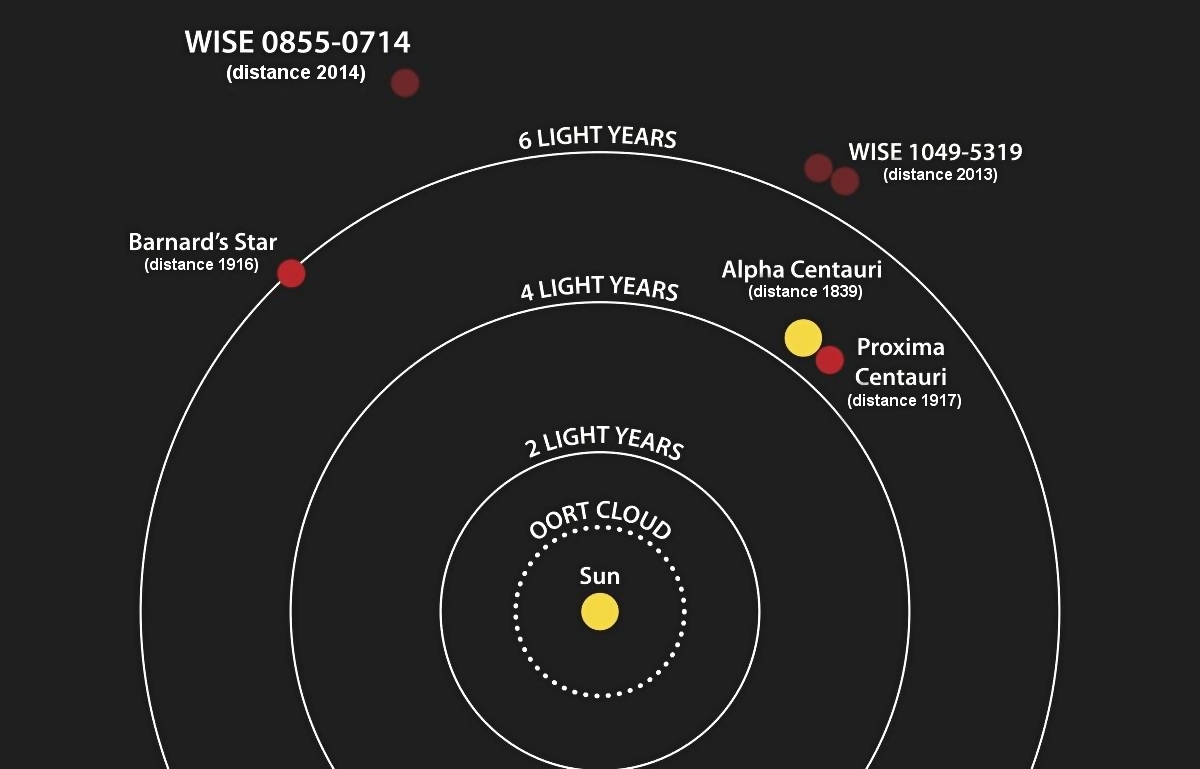
Estrellas más cercanas al Sol con distancias expresadas en años-luz. Fuente: NASA/Penn State University.

Dentro de los cientos de miles de millones de estrellas que contiene nuestra galaxia, es de esperar que exista una estrella que sea la más cercana a la que nosotros orbitamos. Resulta que es un grupo de tres estrellas, muy cercanas entre sí, el más próximo a nuestro sol. Este grupo recibe el nombre de Alpha Centauri y se aprecia como un único punto desde la Tierra. Las dos estrellas más visibles de este grupo, Alpha Centauri A y Alpha Centauri B, forman un sistema binario que se encuentra a algo más de 4,3 años-luz de nosotros mientras que una tercera estrella, llamada Próxima Centauri, se encuentra un tanto más cerca de nosotros, a 4,2 años-luz, constituyéndose así como la más próxima a nuestro sistema solar.
Una distancia de 4,2 años-luz es equivalente a casi 40 billones de kilómetros, un 4 seguido de 13 ceros. Comparemos esto con cifras asociadas a la actividad humana en el espacio hasta la fecha. La máxima distancia de la Tierra a la que los humanos han volado se alcanzó en abril de 1970 cuando la tripulación del Apolo 13 pasó por detrás de la Luna a una altitud de 254 km sobre su superficie, lo que la situó a 400.171 km de la Tierra. Esto es apenas 1,33 segundos-luz de distancia, la máxima a la que ha estado el ser humano hasta el día de hoy.
Cuando hablamos el año pasado acerca de por qué es difícil ir a Marte, tal vez el ambicioso próximo objetivo a conquistar en nuestro sistema solar, vimos que las dificultades para posar allí seres humanos derivaban principalmente de la distancia a ese planeta. Y, sin embargo, cuando trasladamos a unidades de tiempo-luz los 55 millones de km de distancia más cercana o los 400 millones de km de distancia más lejana a la que la Tierra puede estar del planeta en su recorrido orbital alrededor del Sol, estas distancias resultan ser equivalentes a 3 minutos-luz y a 22 minutos-luz respectivamente, comparables a los 8,3 minutos-luz que nos separan de nuestra propia estrella. Ciertamente, estas distancias palidecen ante la de Próxima b a pesar de ser el exoplaneta más cercano a nosotros.
 
voyager1
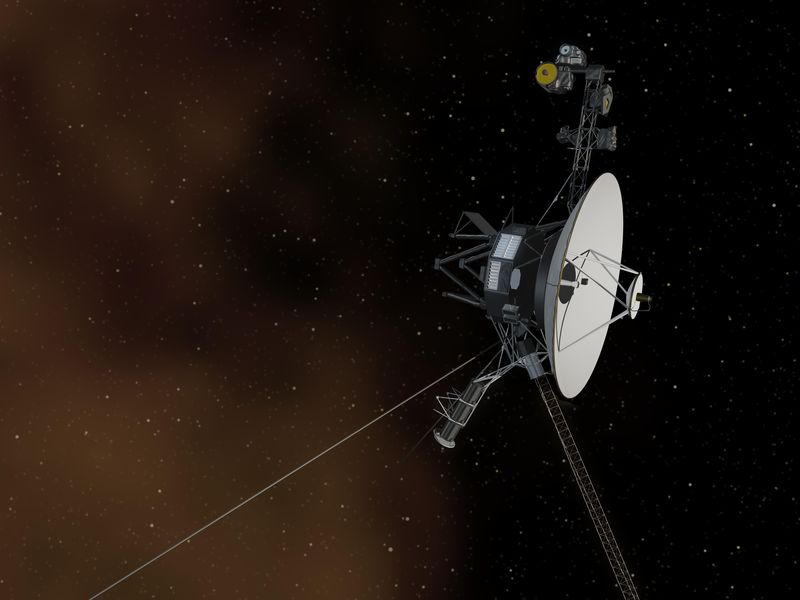
Sonda Voyager 1. Fuente: NASA/JPL-Caltech.

A día de hoy, la sonda Voyager 1, lanzada al espacio en 1977, es el artefacto humano que más se ha alejado de nuestro sistema solar. La Voyager 1 entró en el espacio interestelar en agosto del 2012 y en la actualidad se encuentra mucho más lejos que Plutón, a algo más de 20 mil millones de kilómetros del Sol, una distancia absolutamente increíble, pero que es de tan solo casi 19 horas-luz, una distancia que sigue siendo imperceptible frente a los 4,2 años-luz que nos separan de nuestra estrella más cercana fuera del Sistema Solar y de su planeta.
Voyager 1 es también el artefacto humano más veloz alejándose del Sol en la actualidad. Cada año recorre 3,6 veces la distancia de la Tierra al Sol, casi 540 millones de km cada año, equivalente a viajar a 17 kilómetros por segundo, unos 61.500 kilómetros por hora. A esta velocidad tan increíble, Voyager 1, sin embargo, aún tardaría 74.000 años en alcanzar Próxima Centauri. Como curiosidad, los seres humanos que han viajado a la mayor velocidad con respecto a la Tierra fueron los de la tripulación del Apolo 10, que casi llegaron a alcanzar los 39.900 kilómetros por hora, o unos 11 km por segundo, cuando se dirigían de vuelta a la Tierra desde la Luna; una velocidad extraordinaria, pero que les habría hecho tardar 114.000 años en llegar a Próxima Centauri.
Como vemos, las cifras ponen en contexto lo lejos que está de nosotros Próxima Centauri a pesar de ostentar el título de ser la estrella más cercana. Volviendo a la pregunta que formulé al principio del escrito, si usted es una persona interesada en asuntos relacionados con el espacio, posiblemente ya era conocedor de la respuesta o tenía una idea aproximadamente correcta acerca de cuál podría ser la solución; pero cuando hago esta pregunta, la mayor parte de la gente contesta que la estrella más cercana estaría en algún lugar del terreno de juego. Algunos me dicen que estaría algo más allá del círculo central, otros que en una de las porterías o acaso en uno de los corners. Menos personas me dicen que la estrella más cercana estaría en las gradas, tal vez en el gallinero, y aún muchos menos me dicen que estaría fuera del campo, tal vez en una calle aledaña. Nunca nadie se aproximó mínimamente a la realidad, nadie me contestó nunca que la estrella más cercana al Sol no estaría ni en el campo ni en las gradas ni en una calle aledaña fuera del estadio, que ni siquiera estaría en el mismo barrio ni en el mismo pueblo, ni siquiera en la misma ciudad, ni siquiera en la misma provincia. La estrella más cercana estaría a casi 270 kilómetros de ese garbanzo en el punto central de ese campo de fútbol, la distancia en línea recta que separa Madrid de Zaragoza… de cientos de miles de millones de estrellas en la galaxia… nuestra estrella más cercana.

Si te gusta Compártelo:
NASA en Español
Guillermo Gonzalo Sánchez Achutegui
ayabaca@gmail.com
ayabaca@hotmail.com
ayabaca@yahoo.com
Inscríbete en el Foro del blog y participa : A Vuelo De Un Quinde - El Foro!

martes, 4 de marzo de 2014

NASA : Source Region for Possible Europa Plumes


Source Region for Possible Europa Plumes
This reprojection of the official USGS basemap of Jupiter's moon Europa is centered at the estimated source region for potential water vapor plumes that might have been detected using the Hubble Space Telescope. The view is centered at -65 degrees latitude, 183 degrees longitude.
In addition to the plume source region, the image also shows the hemisphere of Europa that might be affected by plume deposits. This map is composed of images from NASA's Galileo and Voyager missions. The black region near the south pole results from gaps in imaging coverage.
Image Credit: NASA/JPL-Caltech/SETI Institute
NASA
Guillermo Gonzalo Sánhez Achutegui
ayabaca@gmail.com
ayabaca@hotmail.com
ayabaca@yahoo.com
Inscríbete en el Foro del blog y participa : A Vuelo De Un Quinde - El Foro!

sábado, 19 de octubre de 2013

NASA : NASA's Cassini Spacecraft Finds Ingredient of Household Plastic in Space

NASA's Cassini spacecraft has detected propylene, a chemical used to make food-storage containers, car bumpers and other consumer products, on Saturn's moon Titan.
This is the first definitive detection of the plastic ingredient on any moon or planet, other than Earth.
Youtube Override:
Image Credit:
NASA's Goddard Space Flight Center
Image Token:
Feature Link:
A small amount of propylene was identified in Titan's lower atmosphere by Cassini's Composite Infrared Spectrometer (CIRS). This instrument measures the infrared light, or heat radiation, emitted from Saturn and its moons in much the same way our hands feel the warmth of a fire.
Propylene is the first molecule to be discovered on Titan using CIRS. By isolating the same signal at various altitudes within the lower atmosphere, researchers identified the chemical with a high degree of confidence. Details are presented in a paper in the Sept. 30 edition of the Astrophysical Journal Letters.
"This chemical is all around us in everyday life, strung together in long chains to form a plastic called polypropylene," said Conor Nixon, a planetary scientist at NASA's Goddard Space Flight Center in Greenbelt, Md., and lead author of the paper. "That plastic container at the grocery store with the recycling code 5 on the bottom -- that's polypropylene."
CIRS can identify a particular gas glowing in the lower layers of the atmosphere from its unique thermal fingerprint. The challenge is to isolate this one signature from the signals of all other gases around it.
The detection of the chemical fills in a mysterious gap in Titan observations that dates back to NASA's Voyager 1 spacecraft and the first-ever close flyby of this moon in 1980.
Voyager identified many of the gases in Titan's hazy brownish atmosphere as hydrocarbons, the chemicals that primarily make up petroleum and other fossil fuels on Earth.
On Titan, hydrocarbons form after sunlight breaks apart methane, the second-most plentiful gas in that atmosphere. The newly freed fragments can link up to form chains with two, three or more carbons. The family of chemicals with two carbons includes the flammable gas ethane. Propane, a common fuel for portable stoves, belongs to the three-carbon family.
Voyager detected all members of the one- and two-carbon families in Titan's atmosphere. From the three-carbon family, the spacecraft found propane, the heaviest member, and propyne, one of the lightest members. But the middle chemicals, one of which is propylene, were missing.
As researchers continued to discover more and more chemicals in Titan's atmosphere using ground- and space-based instruments, propylene was one that remained elusive. It was finally found as a result of more detailed analysis of the CIRS data.
"This measurement was very difficult to make because propylene's weak signature is crowded by related chemicals with much stronger signals," said Michael Flasar, Goddard scientist and principal investigator for CIRS. "This success boosts our confidence that we will find still more chemicals long hidden in Titan's atmosphere."
Cassini's mass spectrometer, a device that looks at the composition of Titan's atmosphere, had hinted earlier that propylene might be present in the upper atmosphere. However, a positive identification had not been made.
"I am always excited when scientists discover a molecule that has never been observed before in an atmosphere," said Scott Edgington, Cassini's deputy project scientist at NASA's Jet Propulsion Laboratory (JPL) in Pasadena, Calif. "This new piece of the puzzle will provide an additional test of how well we understand the chemical zoo that makes up Titan's atmosphere."
The Cassini-Huygens mission is a cooperative project of NASA, the European Space Agency and the Italian Space Agency. JPL manages the mission for NASA's Science Mission Directorate in Washington. The CIRS team is based at Goddard.
For more information about the Cassini mission, visit:
NASA
Guillermo Gonzalo Sánchez Achutegui

domingo, 15 de septiembre de 2013

NASA - NASA Spacecraft Embarks on Historic Journey into Interstellar Space


Artist's concept depicts NASA's Voyager 1 spacecraft entering interstellar space
The Space Between: This artist's concept shows the Voyager 1 spacecraft entering the space between stars. Interstellar space is dominated by plasma, ionized gas (illustrated here as brownish haze), that was thrown off by giant stars millions of years ago.
Image Token:
Feature Link:
 
Artist's concept of Voyager 1 and 2
Beyond the Bubble: The general locations of Voyager 1 and 2 are shown in this illustration at the edge of the heliosphere, the bubble created by solar wind.
Image Credit: NASA/JPL-Caltech
Image Token:
Feature Link:
Youtube Override:
After decades of exploration, Voyager 1 reaches a historic milestone for mankind--interstellar space. Learn how the team discovered the craft had reached the space between the stars.
Image Token:
Youtube Override:
Neil deGrasse Tyson, Wil Wheaton, Carl Sagan's son and others share messages to the Voyager 1 spacecraft.
Image Token:
Pale Blue, Take Two: In 1990, Voyager 1 took the famous "Pale Blue Dot" picture looking back at Earth. In 2013, the Very Long Baseline Array got the reverse-angle shot — this radio telescope image showing the signal of the spacecraft as a similar point of light.
Image Credit: NRAO/AUI/NSF.
Image Token:
Feature Link:

PASADENA, Calif. -- NASA's Voyager 1 spacecraft officially is the first human-made object to venture into interstellar space. The 36-year-old probe is about 12 billion miles (19 billion kilometers) from our sun.
New and unexpected data indicate Voyager 1 has been traveling for about one year through plasma, or ionized gas, present in the space between stars. Voyager is in a transitional region immediately outside the solar bubble, where some effects from our sun are still evident. A report on the analysis of this new data, an effort led by Don Gurnett and the plasma wave science team at the University of Iowa, Iowa City, is published in Thursday's edition of the journal Science.
"Now that we have new, key data, we believe this is mankind's historic leap into interstellar space," said Ed Stone, Voyager project scientist based at the California Institute of Technology, Pasadena. "The Voyager team needed time to analyze those observations and make sense of them. But we can now answer the question we've all been asking -- 'Are we there yet?' Yes, we are."
Voyager 1 first detected the increased pressure of interstellar space on the heliosphere, the bubble of charged particles surrounding the sun that reaches far beyond the outer planets, in 2004. Scientists then ramped up their search for evidence of the spacecraft's interstellar arrival, knowing the data analysis and interpretation could take months or years.
Voyager 1 does not have a working plasma sensor, so scientists needed a different way to measure the spacecraft's plasma environment to make a definitive determination of its location. A coronal mass ejection, or a massive burst of solar wind and magnetic fields, that erupted from the sun in March 2012 provided scientists the data they needed. When this unexpected gift from the sun eventually arrived at Voyager 1's location 13 months later, in April 2013, the plasma around the spacecraft began to vibrate like a violin string. On April 9, Voyager 1's plasma wave instrument detected the movement. The pitch of the oscillations helped scientists determine the density of the plasma. The particular oscillations meant the spacecraft was bathed in plasma more than 40 times denser than what they had encountered in the outer layer of the heliosphere. Density of this sort is to be expected in interstellar space.
The plasma wave science team reviewed its data and found an earlier, fainter set of oscillations in October and November 2012. Through extrapolation of measured plasma densities from both events, the team determined Voyager 1 first entered interstellar space in August 2012.
"We literally jumped out of our seats when we saw these oscillations in our data -- they showed us the spacecraft was in an entirely new region, comparable to what was expected in interstellar space, and totally different than in the solar bubble," Gurnett said. "Clearly we had passed through the heliopause, which is the long-hypothesized boundary between the solar plasma and the interstellar plasma."
The new plasma data suggested a timeframe consistent with abrupt, durable changes in the density of energetic particles that were first detected on Aug. 25, 2012. The Voyager team generally accepts this date as the date of interstellar arrival. The charged particle and plasma changes were what would have been expected during a crossing of the heliopause.
"The team’s hard work to build durable spacecraft and carefully manage the Voyager spacecraft's limited resources paid off in another first for NASA and humanity," said Suzanne Dodd, Voyager project manager, based at NASA's Jet Propulsion Laboratory, Pasadena, Calif. "We expect the fields and particles science instruments on Voyager will continue to send back data through at least 2020. We can't wait to see what the Voyager instruments show us next about deep space."
Voyager 1 and its twin, Voyager 2, were launched 16 days apart in 1977. Both spacecraft flew by Jupiter and Saturn. Voyager 2 also flew by Uranus and Neptune. Voyager 2, launched before Voyager 1, is the longest continuously operated spacecraft. It is about 9.5 billion miles (15 billion kilometers) away from our sun.
Voyager mission controllers still talk to or receive data from Voyager 1 and Voyager 2 every day, though the emitted signals are currently very dim, at about 23 watts -- the power of a refrigerator light bulb. By the time the signals get to Earth, they are a fraction of a billion-billionth of a watt. Data from Voyager 1's instruments are transmitted to Earth typically at 160 bits per second, and captured by 34- and 70-meter NASA Deep Space Network stations. Traveling at the speed of light, a signal from Voyager 1 takes about 17 hours to travel to Earth. After the data are transmitted to JPL and processed by the science teams, Voyager data are made publicly available.
“Voyager has boldly gone where no probe has gone before, marking one of the most significant technological achievements in the annals of the history of science, and adding a new chapter in human scientific dreams and endeavors,” said John Grunsfeld, NASA’s associate administrator for science in Washington. “Perhaps some future deep space explorers will catch up with Voyager, our first interstellar envoy, and reflect on how this intrepid spacecraft helped enable their journey.”
Scientists do not know when Voyager 1 will reach the undisturbed part of interstellar space where there is no influence from our sun. They also are not certain when Voyager 2 is expected to cross into interstellar space, but they believe it is not very far behind.
JPL built and operates the twin Voyager spacecraft. The Voyagers Interstellar Mission is a part of NASA's Heliophysics System Observatory, sponsored by the Heliophysics Division of NASA's Science Mission Directorate in Washington. NASA's Deep Space Network, managed by JPL, is an international network of antennas that supports interplanetary spacecraft missions and radio and radar astronomy observations for the exploration of the solar system and the universe. The network also supports selected Earth-orbiting missions.
The cost of the Voyager 1 and Voyager 2 missions -- including launch, mission operations and the spacecraft’s nuclear batteries, which were provided by the Department of Energy -- is about $988 million through September.
For a sound file of the oscillations detected by Voyager in interstellar space, animations and other information, visit:
For an image of the radio signal from Voyager 1 on Feb. 21 by the National Radio Astronomy Observatory's Very Long Baseline Array, which links telescopes from Hawaii to St. Croix, visit:
NASA
Guillermo Gonzalo Sánchez Achutegui

domingo, 30 de junio de 2013

NASA - NASA Launches Satellite to Study How Sun's Atmosphere is Energized


Back to Gallery 
 Download Links


NASA's Voyager 1 Explores Final Frontier of Our 'Solar Bubble'
June 27, 2013
Artist concept of NASA's Voyager spacecraft. Image credit: NASA/JPL-Caltech
Artist concept of NASA's Voyager spacecraft.
Image Credit: 
NASA/JPL-Caltech
PASADENA, Calif. -- Data from Voyager 1, now more than 11 billion miles (18 billion kilometers) from the sun, suggest the spacecraft is closer to becoming the first human-made object to reach interstellar space. Research using Voyager 1 data and published in the journal Science today provides new detail on the last region the spacecraft will cross before it leaves the heliosphere, or the bubble around our sun, and enters interstellar space. Three papers describe how Voyager 1's entry into a region called the magnetic highway resulted in simultaneous observations of the highest rate so far of charged particles from outside heliosphere and the disappearance of charged particles from inside the heliosphere.
Scientists have seen two of the three signs of interstellar arrival they expected to see: charged particles disappearing as they zoom out along the solar magnetic field, and cosmic rays from far outside zooming in. Scientists have not yet seen the third sign, an abrupt change in the direction of the magnetic field, which would indicate the presence of the interstellar magnetic field.
"This strange, last region before interstellar space is coming into focus, thanks to Voyager 1, humankind's most distant scout," said Ed Stone, Voyager project scientist at the California Institute of Technology in Pasadena. "If you looked at the cosmic ray and energetic particle data in isolation, you might think Voyager had reached interstellar space, but the team feels Voyager 1 has not yet gotten there because we are still within the domain of the sun's magnetic field."
Scientists do not know exactly how far Voyager 1 has to go to reach interstellar space. They estimate it could take several more months, or even years, to get there. The heliosphere extends at least 8 billion miles (13 billion kilometers) beyond all the planets in our solar system. It is dominated by the sun's magnetic field and an ionized wind expanding outward from the sun. Outside the heliosphere, interstellar space is filled with matter from other stars and the magnetic field present in the nearby region of the Milky Way.
Voyager 1 and its twin spacecraft, Voyager 2, were launched in 1977. They toured Jupiter, Saturn, Uranus and Neptune before embarking on their interstellar mission in 1990. They now aim to leave the heliosphere. Measuring the size of the heliosphere is part of the Voyagers' mission.
The Science papers focus on observations made from May to September 2012 by Voyager 1's cosmic ray, low-energy charged particle and magnetometer instruments, with some additional charged particle data obtained through April of this year.
Voyager 2 is about 9 billion miles (15 billion kilometers) from the sun and still inside the heliosphere. Voyager 1 was about 11 billion miles (18 billion kilometers) from the sun Aug. 25 when it reached the magnetic highway, also known as the depletion region, and a connection to interstellar space. This region allows charged particles to travel into and out of the heliosphere along a smooth magnetic field line, instead of bouncing around in all directions as if trapped on local roads. For the first time in this region, scientists could detect low-energy cosmic rays that originate from dying stars.
"We saw a dramatic and rapid disappearance of the solar-originating particles. They decreased in intensity by more than 1,000 times, as if there was a huge vacuum pump at the entrance ramp onto the magnetic highway," said Stamatios Krimigis, the low-energy charged particle instrument's principal investigator at the Johns Hopkins University Applied Physics Laboratory in Laurel, Md. "We have never witnessed such a decrease before, except when Voyager 1 exited the giant magnetosphere of Jupiter, some 34 years ago."
Other charged particle behavior observed by Voyager 1 also indicates the spacecraft still is in a region of transition to the interstellar medium. While crossing into the new region, the charged particles originating from the heliosphere that decreased most quickly were those shooting straightest along solar magnetic field lines. Particles moving perpendicular to the magnetic field did not decrease as quickly. However, cosmic rays moving along the field lines in the magnetic highway region were somewhat more populous than those moving perpendicular to the field. In interstellar space, the direction of the moving charged particles is not expected to matter.
In the span of about 24 hours, the magnetic field originating from the sun also began piling up, like cars backed up on a freeway exit ramp. But scientists were able to quantify that the magnetic field barely changed direction -- by no more than 2 degrees. "
A day made such a difference in this region with the magnetic field suddenly doubling and becoming extraordinarily smooth," said Leonard Burlaga, the lead author of one of the papers, and based at NASA's Goddard Space Flight Center in Greenbelt, Md. "But since there was no significant change in the magnetic field direction, we're still observing the field lines originating at the sun."
NASA's Jet Propulsion Laboratory, in Pasadena, Calif., built and operates the Voyager spacecraft. California Institute of Technology in Pasadena manages JPL for NASA. The Voyager missions are a part of NASA's Heliophysics System Observatory, sponsored by the Heliophysics Division of the Science Mission Directorate at NASA Headquarters in Washington.
For more information about the Voyager spacecraft mission, visit:
http://www.nasa.gov/voyager
and
 http://voyager.jpl.nasa.gov .
Jia-Rui C. Cook
818-354-0850
Jet Propulsion Laboratory, Pasadena, Calif.
jccook@jpl.nasa.gov
Steve Cole
202-358-0918
NASA Headquarters, Washington
stephen.e.cole@nasa.gov
NASA
Guillermo Gonzalo Sánchez Achutegui
ayabaca@gmail.com
ayabaca@hotmail.com
ayabaca@yahoo.com
Inscríbete en el Foro del blog y participa : A Vuelo De Un Quinde - El Foro!

martes, 4 de diciembre de 2012

NASA - NASA Voyager 1 Probe Encounters New Region in Deep Space

PASADENA, Calif. -- NASA's Voyager 1 spacecraft has entered a new region at the far reaches of our solar system that scientists feel is the final area the spacecraft has to cross before reaching interstellar space.
Scientists refer to this new region as a magnetic highway for charged particles because our sun's magnetic field lines are connected to interstellar magnetic field lines. This connection allows lower-energy charged particles that originate from inside our heliosphere -- or the bubble of charged particles the sun blows around itself -- to zoom out and allows higher-energy particles from outside to stream in. Before entering this region, the charged particles bounced around in all directions, as if trapped on local roads inside the heliosphere.
The Voyager team infers this region is still inside our solar bubble because the direction of the magnetic field lines has not changed. The direction of these magnetic field lines is predicted to change when Voyager breaks through to interstellar space. The new results were described at the American Geophysical Union meeting in San Francisco on Monday.
"Although Voyager 1 still is inside the sun's environment, we now can taste what it's like on the outside because the particles are zipping in and out on this magnetic highway," said Edward Stone, Voyager project scientist based at the California Institute of Technology, Pasadena. "We believe this is the last leg of our journey to interstellar space. Our best guess is it's likely just a few months to a couple years away. The new region isn't what we expected, but we've come to expect the unexpected from Voyager."
Since December 2004, when Voyager 1 crossed a point in space called the termination shock, the spacecraft has been exploring the heliosphere's outer layer, called the heliosheath. In this region, the stream of charged particles from the sun, known as the solar wind, abruptly slowed down from supersonic speeds and became turbulent. Voyager 1's environment was consistent for about five and a half years. The spacecraft then detected that the outward speed of the solar wind slowed to zero.
The intensity of the magnetic field also began to increase at that time.
Voyager data from two onboard instruments that measure charged particles showed the spacecraft first entered this magnetic highway region on July 28, 2012. The region ebbed away and flowed toward Voyager 1 several times. The spacecraft entered the region again Aug. 25 and the environment has been stable since.
"If we were judging by the charged particle data alone, I would have thought we were outside the heliosphere," said Stamatios Krimigis, principal investigator of the low-energy charged particle instrument, based at the Johns Hopkins Applied Physics Laboratory, Laurel, Md. "But we need to look at what all the instruments are telling us and only time will tell whether our interpretations about this frontier are correct."
Spacecraft data revealed the magnetic field became stronger each time Voyager entered the highway region; however, the direction of the magnetic field lines did not change.
"We are in a magnetic region unlike any we've been in before -- about 10 times more intense than before the termination shock -- but the magnetic field data show no indication we're in interstellar space," said Leonard Burlaga, a Voyager magnetometer team member based at NASA's Goddard Space Flight Center in Greenbelt, Md. "The magnetic field data turned out to be the key to pinpointing when we crossed the termination shock. And we expect these data will tell us when we first reach interstellar space."
Voyager 1 and 2 were launched 16 days apart in 1977. At least one of the spacecraft has visited Jupiter, Saturn, Uranus and Neptune. Voyager 1 is the most distant human-made object, about 11 billion miles (18 billion kilometers) away from the sun. The signal from Voyager 1 takes approximately 17 hours to travel to Earth. Voyager 2, the longest continuously operated spacecraft, is about 9 billion miles (15 billion kilometers) away from our sun. While Voyager 2 has seen changes similar to those seen by Voyager 1, the changes are much more gradual. Scientists do not think Voyager 2 has reached the magnetic highway.
The Voyager spacecraft were built and continue to be operated by NASA's Jet Propulsion Laboratory, in Pasadena, Calif. Caltech manages JPL for NASA. The Voyager missions are a part of NASA's Heliophysics System Observatory, sponsored by the Heliophysics Division of the Science Mission Directorate at NASA Headquarters in Washington.
For more information about the Voyager spacecraft, 
 
 
Jia-Rui C. Cook 818-354-0850
Jet Propulsion Laboratory, Pasadena, Calif.
jccook@jpl.nasa.gov

Dwayne Brown 202-358-1726
NASA Headquarters, Washington
dwayne.c.brown@nasa.gov
This still image and set of animations show NASA's Voyager 1 spacecraft exploring a new region in our solar system called the

 This still image and set of animations show NASA's Voyager 1 spacecraft exploring a new region in our solar system called the "magnetic highway." Image credit: NASA/JPL-Caltech › Full image and caption       › Image gallery

Download Image

› Full Size


 Artist's concept of NASA's Voyager 1 spacecraft in solar wind
 › Full image and caption
› Teleconference images

Download Image

› Full Size 

NASA
Guillermo Gonzalo Sánchez Achutegui
ayabaca@gmail.com
ayabaca@hotmail.com
ayabaca@yahoo.com

 Inscríbete en el Foro del blog y participa : A Vuelo De Un Quinde - El Foro!

Mi lista de blogs