Mostrando entradas con la etiqueta The Woods Hole Oceanographic Institution (WHOI). Mostrar todas las entradas

domingo, 23 de octubre de 2016

NSF : Researchers track effects of changing ocean temperature on phytoplankton .- Los investigadores rastrean los efectos de los cambios en la temperatura del fitoplancton en el océano.....

https://www.nsf.gov/news/news_summ.jsp?cntn_id=190021&WT.mc_id=USNSF_51&WT.mc_ev=click

New study shows changes could have major effects on global marine ecosystems
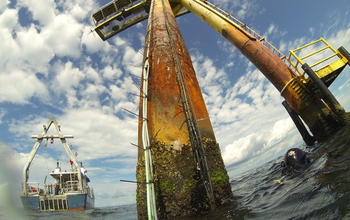
Research vessel Tioga waits for divers; they're under the Martha's Vineyard Coastal Observatory.

Research vessel Tioga waits for divers. They're under the Martha's Vineyard Coastal Observatory.
Credit and Larger Version

October 20, 2016
Changes in ocean temperature affect a key species of phytoplankton, according to scientists at the Woods Hole Oceanographic Institution (WHOI) funded by the National Science Foundation (NSF).
Their study, published in this week's issue of the journal Science, tracked levels of Synechococcus -- a tiny bacterium common in marine ecosystems -- near the coast of Massachusetts over a 13-year period.
"Synechococcus and other phytoplankton are sentinels," says WHOI biologist Heidi Sosik, who initiated the study. "They tell us how an ecosystem is responding to shifts in climate."
As ocean temperatures increased during the study period, annual blooms of Synechococcus occurred up to four weeks earlier, researchers found, because cells divide faster in warmer waters. Such shifts could have major effects on marine ecosystems worldwide, according to Sosik.
If ocean temperatures continue warming over the next century, some ecosystems could become dominated by small phytoplankton, eventually leading to changes that could affect larger species like fish, whales and birds, Sosik says.
That growth in smaller phytoplankton isn't a sure thing, however.
"Now that we have the appropriate technology to study phytoplankton on time scales of hours to weeks, we're gaining a much better understanding of what controls phytoplankton populations in coastal ocean ecosystems," says David Garrison, program director in NSF's Division of Ocean Sciences, which funded the research.
Although Sosik and colleagues saw that Synechococcus cells reproduced faster than usual as conditions warmed, the overall size of the phytoplankton bloom didn't increase much during the course of the study.
As the bacteria grew more quickly, tiny protozoa, viruses and other single-celled organisms that prey on Synechococcus consumed them more quickly.
"That was a surprise to us," says Sosik. "We didn't expect such a tight lockstep among Synechococcus and its consumers as the spring bloom changed. It shows that the consumers are able to keep up."
This balance of bacteria and consumers leads to a similar bloom cycle year after year, but with a shift in timing earlier or later as the water temperature changes, Sosik says.
"The question is: How stable is that balance?" asks Kristen Hunter-Cervera, lead author of the paper and a graduate of the MIT-WHOI Joint Program in Oceanography. "In the future, will consumer species be able to keep up? A mismatch is a huge concern. If the bloom expands, or moves earlier in the year, higher-level organisms that feed on those consumers at a certain time of year might miss them entirely."
The team was able to determine division rates of Synechococcus by using an automated sensor called "FlowCytobot," developed by Sosik and WHOI colleague Rob Olson. FlowCytobot continually sampled seawater for 13 years.
The device looks for the physical characteristics of Synechococcus cells, which are roughly one micrometer in diameter and contain compounds that glow orange and red under laser light.
Using this method to tally cells has allowed the researchers to home in on just one species of phytoplankton among thousands in seawater -- the first time such a long-term experiment has been able to do so.
"Looking at physiology at the species level is a holy grail in marine ecology," Sosik says. "Each species interacts with its environment in a different way, so to understand the effects of something like temperature, it's critical to be able to study a single species. Doing that every hour, every day, every year gave us a very high-resolution picture. There's nothing like this out there."
The Gordon and Betty Moore Foundation, NASA, a National Defense Science and Engineering graduate fellowship from the U.S. Department of Defense, and WHOI also supported the work.
-NSF-
Media Contacts Cheryl Dybas, NSF, (703) 292-7734,
cdybas@nsf.gov
Stephanie Murphy, WHOI, (508) 566-3055,
Related WebsitesNSF Grant: MRI Development: Imaging FlowCytobot on Autonomous Vehicles for Plankton Research and Harmful Algal Bloom Mitigation:


The National Science Foundation (NSF) is an independent federal agency that supports fundamental research and education across all fields of science and engineering. In fiscal year (FY) 2016, its budget is $7.5 billion. NSF funds reach all 50 states through grants to nearly 2,000 colleges, universities and other institutions. Each year, NSF receives more than 48,000 competitive proposals for funding and makes about 12,000 new funding awards. NSF also awards about $626 million in professional and service contracts yearly.
Useful NSF Web Sites:
NSF Home Page:
 https://www.nsf.gov
NSF News:
https://www.nsf.gov/news/
For the News Media:
 https://www.nsf.gov/news/newsroom.jsp
Science and Engineering Statistics:
 https://www.nsf.gov/statistics/
Awards Searches:
 https://www.nsf.gov/awardsearch/
Researcher Bennett Lambert assists with FlowCytobot at the Martha's Vineyard Coastal Observatory.
Credit and Larger Version
Divers from the Martha's Vineyard Coastal Observatory operations team return topside to the Tioga.
Credit and Larger Version
Diver's view of shipboard operations as scientist Rob Olson reaches to recover a float.
Credit and Larger Version
Researcher Kristen Hunter-Cevera uses low-tech bucket-sampling to collect seawater for analysis.
Credit and Larger Version
Scientists Rob Olson and Heidi Sosik work on the FlowCytobot automated submersible plankton sensor.
Credit and Larger Version
The National Science Foundation (NSF)
Guillermo Gonzalo Sánchez Achutegui
ayabaca@gmail.com
ayabaca@Hotmail.com
ayabaca@yahoo.com
Inscríbete en el Foro del blog y participa : A Vuelo De Un Quinde - El Foro!

domingo, 17 de mayo de 2015

nsf.gov - National Science Foundation - Revealing the ocean's hidden fertilizer .- Revelando fertilizantes que oculta los océanos

Hola amigos: A VUELO DE UN QUINDE EL BLOG., hemos recibido información de la Fundación Nacional de Ciencia de Los Estados Unidos, dándonos a conocer los fertilizantes que ocultan los océanos, teniéndose en cuenta que el fósforo es una de las sustancias más comunes de La Tierra, y por su puesto las plantas marinas  juegan un diminuto  papel importante en el ciclo del fósforo.
El fósforo,  nutriente esencial para todos los organismos vivos y los seres humanos requieren aproximadamente 700 miligramos por día,  nosotros  estamos preocupado por consumir lo suficiente, ya que es en la mayoría de los alimentos que comemos.
Los científicos que estudian el ciclo de fósforo marino han sabido que el fósforo fue absorbido por las plantas y los animales y lanzó de nuevo al agua de mar en forma de fosfato ; de como estas plantas y animales en decadencia y la muerte.
Sin embargo, un creciente cuerpo de investigación sugiere que los microbios en el océano transforman fósforo en formas que siguen siendo un misterio.

More information.....
http://www.nsf.gov/news/news_summ.jsp?cntn_id=135149&WT.mc_id=USNSF_51&WT.mc_ev=click
Tiny marine plants play major role in phosphorus cycle

An instrument system used to collect samples from different water depths in the ocean.
Credit and Larger Version
May 14, 2015
Phosphorus is one of the most common substances on Earth.
An essential nutrient for every living organism--humans require approximately 700 milligrams per day--we're rarely concerned about consuming enough because it is in most of the foods we eat.
Despite its ubiquity and living organisms' dependence on it, we know surprisingly little about how it moves, or cycles, through the ocean environment.
Scientists studying the marine phosphorous cycle have known that phosphorus was absorbed by plants and animals and released back to seawater in the form of phosphate as these plants and animals decay and die.
But a growing body of research hints that microbes in the ocean transform phosphorus in ways that remain a mystery.
 
Hidden role of ocean's microbes
A new study by a research team from the Woods Hole Oceanographic Institution (WHOI) and Columbia University reveals for the first time a marine phosphorus cycle that is much more complex than previously thought.
The work also highlights the important but previously hidden role that some microbial communities play in using and breaking down forms of this essential element.
A paper reporting the findings is published this week in the journal Science.
"A reason to be excited about this elegant study is in the paper's last sentence: 'the environmental, ecological and evolutionary controls ...remain completely unknown,'" says Don Rice, program director in the National Science Foundation's (NSF) Division of Ocean Sciences, which funded the research through its Chemical Oceanography Program. "There's still a lot we don't know about the sea."
The work is also supported by an NSF Dimensions of Biodiversity grant.
"This is an exciting new discovery that closes a fundamental knowledge gap in our understanding of the marine phosphorus cycle," says the paper's lead author Ben Van Mooy, a biochemist at WHOI.
Much like phosphorus-based fertilizers boost the growth of plants on land, phosphorus in the ocean promotes the production of microbes and tiny marine plants called phytoplankton, which compose the base of the marine food chain.
 
Phosphonate mystery
 
It's been unclear exactly how phytoplankton are using the most abundant forms of phosphorus found in the ocean--phosphates and a strange form of phosphorus called phosphonates.
"Phosphonates have always been a huge mystery," Van Mooy says.
"No one's been able to figure out exactly what they are, and more importantly, if they're made and consumed quickly by microbes, or if they're just lying around in the ocean."
To find out more about phosphonates and how microbes metabolize them, the researchers took samples of seawater at a series of stations during a research cruise from Bermuda to Barbados.
They added phosphate to the samples so they could see the microbes in action.
The research team used ion chromatography onboard ship for water chemistry analyses, which allowed the scientists to observe how quickly microbes reacted to the added phosphate in the seawater.
"The ion chromatograph [IC] separates out the different families of molecules," explains Van Mooy.
"We added radioactive phosphate, then isolated the phosphonate to see if the samples became radioactive, too. It's the radioactive technique that let us see how fast phosphate was transformed to phosphonate."
 
Enter the microbes
 
The researchers found that about 5 percent of the phosphate in the shallow water samples was taken up by the microbes and changed to phosphonates.
In deeper water samples, which were taken at depths of 40 and 150 meters (131 feet and 492 feet), about 15 to 20 percent of the phosphates became phosphonates.
"Although evidence of the cycling of phosphonates has been mounting for nearly a decade, these results show for the first time that microbes are producing phosphonates in the ocean, and that it is happening very quickly," says paper co-author Sonya Dyhrman of Columbia University.
"An exciting aspect of this study was the application of the IC method at sea. In near-real-time, we could tell that the phosphate we added was being transformed to phosphonate."
 
Better understanding of phosphorus cycle
 
A better understanding of phosphorus cycling in the oceans is important, as it affects the marine food web and, therefore, the ability of the oceans to absorb atmospheric carbon dioxide.
The researchers say that solving the mystery of phosphonates also reinforces the need to identify the full suite of phosphorus biochemicals being produced and metabolized by marine microbes, and what physiological roles they serve for these cells.
"Such work will help us further resolve the complexities of how this critical element is cycled in the ocean," Dyhrman adds.
Grants from the Simons Foundation also supported the work.
-NSF-
Media Contacts Cheryl Dybas, NSF, (703) 292-7734, cdybas@nsf.gov
Erin Koening, WHOI, (508) 289-2271, ekoenig@whoi.edu

Related WebsitesNSF Grant: Dimensions: Collaborative Research: Biological Controls on the Ocean C:N:P ratios: http://www.nsf.gov/awardsearch/showAward?AWD_ID=1045966&HistoricalAwards=false
NSF Grant: Dissolved Phosphorus Processing by Trichodesmium Consortia: Quantitative Partitioning, Role of Microbial Coordination, and Impact on Nitrogen Fixation: http://www.nsf.gov/awardsearch/showAward?AWD_ID=1332898&HistoricalAwards=false


The National Science Foundation (NSF) is an independent federal agency that supports fundamental research and education across all fields of science and engineering. In fiscal year (FY) 2015, its budget is $7.3 billion. NSF funds reach all 50 states through grants to nearly 2,000 colleges, universities and other institutions. Each year, NSF receives about 48,000 competitive proposals for funding, and makes about 11,000 new funding awards. NSF also awards about $626 million in professional and service contracts yearly.
 Get News Updates by Email 
Useful NSF Web Sites:
NSF Home Page:
 http://www.nsf.gov
NSF News:
 http://www.nsf.gov/news/
For the News Media:
http://www.nsf.gov/news/newsroom.jsp
Science and Engineering Statistics:
 http://www.nsf.gov/statistics/
Awards Searches:
 http://www.nsf.gov/awardsearch/
The vessel Atlantic Explorer, used in the study, just before a research cruise to Barbados.
Credit and Larger Version
Tiny marine plankton form colonies in a variety of shapes visible to the naked eye.
Credit and Larger Version
Lead scientist Ben Van Mooy processed data aboard ship late into the evening.
Credit and Larger Version
Researchers place sampling bottles in a container that mimicks the sea's light and temperature.
Credit and Larger Version
young woman in Cuba checks smartphone
The researchers' findings are described in the May 15, 2015, issue of the journal Science.
Credit and Larger Version
The National Science Foundation (NSF)
Guillermo Gonzalo Sánchez Achutegui
ayabaca@gmail.com
ayabaca@hotmail.com
ayabaca@yahoo.com
Inscríbete en el Foro del blog y participa : A Vuelo De Un Quinde - El Foro!

domingo, 10 de agosto de 2014

nsf.gov - National Science Foundarion - Mercury in the world's oceans: On the rise


New results show three times as much in upper oceans since Industrial Revolution times
Ahi tuna heads on display at the market
Ahi tuna, often a favorite on dinner tables, carries very high amounts of mercury.
Credit and Larger Version
August 6, 2014
Little was known about how much mercury in the environment was the result of human activities, or how much "bioavailable" mercury was in the world's oceans. Until now.
The first direct calculation of mercury pollution in the world's oceans, based on data from 12 oceanographic sampling cruises during the last eight years, is reported in this week's issue of the journal Nature.
The scientists involved are affiliated with the Woods Hole Oceanographic Institution (WHOI) in Massachusetts, Wright State University in Ohio, the Observatoire Midi-Pyréneés in France and the Royal Netherlands Institute for Sea Research in the Netherlands.
The research was funded by the National Science Foundation (NSF) and the European Research Council. It was led by WHOI marine chemist Carl Lamborg. The results offer a look at the global distribution of mercury in the marine environment.
"Mercury is an environmental poison that's detectable wherever we look for it, including the ocean abyss," says Don Rice, director of the NSF's Chemical Oceanography Program.
"These scientists have reminded us that the problem is far from abatement, especially in regions of the world's oceans where the human fingerprint is most distinct."
Mercury is a naturally occurring element as well as a by-product of such human activities as burning coal and making cement.
"If we want to regulate mercury emissions into the environment and in the food we eat, we should first know how much is there and how much human activity is adding every year," says Lamborg.
"At the moment, however, there is no way to look at a water sample and tell the difference between mercury that came from pollution and mercury that came from natural sources. Now we at least have a way to separate the bulk contributions of natural and human sources over time."
The group started by looking at data that reveal details about ocean levels of phosphate, a substance that is better studied in the oceans than mercury and that behaves in much the same way as mercury.
Phosphate is a nutrient that, like mercury, is taken up into the marine food web by binding with organic material.
By determining the ratio of phosphate-to-mercury in water deeper than 1,000 meters (3,300 feet) that has not been in contact with Earth's atmosphere since the Industrial Revolution, the researchers were able to estimate mercury in the oceans that originated from natural sources such as the breakdown, or weathering, of rocks on land.
Their findings agreed with what they would expect to see given the pattern of global ocean circulation.
North Atlantic waters, for example, showed the most obvious signs of mercury pollution because that's where surface waters sink to form deep and intermediate water flows.
The tropical and Northeast Pacific, on the other hand, were relatively unaffected; it takes centuries for deep ocean water to circulate to these regions.
Determining the contribution of mercury from human activity required another step.
To obtain estimates for shallower waters and to provide numbers for the amount of mercury in the oceans, the scientists needed a tracer--a substance that could be linked with major human activities that release mercury into the environment.
They found it in one of the most well-studied gases of the past 40 years: carbon dioxide. Databases containing information on carbon dioxide in ocean waters are extensive and readily available for every ocean at all depths.
Because much of the mercury and carbon dioxide from human sources comes from the same activities, the team was able to derive with an index relating the two.
The results show that the oceans contain about 60,000 to 80,000 tons of mercury pollution.
Ocean waters shallower than about 100 meters (300 feet) have tripled in mercury concentration since the Industrial Revolution. Mercury in the oceans as a whole has increased roughly 10 percent over pre-industrial times.
"The next 50 years could very well add the same amount we've seen in the past 150," says Lamborg.
"We don't know what that means for fish and marine mammals, but likely that some fish contain at least three times more mercury than 150 years ago. It could be more.
"The key is that now we have some solid numbers on which to base continued work."
-NSF-
Media Contacts Cheryl Dybas, NSF, (703) 292-7734, cdybas@nsf.gov
Stephanie Murphy, WHOI, (508) 289-3340, samurphy@whoi.edu

                               
The National Science Foundation (NSF)is an independent federal agency that supports fundamental research and education across all fields of science and engineering. In fiscal year (FY) 2014, its budget is $7.2 billion. NSF funds reach all 50 states through grants to nearly 2,000 colleges, universities and other institutions. Each year, NSF receives about 50,000 competitive requests for funding, and makes about 11,500 new funding awards. NSF also awards about $593 million in professional and service contracts yearly.
Useful NSF Web Sites:
NSF Home Page:
 http://www.nsf.gov
NSF News:
http://www.nsf.gov/news/
For the News Media:
 http://www.nsf.gov/news/newsroom.jsp
Science and Engineering Statistics:

One drop of mercury. How much is in the world's oceans? Scientists are finding out.
Credit and Larger Version
Scientists Carl Lamborg (left) and Gretchen Swarr of WHOI working in the lab
Scientists Carl Lamborg (left) and Gretchen Swarr of WHOI work to estimate mercury in the oceans.
Credit and Larger Version
Scientists on ship lower instruments to collected water samples from the ocean.
Instruments that collected water samples used in the mercury study are lowered into the ocean.
Credit and Larger Version
Orange roughy fish
Orange roughy are among the fish with the highest levels of mercury.
Credit and Larger Version
catfish fillets on a table ready to be cooked
Mercury in catfish is usually comparatively low.
Credit and Larger Versión

The National Science Foundation (NSF)
Guillermo Gonzalo Sánchez Achutegui
Inscríbete en el Foro del blog y participa : A Vuelo De Un Quinde - El Foro!

viernes, 24 de enero de 2014

nsf.gov - National Science Foundation - Deep-diving sub Alvin cleared to return to service

Navy certification is final step in Alvin upgrade project

Artist's rendition of the newly upgraded Alvin, showing its improved interior layout.
Credit and Larger Version
January 24, 2014
After a three-year overhaul and major upgrade, the United States' deepest-diving research submersible, Alvin, has been cleared to return to work exploring the ocean's depths.
The sub has been out of service since December 2010, undergoing a major upgrade, including the replacement of its personnel sphere with a newly fabricated, larger, more capable hull.
The Woods Hole Oceanographic Institution (WHOI) operates the U.S. Navy-owned sub for the National Deep Submergence Facility on behalf of a consortium of universities and research organizations conducting deep ocean research.
On Jan. 8, 2014, the Naval Sea Systems Command's (NAVSEA) Executive Director of Undersea Warfare for the Department of the Navy Steven Schulze certified that the sub could safely operate to depths of 3,800 meters, with the expectation that a certification dive to 4,500 meters will be completed later this year.
"There has been tremendous coordination between the Navy, Woods Hole Oceanographic Institution and the National Science Foundation (NSF) to ensure Alvin's safety and integrity," said the Navy's Director of Advanced Undersea Integration Don Hoffer. "Alvin is a national asset and the Navy is pleased to be a part of the team that returned the vehicle to service."
"Achieving Navy certification is a major milestone in the Alvin upgrade project, enabling the vehicle to get back to its critical mission of taking scientists to the deep sea," said WHOI Vice President for Marine Facilities and Operations Rob Munier.
"This significant accomplishment is a testament to the rigorous engineering collaboration between WHOI and NAVSEA and the unwavering support of NSF. Certification helps ensure that Alvin's excellent record of safety will continue for many decades to come."
Alvin carries a pilot and two science observers on missions that last approximately eight hours.
Certification was the final step in Stage I of the Alvin upgrade project, funded by NSF and WHOI.
The project included upgrades to major components for an increased depth rating of 6,500 meters, including installation of a new, larger personnel sphere with improved interior ergonomics; five viewports (instead of the previous three) to improve visibility and provide overlapping fields of view; new lighting and high-definition imaging systems; new syntactic foam for buoyancy and an improved command-and-control system.
Upgrades also included improvements to Alvin's launch system and storage hangar onboard its support vessel, the R/V Atlantis.
The Navy certified Alvin using its Deep Submergence Scope of Certification process, reviewing the design, construction and materials used to ensure the vehicle performs as expected. The Navy uses the same process to certify manned undersea systems for submarine rescue and submarine-based Special Operation Forces delivery systems.
"The successful partnership between NSF, Navy and WHOI ensures that researchers will continue to have direct access to the deep ocean for the next generation of scientists and scientific challenges," said Bob Houtman, section head in NSF's Division of Ocean Sciences.
Added Brian Midson, program director in NSF's Ocean Sciences Division, "WHOI engineers demonstrated remarkable adaptability in directing progress in constructing the 6,500-meter submersible--especially the larger titanium hull.
"The re-design of the existing vehicle was only possible thanks to the experience and expertise of the Alvin team, whose members worked closely with NAVSEA to meet the rigorous demands of naval safety standards."
Alvin will be put into service in mid-March for a "science verification" cruise led by Peter Girguis of Harvard University, who is chair of the University National Oceanographic Laboratory System's Deep Submergence Science Committee, tasked with oversight of the National Deep Submergence Facility.
Girguis, along with a team of scientists from across the United States, will test the various data acquisition and sampling systems in and around a combination of cold seep and deep-water coral sites in the Northern Gulf of Mexico, between New Orleans and Gulfport, Miss.
The scientists onboard will provide the research community with their written descriptions and assessments of the sub's performance.
Following that expedition, Alvin is scheduled to conduct three research expeditions in the Gulf of Mexico, examining the impacts of the Deepwater Horizon oil spill, determining the effects of ocean acidification on deep-water corals and studying deep water seeps.
During the second half of 2014, Alvin will be on the U.S. West Coast for dives on Juan De Fuca Ridge and later at the East Pacific Rise and Dorado Outcrop off Costa Rica.
Last November, the Alvin operations team, along with observers from the U.S. Navy, conducted certification dives off San Diego, where the sub was taken to progressively greater depths to prove that all its systems are safe for operation.
"The modifications made to Alvin during this upgrade and overhaul have exponentially improved its capabilities," said Pat Hickey, Alvin manager and one of the chief test pilots.
"The new LED lights save power while illuminating a far greater area than before, and the bigger and repositioned windows improve visibility. By repositioning the manipulators, we increased our work area, and the larger science basket allows us to load up to 400 pounds of exterior equipment and samples. An additional lateral thruster now allows the sub to hover like an underwater helicopter."
While Alvin is capable of operating at depths of 4,500 meters, time and location constraints during the certification trials prohibited dives to those depths.
Later this year, WHOI, NSF and the U.S. Office of Naval Research will schedule a dive to 4,500 meters to achieve the maximum certified depth of 4,500 meters for Stage I. The current Alvin certification depth supports all planned science activities in 2014.
Stage II of the upgrade is dependent on funding and improvements to lithium-ion battery technology. That stage will bring the remaining systems (battery, variable ballast and hydraulics) to the 6,500-meter capability, and the sub will then be certified to that depth.
This year marks Alvin's 50th year in operation. Commissioned in 1964 as one of the world's first deep-ocean submersibles, Alvin has made more than 4,600 dives.
The sub has undergone many upgrades over the years, including replacement of its steel personnel sphere in 1973 with one made of titanium, enabling access to a greater percentage of the seafloor.
The sub's most famous exploits include locating a lost hydrogen bomb in the Mediterranean Sea in 1966, exploring the first known hydrothermal vent sites in the 1970s and surveying the wreck of RMS Titanic in 1986.
In addition, the sub has enabled dozens of new discoveries in deep-sea geology, chemistry and biology.
-NSF-

Media Contacts Cheryl Dybas, NSF, (703) 292-7734, cdybas@nsf.gov
Stephanie Murphy, WHOI, (508) 289-3340, samurphy@whoi.edu
Eric Beidel, U.S. Office of Naval Research, (703) 696-1273, eric.beidel.ctr@navy.mil

Related WebsitesExplorer of the depths: the submersible Alvin: http://www.whoi.edu/alvin/
NSF Grant: A Phased Engineering Program to Build a New 6500-M Research Submersible for the U.S. Scientific Community: The New Alvin:

The National Science Foundation (NSF) is an independent federal agency that supports fundamental research and education across all fields of science and engineering. In fiscal year (FY) 2012, its budget was $7.0 billion. NSF funds reach all 50 states through grants to nearly 2,000 colleges, universities and other institutions. Each year, NSF receives about 50,000 competitive requests for funding, and makes about 11,500 new funding awards. NSF also awards about $593 million in professional and service contracts yearly.
Useful NSF Web Sites:
NSF Home Page: http://www.nsf.gov
NSF News: http://www.nsf.gov/news/
For the News Media: http://www.nsf.gov/news/newsroom.jsp
Science and Engineering Statistics: http://www.nsf.gov/statistics/
Awards Searches: http://www.nsf.gov/awardsearch/
The National Science Foundation (NSF)

Starboard profile of Alvin on the fantail of its support vessel, the R/V Atlantis.
Credit and Larger Version
Researchers work on Alvin off the stern of the R/V Atlantis during sea trials off San Diego.
Alvin off the stern of the R/V Atlantis during sea trials in November 2013.
Credit and Larger Version
Researchers testing Alvin off the R/V Atlantis at night
Alvin has far-reaching discoveries from decades of service to its credit.
Credit and Larger Version
Two technicians working on the new Alvin personnel sphere
A view of the newly built Alvin personnel sphere, pressure-tested for 6,500 meters down.
Credit and Larger Version
Alvin leaving Woods Hole, Mass., facility
Alvin as it leaves Woods Hole, Mass., for the U.S. West Coast, where it underwent sea trials.
Credit and Larger Version
The National Science Foundation (NSF)
Guillermo Gonzalo Sánchez Achutegui

Mi lista de blogs