Mostrando entradas con la etiqueta Titan. Mostrar todas las entradas

miércoles, 4 de enero de 2017

NASA : Send in the Clouds .- Enviar en las nubes............del Titán.....

https://www.nasa.gov/image-feature/jpl/send-in-the-clouds

Titan
Floating high above the hydrocarbon lakes, wispy clouds have finally started to return to Titan's northern latitudes.

Clouds like these disappeared from Titan's (3,200 miles or 5,150 kilometers across) northern reaches for several years (from about 2010 to 2014). Now they have returned, but in far smaller numbers than expected. Since clouds can quickly appear and disappear, Cassini scientists regularly monitor the large moon, in the hopes of observing cloud activity. They are especially interested in comparing these observations to predictions of how cloud cover should change with Saturn’s seasons. Titan’s clear skies are not what researchers expected.

See PIA18421 for more on the disappearance and return of the clouds. For a movie of the clouds in motion, see PIA21051.

This view looks toward the Saturn-facing side of Titan. North on Titan is up and rotated 3 degrees to the left. The image was taken with the Cassini spacecraft narrow-angle camera on Oct. 29, 2016 using a spectral filter that preferentially admits wavelengths of near-infrared light centered at 938 nanometers.

The view was obtained at a distance of approximately 545,000 miles (878,000 kilometers) from Titan. Image scale is 3 miles (5 kilometers) per pixel.


The Cassini mission is a cooperative project of NASA, ESA (the European Space Agency) and the Italian Space Agency. The Jet Propulsion Laboratory, a division of the California Institute of Technology in Pasadena, manages the mission for NASA's Science Mission Directorate, Washington. The Cassini orbiter and its two onboard cameras were designed, developed and assembled at JPL. The imaging operations center is based at the Space Science Institute in Boulder, Colorado.

For more information about the Cassini-Huygens mission visit 
and
The Cassini imaging team homepage is at 

Credit: NASA/JPL-Caltech/Space Science Institute

Last Updated: Jan. 3, 2017
Editor: Tony Greicius
NASA
Guillermo Gonzalo Sánchez Achutegui
Inscríbete en el Foro del blog y participa : A Vuelo De Un Quinde - El Foro!

lunes, 19 de septiembre de 2016

ESA : Methane-flooded canyons on Titan .- Cañones inundados CON metano en Titán

http://www.esa.int/spaceinimages/Images/2016/09/Methane-flooded_canyons_on_Titan

Methane-flooded canyons on Titan

Details

Open/Close
  • Title Methane-flooded canyons on Titan
  • Released 19/09/2016 1:27 pm
  • Copyright NASA/JPL-Caltech/ASI
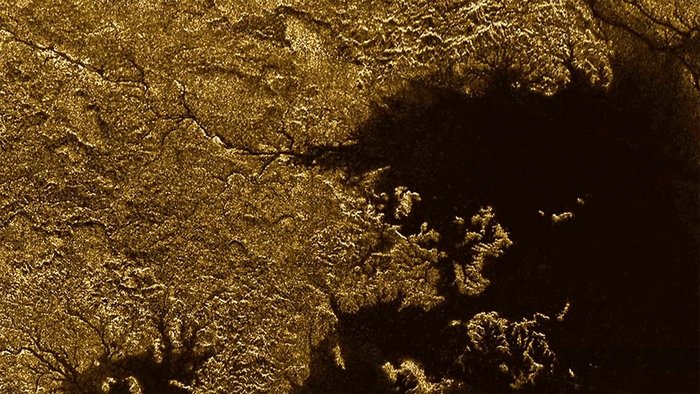
  • Description The aptly named Titan, Saturn’s largest moon, is remarkably Earth-like. Its diameter is only about 40% that of our planet, but Titan’s nitrogen-rich, dense atmosphere and the geological activity at the moon’s surface make comparisons between the two bodies inevitable.

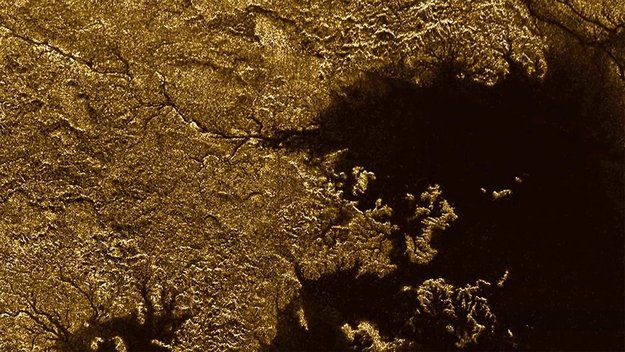
  • This image, taken with the radar on the Cassini spacecraft, shows just how similar the features in Titan’s surface are to Earth’s landforms.

  • Aside from Earth, Titan is the only other body where we have found evidence of active erosion on a large scale. There are seas, lakes and rivers filled with liquid hydrocarbons – mainly methane and some ethane – that etch the moon’s surface, in much the same way water erodes Earth’s.

  • A striking example is Vid Flumina, the Nile-like, branching river system visible on the upper-left quadrant of the image. The river, in the moon’s north polar region, flows into Ligeia Mare, a methane-rich sea that appears as a dark patch on the right side of the image.
    Researchers in Italy and the US analysed Cassini radar observations from May 2013 and recently revealed that the narrow channels that branch off Vid Flumina are deep, steep-sided canyons filled with flowing hydrocarbons.

  • The channels are a little less than a kilometre wide, up to 570 m deep and with slopes steeper than 40º. This suggests they have been sculpted by liquid methane, flowing into the main Vid Flumina river, that has persistently eroded the canyon walls – a geological process reminiscent of the carving of river gorges on our planet.

  • The study is the first direct evidence of deeply entrenched, methane-flooded channels on Titan. Finding out how they formed provides insights into the moon’s origin and evolution and could help understand similar geological processes on Earth.

  • The Cassini–Huygens radar team is hoping to observe the Ligeia Mare and Vid Flumina region again in April 2017, during Cassini’s final approach to Titan. The mission is a cooperation between NASA, ESA and Italy’s ASI space agency.
  • Id 365411
  • TAGS

    Open/Close

VERSIÓN EN ESPAÑOL:

Cañones con metano en Titán

19 septiembre 2016 Titán, la luna más grande de Saturno, es muy similar a la Tierra. Aunque su diámetro apenas llega al 40% del de nuestro planeta, su atmósfera densa y rica en nitrógeno, así como la actividad geológica en su superficie, hacen que las comparaciones entre ambas sean inevitables.
Esta imagen, captada con el radar de la nave Cassini, muestra precisamente lo parecidas que las formaciones en la superficie de Titán son a los paisajes terrestres.
Titán es el único cuerpo celeste, además de la Tierra, en el que se han hallado pruebas de erosión activa a gran escala. Se trata de mares, lagos y ríos de hidrocarburos líquidos, principalmente metano y algo de etano, que horadan la superficie del satélite del mismo modo en que el agua erosiona la Tierra.
Un ejemplo espectacular lo constituye Vid Flumina, un sistema fluvial ramificado similar al Nilo, que puede apreciarse en el cuadrante superior izquierdo de la imagen. El río discurre por la región polar norte de Titán y desemboca en Ligeia Mare, un mar rico en metano que podemos ver como una mancha oscura en la parte derecha de la fotografía.

Investigadores en Italia y Estados Unidos llevan analizando las observaciones del radar de Cassini desde mayo de 2013 y han revelado recientemente que los estrechos canales que parten de Vid Flumina son profundos y empinados cañones por los que fluyen hidrocarburos.

Estos canales tiene menos de un kilómetro de ancho, hasta 570 m de profundidad y sus pendientes superan los 40º de inclinación. Esto sugiere que han sido esculpidos por el metano líquido que fluye hacia Vid Flumina y que ha ido erosionando las paredes de los cañones: un proceso geológico que recuerda a la formación de las gargantas fluviales en nuestro planeta.

Este estudio constituye la primera evidencia directa de la existencia de canales profundos y llenos de metano en Titán. Conocer cómo se formaron da cuenta del origen y la evolución de esta luna y podría ayudar a comprender procesos geológicos similares en la Tierra.

El equipo del radar de Cassini-Huygens espera volver a observar la región de Ligeia Mare y Vid Flumina en abril de 2017, durante el acercamiento final de la nave a Titán. Cassini-Huygens es una misión conjunta de la NASA, la ESA y la agencia espacial italiana ASI.

ESA
Guillermo Gonzalo Sánchez Achutegui
ayabaca@gmail.com
ayabaca@hotmail.com
ayabaca@yahoo.com
Inscríbete en el Foro del blog y participa : A Vuelo De Un Quinde - El Foro!

domingo, 9 de noviembre de 2014

NASA : Specular Spectacular .- Reflejo Espectacular...................

Hola amigos : A VUELO DE UN QUINDE EL BLOG., la Agencia Espacial NASA, nos informa sobre diferentes vistas captadas al satélite Titan de Saturno... NASA  nos dice.............."Esta vista en infrarrojo cercano, mosaico de color captada de la nave espacial Cassini de la NASA muestra el sol brillando fuera de los mares polares del norte de Titán. Mientras que Cassini ha captado, por separado, vistas de los mares polares (ver PIA17470) y el sol brillando fuera de ellos (ver PIA12481 y PIA18433) en el pasado, esta es la primera vez que ambos han sido vistos juntos en la misma vista.............
El reflejo solar, también llamado un reflejo especular, es el área brillante cerca de la posición de las 11 en punto de la parte superior izquierda. Esto como un espejo de reflexión, conocido como el punto de especular, es en el sur del mar más grande de Titán, Kraken Mare, al norte de la isla de un archipiélago que separa dos partes separadas del mar.................
 
Este sunglint particular era tan brillante como para saturar el detector de infrarrojos y Espectrómetro de Mapeo (VIMS) instrumento visual de la Cassini, que captura la vista. Es también el sunglint visto con la elevación más alta de observación hasta el momento - el sol fue un total de 40 grados sobre el horizonte como se ve desde Kraken Mare en este momento - mucho mayor que los 22 grados visto en PIA18433. Debido a que era tan brillante, este destello fue visible a través de la neblina en longitudes de onda mucho más bajos que antes, hasta 1,3 micras.............


Specular Spectacular
This near-infrared, color mosaic from NASA's Cassini spacecraft shows the sun glinting off of Titan's north polar seas. While Cassini has captured, separately, views of the polar seas (see PIA17470) and the sun glinting off of them (see PIA12481 and PIA18433) in the past, this is the first time both have been seen together in the same view.
The sunglint, also called a specular reflection, is the bright area near the 11 o'clock position at upper left. This mirror-like reflection, known as the specular point, is in the south of Titan's largest sea, Kraken Mare, just north of an island archipelago separating two separate parts of the sea.
This particular sunglint was so bright as to saturate the detector of Cassini's Visual and Infrared Mapping Spectrometer (VIMS) instrument, which captures the view. It is also the sunglint seen with the highest observation elevation so far -- the sun was a full 40 degrees above the horizon as seen from Kraken Mare at this time -- much higher than the 22 degrees seen in PIA18433. Because it was so bright, this glint was visible through the haze at much lower wavelengths than before, down to 1.3 microns.
The southern portion of Kraken Mare (the area surrounding the specular feature toward upper left) displays a "bathtub ring" -- a bright margin of evaporate deposits -- which indicates that the sea was larger at some point in the past and has become smaller due to evaporation. The deposits are material left behind after the methane & ethane liquid evaporates, somewhat akin to the saline crust on a salt flat.
The highest resolution data from this flyby -- the area seen immediately to the right of the sunglint -- cover the labyrinth of channels that connect Kraken Mare to another large sea, Ligeia Mare. Ligeia Mare itself is partially covered in its northern reaches by a bright, arrow-shaped complex of clouds. The clouds are made of liquid methane droplets, and could be actively refilling the lakes with rainfall.
The view was acquired during Cassini's August 21, 2014, flyby of Titan, also referred to as "T104" by the Cassini team.
The view contains real color information, although it is not the natural color the human eye would see. Here, red in the image corresponds to 5.0 microns, green to 2.0 microns, and blue to 1.3 microns. These wavelengths correspond to atmospheric windows through which Titan's surface is visible. The unaided human eye would see nothing but haze, as in PIA12528.
The Cassini-Huygens mission is a cooperative project of NASA, the European Space Agency and the Italian Space Agency. JPL, a division of the California Institute of Technology, Pasadena, manages the mission for NASA's Science Mission Directorate in Washington. The VIMS team is based at the University of Arizona in Tucson.
More information about Cassini is available at http://www.nasa.gov/cassini and http://saturn.jpl.nasa.gov.
Image Credit: NASA/JPL-Caltech/University of Arizona/University of Idaho
 
NASA
Guillermo Gonzalo Sánchez Achutegui
Inscríbete en el Foro del blog y participa : A Vuelo De Un Quinde - El Foro!

domingo, 26 de octubre de 2014

NASA : NASA-led Study Sees Titan Glowing at Dusk and Dawn.- Estudio dirigido por la NASA ve Titán brilla intensamente en la oscuridad y el amanecer

Hola amigos: A VUELO DE UN QUINDE EL BLOG., la Agencia Espacial NASA, nos hace llegar la información de la vista captada al Satélite Titán del Planeta Saturno, y para poder explicar la visión captada nos dice:  ..."En lo alto de la atmósfera de Titán, grandes manchas de dos gases traza brillan cerca del polo norte, en el lado de la oscuridad de la luna, y cerca del polo sur, en el lado del amanecer. Colores más brillantes indican señales más fuertes de los dos gases, HNC (izquierda) y HC3N (derecha); tonos rojos indican las señales menos pronunciadas......
Los nuevos mapas del satélite Titán de Saturno  revelan grandes manchas de gases traza que brillan intensamente cerca de los polos norte y sur. Estas regiones se desplazan curiosamente fuera de los polos, al este o al oeste, por lo que el amanecer se está rompiendo a través de la región del sur, mientras que la oscuridad está cayendo sobre el norte........
 
El par de  lo que se podría llamar : "parches" fue descubierto por un equipo internacional dirigido por los investigadores de la NASA para estudiar  la composición química de la atmósfera de Titán......"
 
data map of gas clouds over a linear sketch of a moon
High in the atmosphere of Titan, large patches of two trace gases glow near the north pole, on the dusk side of the moon, and near the south pole, on the dawn side. Brighter colors indicate stronger signals from the two gases, HNC (left) and HC3N (right); red hues indicate less pronounced signals.
Image Credit: 
NRAO/AUI/NSF
 
New maps of Saturn’s moon Titan reveal large patches of trace gases shining brightly near the north and south poles. These regions are curiously shifted off the poles, to the east or west, so that dawn is breaking over the southern region while dusk is falling over the northern one.

The pair of patches was spotted by a NASA-led international team of researchers investigating the chemical make-up of Titan’s atmosphere.
“This is an unexpected and potentially groundbreaking discovery,” said Martin Cordiner, an astrochemist working at NASA’s Goddard Space Flight Center in Greenbelt, Maryland, and the lead author of the study. “These kinds of east-to-west variations have never been seen before in Titan’s atmospheric gases. Explaining their origin presents us with a fascinating new problem.”
The mapping comes from observations made by the Atacama Large Millimeter/submillimeter Array (ALMA), a network of high-precision antennas in Chile. At the wavelengths used by these antennas, the gas-rich areas in Titan’s atmosphere glowed brightly. And because of ALMA’s sensitivity, the researchers were able to obtain spatial maps of chemicals in Titan’s atmosphere from a “snapshot” observation that lasted less than three minutes.
Titan’s atmosphere has long been of interest because it acts as a chemical factory, using energy from the sun and Saturn’s magnetic field to produce a wide range of organic, or carbon-based, molecules. Studying this complex chemistry may provide insights into the properties of Earth’s very early atmosphere, which may have shared many chemical characteristics with present-day Titan.
In this study, the researchers focused on two organic molecules, hydrogen isocyanide (HNC) and cyanoacetylene (HC3N), that are formed in Titan’s atmosphere. At lower altitudes, the HC3N appears concentrated above Titan’s north and south poles. These findings are consistent with observations made by NASA’s Cassini spacecraft, which has found a cloud cap and high concentrations of some gases over whichever pole is experiencing winter on Titan.
The surprise came when the researchers compared the gas concentrations at different levels in the atmosphere. At the highest altitudes, the gas pockets appeared to be shifted away from the poles. These off-pole locations are unexpected because the fast-moving winds in Titan’s middle atmosphere move in an east–west direction, forming zones similar to Jupiter’s bands, though much less pronounced. Within each zone, the atmospheric gases should, for the most part, be thoroughly mixed.
The researchers do not have an obvious explanation for these findings yet.
“It seems incredible that chemical mechanisms could be operating on rapid enough timescales to cause enhanced 'pockets' in the observed molecules,” said Conor Nixon, a planetary scientist at Goddard and a coauthor of the paper, published online today in the Astrophysical Journal Letters. “We would expect the molecules to be quickly mixed around the globe by Titan’s winds.”
At the moment, the scientists are considering a number of potential explanations, including thermal effects, previously unknown patterns of atmospheric circulation, or the influence of Saturn’s powerful magnetic field, which extends far enough to engulf Titan.
Further observations are expected to improve the understanding of the atmosphere and ongoing processes on Titan and other objects throughout the solar system.  
NASA’s Astrobiology Program supported this work through a grant to the Goddard Center for Astrobiology, a part of the NASA Astrobiology Institute. Additional funding came from NASA’s Planetary Atmospheres and Planetary Astronomy programs. ALMA, an international astronomy facility, is funded in Europe by the European Southern Observatory, in North America by the U.S. National Science Foundation in cooperation with the National Research Council of Canada and the National Science Council of Taiwan, and in East Asia by the National Institutes of Natural Sciences of Japan in cooperation with the Academia Sinica in Taiwan.
Nancy Neal-Jones / Elizabeth Zubritsky
NASA's Goddard Space Flight Center, Greenbelt, Md.
301-286-0039 / 301-614-5438
nancy.n.jones@nasa.gov / elizabeth.a.zubritsky@nasa.gov
 
NASA
Guillermo Gonzalo Sánchez Achutegui
Inscríbete en el Foro del blog y participa : A Vuelo De Un Quinde - El Foro!

jueves, 3 de julio de 2014

NASA: Ocean on Saturn Moon Could be as Salty as the Dead Sea


Researchers found that Titan's ice shell, which overlies a very salty ocean, varies in thickness around the moon, suggesting the crust is in the process of becoming rigid.
Image Credit: 
NASA/JPL/SSI/Univ. of Arizona/G. Mitri/University of Nantes
 
Scientists analyzing data from NASA’s Cassini mission have firm evidence the ocean inside Saturn's largest moon, Titan, might be as salty as the Earth's Dead Sea.

The new results come from a study of gravity and topography data collected during Cassini's repeated flybys of Titan during the past 10 years. Using the Cassini data, researchers presented a model structure for Titan, resulting in an improved understanding of the structure of the moon's outer ice shell. The findings are published in this week’s edition of the journal Icarus.
"Titan continues to prove itself as an endlessly fascinating world, and with our long-lived Cassini spacecraft, we’re unlocking new mysteries as fast as we solve old ones," said Linda Spilker, Cassini project scientist at NASA's Jet Propulsion Laboratory (JPL) in Pasadena, California, who was not involved in the study.
Additional findings support previous indications the moon's icy shell is rigid and in the process of freezing solid. Researchers found that a relatively high density was required for Titan's ocean in order to explain the gravity data. This indicates the ocean is probably an extremely salty brine of water mixed with dissolved salts likely composed of sulfur, sodium and potassium. The density indicated for this brine would give the ocean a salt content roughly equal to the saltiest bodies of water on Earth.
"This is an extremely salty ocean by Earth standards," said the paper's lead author, Giuseppe Mitri of the University of Nantes in France. "Knowing this may change the way we view this ocean as a possible abode for present-day life, but conditions might have been very different there in the past."
Cassini data also indicate the thickness of Titan's ice crust varies slightly from place to place. The researchers said this can best be explained if the moon's outer shell is stiff, as would be the case if the ocean were slowly crystalizing, and turning to ice. Otherwise, the moon's shape would tend to even itself out over time, like warm candle wax. This freezing process would have important implications for the habitability of Titan's ocean, as it would limit the ability of materials to exchange between the surface and the ocean.
A further consequence of a rigid ice shell, according to the study, is any outgassing of methane into Titan's atmosphere must happen at scattered "hot spots" -- like the hot spot on Earth that gave rise to the Hawaiian Island chain. Titan's methane does not appear to result from convection or plate tectonics recycling its ice shell.
How methane gets into the moon's atmosphere has long been of great interest to researchers, as molecules of this gas are broken apart by sunlight on short geological timescales. Titan's present atmosphere contains about five percent methane. This means some process, thought to be geological in nature, must be replenishing the gas. The study indicates that whatever process is responsible, the restoration of Titan's methane is localized and intermittent.
"Our work suggests looking for signs of methane outgassing will be difficult with Cassini, and may require a future mission that can find localized methane sources," said Jonathan Lunine, a scientist on the Cassini mission at Cornell University, Ithaca, New York, and one of the paper's co-authors. "As on Mars, this is a challenging task."
The Cassini-Huygens mission is a cooperative project of NASA, the European Space Agency and the Italian Space Agency. JPL manages the mission for NASA's Science Mission Directorate in Washington.
For more information about Cassini, visit
NASA
Guillermo Gonzalo Sánchez Achutegui

sábado, 14 de diciembre de 2013

NASA : NASA's Cassini Spacecraft Reveals Clues About Saturn Moon

 
Youtube Override:
This colorized flyover movie from NASA's Cassini mission takes viewers over the two largest seas on Saturn's moon Titan and nearby lakes.
Image Token:
Feature Link:
Colorized mosaic of Titan
This colorized mosaic from NASA's Cassini mission shows the most complete view yet of Titan's northern land of lakes and seas. Saturn's moon Titan is the only world in our solar system other than Earth that has stable liquid on its surface.
Image Credit: NASA/JPL-Caltech/ASI/USGS
Image Token:
Feature Link:

NASA's Cassini spacecraft is providing scientists with key clues about Saturn's moon Titan, and in particular, its hydrocarbon lakes and seas.
Titan is one of the most Earth-like places in the solar system, and the only place other than our planet that has stable liquid on its surface.
Cassini's recent close flybys are bringing into sharper focus a region in Titan's northern hemisphere that sparkles with almost all of the moon's seas and lakes. Scientists working with the spacecraft's radar instrument have put together the most detailed multi-image mosaic of that region to date. The image includes all the seas and most of the major lakes. Some of the flybys tracked over areas that previously were seen at a different angle, so researchers have been able to create a flyover of the area around Titan's largest and second largest seas, known as Kraken Mare and Ligeia Mare, respectively, and some of the nearby lakes.
"Learning about surface features like lakes and seas helps us to understand how Titan's liquids, solids and gases interact to make it so Earth-like," said Steve Wall, acting radar team lead at NASA's Jet Propulsion Laboratory in Pasadena, Calif. "While these two worlds aren't exactly the same, it shows us more and more Earth-like processes as we get new views."
These new images show Kraken Mare is more extensive and complex than previously thought. They also show nearly all of the lakes on Titan fall into an area covering about 600 miles by 1,100 miles (900 kilometers by 1,800 kilometers). Only 3 percent of the liquid at Titan falls outside of this area.
"Scientists have been wondering why Titan's lakes are where they are. These images show us that the bedrock and geology must be creating a particularly inviting environment for lakes in this box," said Randolph Kirk, a Cassini radar team member at the U.S. Geological Survey in Flagstaff, Ariz. "We think it may be something like the formation of the prehistoric lake called Lake Lahontan near Lake Tahoe in Nevada and California, where deformation of the crust created fissures that could be filled up with liquid."
A creative application of a method previously used to analyze data at Mars also revealed that Ligeia Mare is about 560 feet (170 meters) deep. This is the first time scientists have been able to plumb the bottom of a lake or sea on Titan. This was possible partly because the liquid turned out to be very pure, allowing the radar signal to pass through it easily. The liquid surface may be as smooth as the paint on our cars, and it is very clear to radar eyes.
The new results indicate the liquid is mostly methane, somewhat similar to a liquid form of natural gas on Earth.
"Ligeia Mare turned out to be just the right depth for radar to detect a signal back from the sea floor, which is a signal we didn't think we'd be able to get," said Marco Mastrogiuseppe, a Cassini radar team associate at Sapienza University of Rome. "The measurement we made shows Ligeia to be deeper in at least one place than the average depth of Lake Michigan."
One implication is that Cassini scientists now can estimate the total volume of the liquids on Titan. Based on Mastrogiuseppe's work, calculations made by Alexander Hayes, of Cornell University in Ithaca, N.Y., show there are about 2,000 cubic miles (9,000 cubic kilometers) of liquid hydrocarbon, about 40 times more than in all the proven oil reservoirs on Earth.
As Cassini gets closer to northern summer in the Saturn system, mission scientists look forward to potentially the most exciting time for weather at Titan's northern hemisphere.
The Cassini-Huygens mission is a cooperative project of NASA, the European Space Agency, and the Italian Space Agency. JPL, a division of the California Institute of Technology in Pasadena, manages the mission for NASA's Science Mission Directorate in Washington. JPL designed, developed and assembled the Cassini orbiter. JPL and the Italian Space Agency, working with team members from the US and several European countries, built the radar instrument.
For more information about Cassini and its mission,
NASA
Guillermo Gonzalo Sánchez Achutegui
ayabaca@yahoo.com      

lunes, 2 de diciembre de 2013

NASA : Sunlit Edge of Saturn's Largest Moon, Titan


Sunlit Edge of Saturn's Largest Moon, Titan
The sunlit edge of Titan's south polar vortex stands out distinctly against the darkness of the moon's unilluminated hazy atmosphere. The Cassini spacecraft images of the vortex led scientists to conclude that its clouds form at a much higher altitude -- where sunlight can still reach -- than the surrounding haze.
Titan (3,200 miles, or 5,150 kilometers across) is Saturn's largest moon. This view looks toward the trailing hemisphere of Titan. North on Titan is up and rotated 32 degrees to the left. The image was taken with the Cassini spacecraft narrow-angle camera on July 14, 2013 using a spectral filter sensitive to wavelengths of near-infrared light centered at 938 nanometers.
The view was obtained at a distance of approximately 808,000 miles (1.3 million kilometers) from Titan and at a Sun-Titan-spacecraft, or phase, angle of 82 degrees. Image scale is 5 miles (8 kilometers) per pixel.
Image Credit: NASA/JPL-Caltech/Space Science Institute
NASA
Guillermo Gonzalo Sánchez Achutegui
ayabaca@gmail.com
ayabaca@hotmail.com
ayabaca@yahoo.com
Inscríbete en el Foro del blog y participa : A Vuelo De Un Quinde - El Foro!

miércoles, 23 de octubre de 2013

NASA : NASA Administrator to Visit Goddard in First Trip to a Field Center Post-Shutdown

Cassini Gets New Views of Titan's Land of Lakes .-

False-color mosaic
This false-color mosaic, made from infrared data collected by NASA's Cassini spacecraft, reveals the differences in the composition of surface materials around hydrocarbon lakes at Titan, Saturn's largest moon.
Image Credit: NASA/JPL-Caltech/University of Arizona/University of Idaho
Titan
Almost all of the hydrocarbon seas and lakes on the surface of Saturn's moon Titan cluster around the north pole, as can be seen in this mosaic from NASA's Cassini mission.
Image Credit: NASA/JPL-Caltech/SSI/JHUAPL/Univ. of Arizona
Saturn's moon Titan
Ultracold hydrocarbon lakes and seas (dark shapes) near the north pole of Saturn's moon Titan can be seen embedded in some kind of bright surface material in this infrared mosaic from NASA's Cassini mission.
Image Credit: NASA/JPL-Caltech/SSI/JHUAPL/Univ. of Arizona
Hydrocarbon seas and lakes near the north pole of Saturn's moon Titan
The vast hydrocarbon seas and lakes (dark shapes) near the north pole of Saturn's moon Titan sprawl out beneath the watchful eye of NASA's Cassini spacecraft.
Image Credit: NASA/JPL-Caltech/SSI/JHUAPL/Univ. of Arizona
PASADENA, Calif.-- With the sun now shining down over the north pole of Saturn's moon Titan, a little luck with the weather, and trajectories that put the spacecraft into optimal viewing positions, NASA's Cassini spacecraft has obtained new pictures of the liquid methane and ethane seas and lakes that reside near Titan's north pole. The images reveal new clues about how the lakes formed and about Titan's Earth-like "hydrologic" cycle, which involves hydrocarbons rather than water.
The new images are available online at:
While there is one large lake and a few smaller ones near Titan's south pole, almost all of Titan's lakes appear near the moon's north pole. Cassini scientists have been able to study much of the terrain with radar, which can penetrate beneath Titan's clouds and thick haze. And until now, Cassini's visual and infrared mapping spectrometer and imaging science subsystem had only been able to capture distant, oblique or partial views of this area.
Several factors combined recently to give these instruments great observing opportunities. Two recent flybys provided better viewing geometry. Sunlight has begun to pierce the winter darkness that shrouded Titan's north pole at Cassini's arrival in the Saturn system nine years ago. A thick cap of haze that once hung over the north pole has also dissipated as northern summer approaches. And Titan's beautiful, nearly cloudless, rain-free weather continued during Cassini's flybys this past summer.
The images are mosaics in infrared light based on data obtained during flybys of Titan on July 10, July 26, and Sept. 12, 2013. The colorized mosaic from the visual and infrared mapping spectrometer, which maps infrared colors onto the visible-color spectrum, reveals differences in the composition of material around the lakes. The data suggest parts of Titan's lakes and seas may have evaporated and left behind the Titan equivalent of Earth's salt flats. Only at Titan, the evaporated material is thought to be organic chemicals originally from Titan's haze particles that once dissolved in liquid methane. They appear orange in this image against the greenish backdrop of Titan's typical bedrock of water ice.
"The view from Cassini's visual and infrared mapping spectrometer gives us a holistic view of an area that we'd only seen in bits and pieces before and at a lower resolution," said Jason Barnes, a participating scientist for the instrument at the University of Idaho, Moscow. "It turns out that Titan's north pole is even more interesting than we thought, with a complex interplay of liquids in lakes and seas and deposits left from the evaporation of past lakes and seas."
The near-infrared images from Cassini's imaging cameras show a bright unit of terrain in the northern land of lakes that had not previously been visible in the data. The bright area suggests that the surface here is unique from the rest of Titan, which might explain why almost all of the lakes are found in this region. Titan's lakes have very distinctive shapes -- rounded cookie-cutter silhouettes and steep sides -- and a variety of formation mechanisms have been proposed. The explanations range from the collapse of land after a volcanic eruption to karst terrain, where liquids dissolve soluble bedrock. Karst terrains on Earth can create spectacular topography such as the Carlsbad Caverns in New Mexico.
"Ever since the lakes and seas were discovered, we've been wondering why they're concentrated at high northern latitudes," said Elizabeth (Zibi) Turtle, a Cassini imaging team associate based at the Johns Hopkins Applied Physics Laboratory, Laurel, Md. "So, seeing that there's something special about the surface in this region is a big clue to help narrow down the possible explanations."
Launched in 1997, Cassini has been exploring the Saturn system since 2004. A full Saturn year is 30 years, and Cassini has been able to observe nearly a third of a Saturn year. In that time, Saturn and its moons have seen the seasons change from northern winter to northern summer.
"Titan's northern lakes region is one of the most Earth-like and intriguing in the solar system," said Linda Spilker, Cassini project scientist, based at NASA's Jet Propulsion Laboratory, Pasadena, Calif. "We know lakes here change with the seasons, and Cassini's long mission at Saturn gives us the opportunity to watch the seasons change at Titan, too. Now that the sun is shining in the north and we have these wonderful views, we can begin to compare the different data sets and tease out what Titan's lakes are doing near the north pole."
The Cassini-Huygens mission is a cooperative project of NASA, the European Space Agency and the Italian Space Agency. JPL manages the mission for NASA's Science Mission Directorate, Washington. The California Institute of Technology in Pasadena manages JPL for NASA. The VIMS team is based at the University of Arizona in Tucson. The imaging operations center is based at the Space Science Institute in Boulder, Colo.
For more information about the Cassini mission, visit:
and
 
NASA Administrator to Visit Goddard in First Trip to a Field Center Post-Shutdown
NASA Administrator Charles Bolden will visit the agency's Goddard Space Flight Center in Greenbelt, Md. Tuesday, Oct. 22 -- his first visit to a NASA center since the end of the government shutdown. The visit is scheduled to begin at 2 p.m. EDT.
Sen. Barbara Mikulski of Maryland, who is Chairwoman of the Senate Appropriations Committee, will join Bolden at Goddard to view the latest launch preparations for the Global Precipitation Measurement and Magnetospheric Multiscale spacecraft, as well as the James Webb Space Telescope.
Media interested in attending the event should contact Ed Campion in Goddard’s Office of Communications to arrange access. He can be reached at 301-286-0697, 202-423-6285, or at edward.s.campion@nasa.gov. The deadline for accreditation is noon Tuesday.
For information about NASA's programs and missions, visit:
 
NASA
Guillermo Gonzalo Sánchez Achutegui
Inscríbete en el Foro del blog y participa : A Vuelo De Un Quinde - El Foro!

sábado, 19 de octubre de 2013

NASA : NASA's Cassini Spacecraft Finds Ingredient of Household Plastic in Space

NASA's Cassini spacecraft has detected propylene, a chemical used to make food-storage containers, car bumpers and other consumer products, on Saturn's moon Titan.
This is the first definitive detection of the plastic ingredient on any moon or planet, other than Earth.
Youtube Override:
Image Credit:
NASA's Goddard Space Flight Center
Image Token:
Feature Link:
A small amount of propylene was identified in Titan's lower atmosphere by Cassini's Composite Infrared Spectrometer (CIRS). This instrument measures the infrared light, or heat radiation, emitted from Saturn and its moons in much the same way our hands feel the warmth of a fire.
Propylene is the first molecule to be discovered on Titan using CIRS. By isolating the same signal at various altitudes within the lower atmosphere, researchers identified the chemical with a high degree of confidence. Details are presented in a paper in the Sept. 30 edition of the Astrophysical Journal Letters.
"This chemical is all around us in everyday life, strung together in long chains to form a plastic called polypropylene," said Conor Nixon, a planetary scientist at NASA's Goddard Space Flight Center in Greenbelt, Md., and lead author of the paper. "That plastic container at the grocery store with the recycling code 5 on the bottom -- that's polypropylene."
CIRS can identify a particular gas glowing in the lower layers of the atmosphere from its unique thermal fingerprint. The challenge is to isolate this one signature from the signals of all other gases around it.
The detection of the chemical fills in a mysterious gap in Titan observations that dates back to NASA's Voyager 1 spacecraft and the first-ever close flyby of this moon in 1980.
Voyager identified many of the gases in Titan's hazy brownish atmosphere as hydrocarbons, the chemicals that primarily make up petroleum and other fossil fuels on Earth.
On Titan, hydrocarbons form after sunlight breaks apart methane, the second-most plentiful gas in that atmosphere. The newly freed fragments can link up to form chains with two, three or more carbons. The family of chemicals with two carbons includes the flammable gas ethane. Propane, a common fuel for portable stoves, belongs to the three-carbon family.
Voyager detected all members of the one- and two-carbon families in Titan's atmosphere. From the three-carbon family, the spacecraft found propane, the heaviest member, and propyne, one of the lightest members. But the middle chemicals, one of which is propylene, were missing.
As researchers continued to discover more and more chemicals in Titan's atmosphere using ground- and space-based instruments, propylene was one that remained elusive. It was finally found as a result of more detailed analysis of the CIRS data.
"This measurement was very difficult to make because propylene's weak signature is crowded by related chemicals with much stronger signals," said Michael Flasar, Goddard scientist and principal investigator for CIRS. "This success boosts our confidence that we will find still more chemicals long hidden in Titan's atmosphere."
Cassini's mass spectrometer, a device that looks at the composition of Titan's atmosphere, had hinted earlier that propylene might be present in the upper atmosphere. However, a positive identification had not been made.
"I am always excited when scientists discover a molecule that has never been observed before in an atmosphere," said Scott Edgington, Cassini's deputy project scientist at NASA's Jet Propulsion Laboratory (JPL) in Pasadena, Calif. "This new piece of the puzzle will provide an additional test of how well we understand the chemical zoo that makes up Titan's atmosphere."
The Cassini-Huygens mission is a cooperative project of NASA, the European Space Agency and the Italian Space Agency. JPL manages the mission for NASA's Science Mission Directorate in Washington. The CIRS team is based at Goddard.
For more information about the Cassini mission, visit:
NASA
Guillermo Gonzalo Sánchez Achutegui

sábado, 6 de abril de 2013

NASA - Pioneer 11 Image of Saturn and its Moon Titan

Hola amigos: A VUELO DE UN QUINDE EL BLOG., la Agencia espacial NASA, nos alcanza una maravillosa visión  captada por el Satélite The Pioneer 11 spacecraft al planeta Saturno con sus discos que lo rodean y está su luna Titan.
El satélite fue lanzado el 5 de abril de 1,973 y se encuentra a 21,000  kilómetros, este instrumento espacial ha descubierto dos nuevas lunas del planeta Saturno.
Los invito a leer la nota en inglés....

Image of the Day Gallery

 NASA
Guillermo Gonzalo Sánchez Achutegui
ayabaca@gmail.com
ayabaca@hotmail.com
ayabaca@yahoo.com
Inscríbete en el Foro del blog y participa : A Vuelo De Un Quinde - El Foro!

miércoles, 19 de septiembre de 2012

Astronomy: Cassini scientist for a day competition 2012


 Cassini scientist for a day logo 
Credits: NASA

 19 September 2012
The 2012 edition of the 'Cassini Scientist for a Day' competition is now open to entry from students. The competition is designed to give the participants a taste of life as a scientist. Students are invited to submit a 500-word essay explaining their choice of one of three targets to be imaged by the Cassini spacecraft in orbit around Saturn.
 
Be a Cassini scientist for a day
 
The team working on the NASA/ESA/ASI Cassini-Huygens mission have set aside valuable observing time for educational purposes and they will use this to take images as part of the 'Cassini Scientist for a Day' competition. School students from participating countries must choose one of three targets that Cassini will image and write an essay to justify their choice to a panel of experts.  
 
European competition
 
Entries are welcome from students in any ESA Member State, ESA Cooperating State and Europlanet members that are currently participating in the competition, namely: Belgium, Czech Republic, France, Germany, Greece, Ireland, Italy, the Netherlands, Poland, Portugal, Romania, Slovakia, Spain and the UK.

The closing date for the competition in these countries is 23:59 CET, 3 December 2012.

Essays must be submitted to the appropriate national organiser who will select the winners for that nation. Note that competition rules and age categories may vary from country to country.

Contact details for the national organisers can be found here.

Winners of the competition held in ESA Member States, ESA Cooperating States and Europlanet members will receive a special ESA goodie bag and certificate. In addition, the winning essays will be published on the ESA website.
 
 
Which of these three targets would you choose?
 
To enter the competition, students should study each of the three targets that Cassini will image and decide which one they think will yield the best science results. The three targets are:

1. Pan – the shepherd moon
2. The F-ring
3. Saturn

 Artist's impression of the NASA/ESA/ASI Cassini-Huygens spacecraft orbiting Saturn and its magnificent rings. The glint of light behind the magnetometer boom at the bottom of the spacecraft is a reflection of the Sun. 
Credits: NASA

Cassini-Huygens mission

The Cassini-Huygens mission is an international endeavour between NASA, ESA and the Italian Space Agency (ASI). In 2004, after a journey of nearly seven years the spacecraft, comprising NASA's Cassini orbiter and ESA's Huygens probe, was the first to enter orbit around Saturn.

In January 2005, the Huygens probe touched down on the surface of Titan, one of Saturn's moons. This is the only landing to take place in the outer Solar System and the furthest from Earth.

The Cassini spacecraft is currently in orbit around Saturn providing scientists with an abundance of information about the giant planet and its moons.
 

A strong European involvement in the Cassini-Huygens mission

The Huygens probe was developed by ESA and many European countries were involved in the development of the 12 instruments on-board the Cassini orbiter. Data returned to Earth by the Huygens probe, along with data from the ongoing Cassini mission, are studied by hundreds of scientists from around the world. Many of the scientists participating in this international mission of exploration and discovery are European.
 

Contact information

Nicolas Altobelli
ESA Cassini–Huygens Project Scientist
Email: nicolas.altobelli@sciops.esa.int

ESA Science Education
SciEdu@esa.int 
 ESA
Guillermo Gonzalo sánchez Achutegui
ayabaca@gmail.com
ayabaca@hotmail.com
ayabaca@yahoo.com
 Inscríbete en el Foro del blog y participa : A Vuelo De Un Quinde - El Foro!