domingo, 6 de mayo de 2012

The Earth: Spotlight on Sentinel-2

Hi My Friends: A VUELO DE UN QUINDE EL BLOG., The vast potential of ESA’s upcoming Sentinel-2 satellites came into focus last week at a symposium in Italy on how they will benefit current and future projects that exploit Earth observation data.

Download:
 HI-RES JPEG (Size: 644 kb)

Forest cover maps of Gabon in 1990, 2000 and 2010 derived from Landsat data. Green areas represent forests, while yellow areas depict no forest cover. Grey represents no data coverage.
Credits: SIRS
The vast potential of ESA’s upcoming Sentinel-2 satellites came into focus last week at a symposium in Italy on how they will benefit current and future projects that exploit Earth observation data.

The humid and moist tropical climate of Gabon yields immense forests that cover over 85% of the land, making them the number-two driver of the national economy – and deforestation a subject of concern.
The GMES project on Forest Monitoring Reducing Emissions from Deforestation and Degradation mapped deforestation in Gabon from 1990 to 2010 using NASA’s Landsat satellite.
But the Equatorial African country’s heavy cloud cover means that imagery is often difficult to acquire over some areas.
While it takes Landsat 1.5–3.5 years to obtain imagery of the entire country, the future Sentinel-2 mission would require less than a year because of its more frequent coverage.
The future monitoring of land cover by Sentinel-2 was just one of the many topics covered at the Sentinel-2 Preparatory Symposium, hosted this week at ESA’s ESRIN centre for Earth observation in Frascati, Italy.  

Download:
 HI-RES JPEG (Size: 1952 kb)
  HI-RES TIFF (Size: 25 250 kb)


A mockup of the high-resolution images that the future Sentinel-2 mission will deliver, with a swath of 290 km and a resolution of 10 m per pixel. Using 82 observations from the German RapidEye satellites, the image covers the border area of northern Switzerland, southern Germany and eastern France, and includes a small portion of Austria and Lichtenstein. Sentinel-2, envisaged for launch in 2013, is one of five Sentinel missions that ESA is developing for Europe’s Global Monitoring for Environment and Security (GMES) programme.
Credits: RapidEye

Other applications discussed include forestry, agriculture, cartography and the mapping of glaciers and wetlands.
“Sentinel-2 will fill the gap from both a research and operations perspective,” said Chris Steenmans, Head of Programme at the European Environment Agency’s Shared Environmental Information System.
“We are currently struggling with fragmented satellite data, so the timely information that Sentinel-2 will provide is important. The mission will also complement other Earth observation investments on a global level.”
Sentinel-2, planned for launch next year, is one of five Sentinel missions that ESA is developing for Europe’s Global Monitoring for Environment and Security (GMES) programme.
Through GMES, decision-makers will have access to reliable, timely and accurate information services to manage the environment, understand and mitigate the effects of climate change and ensure civil security.
At the recent symposium, Medhavy Thankappan, Director of Science and Strategy at Geoscience Australia’s National Earth Observation Group, presented a national land cover dataset based on analysis of satellite data acquired over an eight-year period.

Download:
 HI-RES JPEG (Size: 1582 kb)


Sentinel-2 will provide systematic global acquisitions of high-resolution multispectral imagery for Europe's Global Monitoring for Environment and Security (GMES) programme.
Credits: Astrium GmbH

The dataset will provide the basis for monitoring Australia’s water resources, agricultural practices, soil erosion and forests.
“The next step is to update the land cover information with new data from a consistent source – to move from mapping to monitoring,” said Mr Thankappan.
“We would also like to move to a higher spatial resolution – that’s where Sentinel-2 comes in.”
Owing to its high resolution of 10 m per pixel, and wide swath of 290 km, global products from Sentinel-2 will be able to be applied locally.
The mission will adhere to the Sentinel Data Policy, which establishes full and open access to data acquired by all five of the upcoming Sentinels.
Participants at the symposium, however, expressed concern over the data delivery arrangement.
“Sentinel-2 is like a dream come true for the forest remote sensing community,” said Tuomas Häme, Research Professor at the VTT Technical Research Centre of Finland.
“It is of utmost importance that the mission can be fully utilised by organising data delivery to the users as smoothly as it is organised for the similar missions with a free and open data policy.”
ESA.
Guillermo Gonzalo Sánchez Achutegui
ayabaca@gmail.com
ayabaca@hotmail.com
ayabaca@yahoo.com
Inscríbete en el Foro del blog y participa : A Vuelo De Un Quinde - El Foro!

Science: Engine Test With a Cyclonic Twist

Hi My Friends: A VUELO DE UN QUINDE EL BLOG., Water forms an interesting cyclonic twist as it is intentionally sucked into the test engine of a U.S. Air Force C-17 transport aircraft during the VIPR project engine health monitoring tests conducted by NASA Dryden. The water was contained on a special platform built by NASA Dryden's Fabrication Branch for the tests.

Download Image

› Full Size

› 1600 x 1200

› 1024 x 768

› 800 x 600

Engine Test With a Cyclonic Twist

Water forms an interesting cyclonic twist as it is intentionally sucked into the test engine of a U.S. Air Force C-17 transport aircraft during the VIPR project engine health monitoring tests conducted by NASA Dryden. The water was contained on a special platform built by NASA Dryden's Fabrication Branch for the tests.
NASA's Aviation Safety Program is developing technology for improved sensors to help spot changes in vibration, speed, temperature and emissions which are symptomatic of engine glitches. These advanced sensors could alert ground crews to problems that can be eliminated with preventive maintenance before becoming serious safety concerns. Ultimately, the sensors could alert pilots to the presence of destructive volcanic ash particles too small for the eyes to see, giving more time for evasive action to prevent engine damage in flight.
Image Credit: NASA / Tony Landis

Guillermo Gonzalo Sánchez Achutegui
ayabaca@gmail.com
ayabaca@hotmail.com
ayabaca@yahoo.com

Astronomía: Nuevos indicios de erosión hídrica en Marte

Hola amigos: A VUELO DE UN QUINDE EL BLOG., La sonda Mars Express de la ESA nos muestra esta semana una región del Planeta Rojo que parece haber sido esculpida por el flujo del agua. Estas imágenes se suman a la larga lista de pruebas de la existencia de grandes masas de agua en la superficie de Marte en algún momento de su pasado.


Download:
 HI-RES JPEG (Size: 324 kb)
  HI-RES TIFF (Size: 61 500 kb)

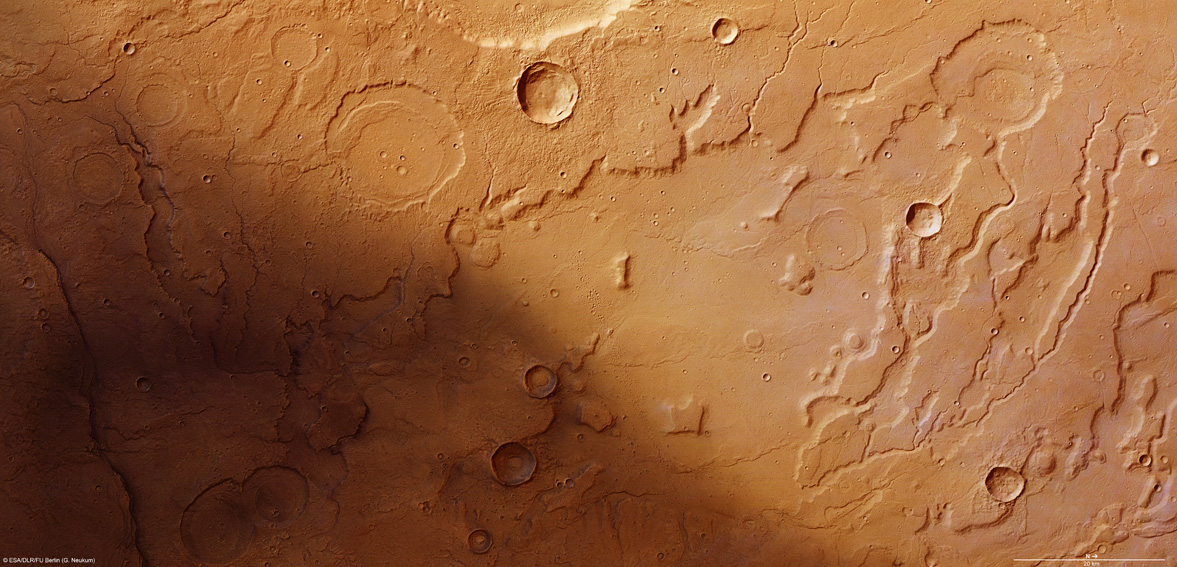
The transition between Acidalia Planitia and Tempe Terra from the Mars Express High-Resolution Stereo Camera (HRSC) nadir and colour channels, combined to form a natural colour view of the region. Centred at around 37°N and 306°E, this image has a ground resolution of about 15 m per pixel. The dendritic channels found commonly on Earth have analogues in the far-flung reaches of the Solar System. Here, it is strong evidence for the existence of water in Mars’ past.
Credits: ESA/DLR/FU Berlin (G. Neukum)


Download:
 HI-RES JPEG (Size: 500 kb)
 HI-RES TIFF (Size: 3180 kb)


The transition between Acidalia Planitia and Tempe Terra is shown here in a computer-generated perspective view. The image was created using data obtained from the High-Resolution Stereo Camera (HRSC) on ESA’s Mars Express spacecraft. Centred at around 37°N and 306°E, this image has a ground resolution of about 15 m per pixel. The foreground craters are believed to come from a younger phase in Mars history, evidenced by a lack of erosion and infilling seen in the background craters, which are believed to have once held liquid water.
Credits: ESA/DLR/FU Berlin (G. Neukum)

Download:
 HI-RES JPEG (Size: 577 kb)
  HI-RES TIFF (Size: 44 444 kb)


The transition between Acidalia Planitia and Tempe Terra was imaged during orbit 9534 of Mars Express by the HRSC. Centred at around 37°N and 306°E, this 3D image has a ground resolution of about 15 m per pixel. Data from HRSC’s nadir channel and one stereo channel are combined to produce this 3D image, which can be viewed using stereoscopic glasses, with red–green or red–blue filters. This anaglyph image clearly shows the difference between the youngest and oldest craters, with the younger craters having a deep interior and sharp slopes, whereas the older craters show a filled interior and shallow slope.
Credits: ESA/DLR/FU Berlin (G. Neukum)


Download:
 HI-RES JPEG (Size: 511 kb)
 HI-RES TIFF (Size: 2870 kb)


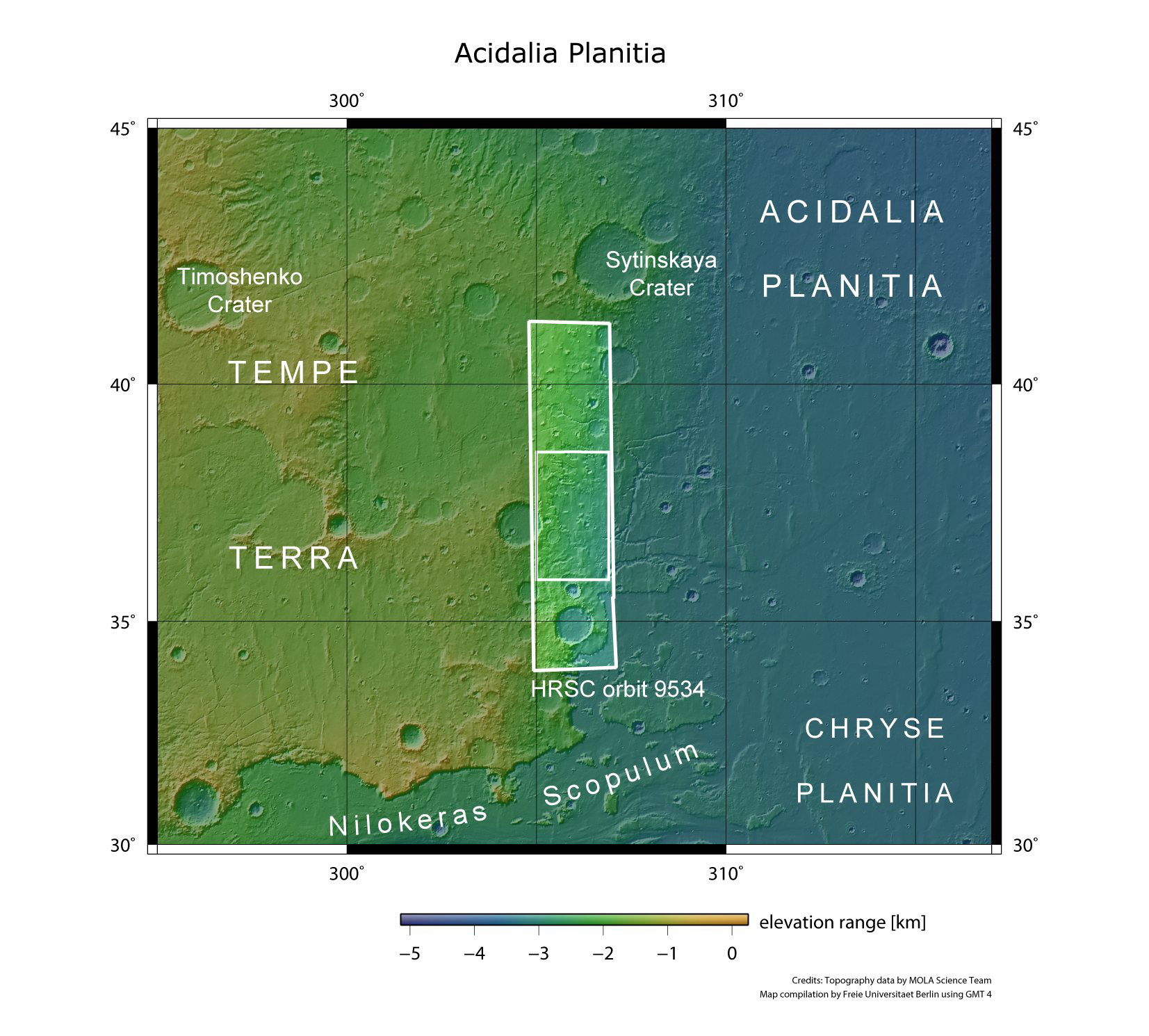
Acidalia Planitia in a broader context. Here we see Acidalia Planitia in a wider context, and the interface between it and Tempe Terra. The smaller rectangle shows the region covered in this Mars Express HRSC image release.
Credits: NASA MGS MOLA Science Team


Download:
 HI-RES JPEG (Size: 356 kb)
  HI-RES TIFF (Size: 75 300 kb)


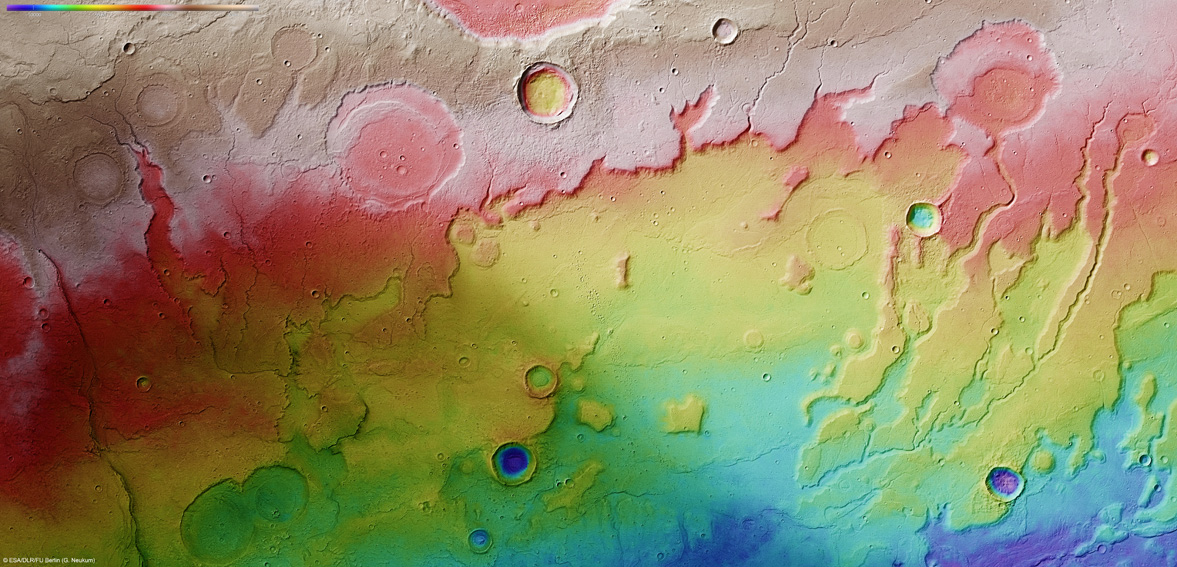
The transition between Acidalia Planitia and Tempe Terra in a colour-coded plan view based on a digital terrain model of the region, from which the topography of the landscape can be derived. Note the variance in depth between the older craters at the top of the image and the younger smaller craters to the lower part. Centred at around 37°N and 306°E, this image has a ground resolution of about 15 m per pixel. The upper craters are believed to have once held liquid water and have been subsequently filled in by sediments.
Credits: ESA/DLR/FU Berlin (G. Neukum)


Nuevos indicios de erosión hídrica en Marte:
La sonda Mars Express de la ESA nos muestra esta semana una región del Planeta Rojo que parece haber sido esculpida por el flujo del agua. Estas imágenes se suman a la larga lista de pruebas de la existencia de grandes masas de agua en la superficie de Marte en algún momento de su pasado.

El 21 de junio del año pasado, Mars Express apuntó su cámara estéreo de alta resolución (HRSC) hacia la parte occidental de Acidalia Planitia, una gigantesca cuenca en las tierras bajas del norte de Marte, cerca de dónde se encuentra con Tempe Terra, un terreno más elevado y de mayor antigüedad.
Acidalia Planitia es una región tan extensa que se puede observar desde la Tierra con un telescopio amateur.
El famoso astrónomo Giovanni Schiaparelli bautizó a esta gran mancha oscura con el nombre de la mítica fuente Acidalia, en Beocia, donde según la mitología griega se bañaba Venus con las tres Gracias.  
 Estas imágenes abarcan parte del límite occidental de la región. En ellas se pueden apreciar sutiles patrones de drenaje ‘dendríticos’ partiendo de los numerosos valles que descienden por la ladera de Tempe Terra.
La palabra ‘dendrítico’ procede del griego δένδρον, que significa ‘árbol’. Se piensa que los canales que se pueden ver en estas imágenes fueron formados por la escorrentía de aguas pluviales o de aguas procedentes del deshielo, en algún momento del pasado de Marte.
La profundidad de estos valles, unida al hecho de que presentan muy pocos afluentes en su curso bajo, sugiere que la región se transformó a través de un mecanismo de erosión conocido como ‘minado’ o ‘socavación’, que es el que tiene lugar cuando el agua arrastra los materiales más blandos de la base de un acantilado.
El proceso de socavación retira el apoyo de las capas superiores, formadas por rocas más duras, que terminan resquebrajándose en grandes bloques que se desprenden por la ladera del desnivel.
De esta forma, el proceso de erosión va avanzando hacia el curso superior del cauce, haciéndolo más profundo, de forma similar a lo que ocurre en la Meseta del Colorado aquí en la Tierra.
La esquina inferior izquierda de la imagen parece estar a la sombra, pero este oscurecimiento se debe en realidad a los distintos materiales que conforman la superficie: la parte izquierda está cubierta por arena oscura, probablemente de origen volcánico, mientras que la derecha está cubierta por una capa de polvo, más brillante.
En estas imágenes también se pueden distinguir varias fallas en la corteza marciana, extendiéndose hacia la región de Idaeus Fossae. Se piensa que estas formaciones pudieron jugar un papel fundamental a la hora de traer agua a la región. Al formarse, pudieron haber dejado al descubierto acuíferos subterráneos, que fluirían creando lagos en los cráteres de sus alrededores.
Los científicos están especialmente interesados en lo que parecen ser sedimentos cubriendo el fondo de algunos de los cráteres más antiguos y erosionados, ya que podrían ser nuevas pruebas de la existencia de agua líquida en la superficie de Marte en algún momento de su historia.
En algunos casos los valles arrancan del borde de un cráter, lo que sugiere que en algún momento el agua se desbordó y fluyó hacia los terrenos colindantes.
En el centro de la imagen se pueden distinguir cráteres más jóvenes, que se caracterizan por estar menos erosionados y por encontrarse sobre estructuras más antiguas.
 Estas imágenes de Mars Express aportan nuevas pruebas de la existencia de agua en la superficie de Marte en algún momento de su pasado, y ayudarán a descifrar cómo el agua surgió, fluyó, erosionó y se retiró de la superficie del Planeta Rojo en distintas épocas de su historia.
ESA.
Guillermo Gonzalo Sánchez Achutegui
ayabaca@gmail.com
ayabaca@hotmail.com
ayabaca@yahoo.com
Inscríbete en el Foro del blog y participa : A Vuelo De Un Quinde - El Foro!
La Historia del Amor Cruel: Capítulo XLIX.- Mónica conoce de boca Simone todo el proceso de su aborto y el apoyo médico recibido

Hola amigos: A VUELO DE UN QUINDE EL BLOG., continuando con La Historia del Amor Cruel, y como informamos en el capítulo anterior; Mónica al momento de sentarse para tomar el desayuno en el gran comedor del alojamiento de la Universidad de La Sorbona en París, siente un ataque de nauseas y haciendo una esfuerzo extraordinario llega  al baño y vomita solamente espuma con fuertes constracciones estomacales, y tanta fue la gravísima dolencia que perdió el conocimiento y terminó en la sala de operaciones, haciéndole un Legrado por que sufrió un pre aborto con intensa hemorragia vaginal; el ginecólogo que la atendió, era un joven médico que se interesó por la situación incómoda de la paciente (Mónica) e ideó una posible salida para evitar una probable  expulsión a su país por aborto que sufrió Mónica siendo soltera, quien tan solo era una estudiante sin matrimonio, así eran las reglas muy rígidas y draconianas.

Aquí en la imagen observamos una típica representación de la terrible situación que muchos hogares atraviesan en el transcurso de existencia por que siempre hay la existencia de un tercer elemento (amante tanto para él como para ella) que como una tentación tenebrosa carcomen las consistencias del matrimonio, y más si los esposos viven solamente la apariencia y no la triste realidad de que no son felices. Fuente: Archivos del blog. Obra Literaria reconocida con Derechos de Autor, según Partida Registral No. 00855-2012, Asiento: 01; con fecha: 10 de Agosto de 2012, por : INDECOPI.

Después de 8 horas de descanso ininterrumpido despertó Mónica en la sala de recuperación y lo primero que vio, fue a un joven médico que aguardaba su pronta  mejoría, ella quiso sentarse, pero el Galeno se lo impidió con frases suaves y de apoyo, quien le dijo:
--- Señorita Mónica, le ruego no mover su cuerpo, por que  ha sido sometida a una intervención de cirugía y por el momento usted está en descanso post quirurgico y yo he sido su cirujano y me alegra verla con reacción favorable que ayudará a su pronta recuperación.
Mónica, que aún sufría los efectos anestésicos y con su mente muy turbada, intentó esclarecer por que  estaba allí y que fue lo que hicieron con ella, por que no recordaba absolutamente nada y preguntando y agradeciendo, dijo:
--- Doctor gracias por estar aquí y por favor dígame que me ha pasado, por que no recuerdo el motivo para haber sido sometida a una intervención de cirugía, en este momento siento un intenso ardor a mis entrañas, insisto que ha pasado con mi cuerpo, por que me encuentro desorientada y confundida.
El doctor que la contemplaba con dulzura a su paciente y la belleza que ella poseía; el mismo estaba confundido viéndola como paciente y como mujer a la vez y trató de consolarla y darle la siguiente explicación:
--- Mónica, usted sufrió un pre aborto que se complicó con dolores vaginales y hemorragia intensa y además tuvo nauseas con fortísimas contracciones estomacales que originó un cuadro clínico con pronostico reservado, y bajo mi dirección se le practicó un legrado perdiendo lamentablemente un feto en formación y como usted es estudiante y soltera que viene desde el extranjero; hemos guardado en reserva absoluta su cuadro clínico y por ahora descanse y en los siguientes días conversaremos para lograr su pronta mejoría y no pierda  sus clases académicas de la Universidad.
Ciertamente pasaron cuatro días con la rápida recuperación post operatoria de Mónica; ella, recibió la visita constante de su madrona y de Simone, pero nadie preguntó ni comentó sobre su situación en la universidad, hasta que Simone decidió decirle toda la verdad con este comentario:
--- Mónica, al momento del desayuno tuviste un ataque de nauseas y fuiste al baño, pues allí te empeoraste y perdiste el conocimiento al caer al piso  y tu cabeza de golpeó, y felizmente yo estuve allí y llamé a los enfermeros y al levantarte para  llevarte al tópico de primeros auxilios, observé tu falda manchada con sangre, la misma que quedó en el piso, yo argumenté que fue de tu naríz por el golpe que sufriste en la cabeza, esta es la versión oficial; pero en realidad no caíste al piso te desmayaste en mis brazos y tu hemorragia fue vaginal......
Simone, se tomó una pausa y continuó, así:
--- Al llegar la tópico, te atendió un ginecólogo que por suerte tuya estaba como "guarda médico", quien en todo momento te prestó los primeros auxilios y como tu estado empeoraba y una enfermera  observó que la hemorragia vaginal continuaba incontenible, te hicieron un legrado y perdiste tu feto en formación.....
Simone, nuevamente hace un pausa y agregó:
--- El ginecólogo se interesó sobremanera en tu caso  y ha ocultado hasta ahora el motivo real de tu salud y por su puesto a la madrona le han informado  que por el golpe en tu cabeza hubo complicaciones que ya estás superando y que pronto irás a clase, es todo lo que puedo informarte.
Mónica, se paró de lo postrada que estaba en la cama y abrazó a Simone, por su apoyo incondicional que le había brindado y le agradeció, diciéndole:
--- Amiga, muchas gracias, has actuado como Mi Ángel de la Guarda, creo que con tu apoyo todo me va a salir bien, nunca pensé en abortar; pero si ese, es el destino y lo decidió así; será lo mejor, pero me duele en el alma, haber perdido lo más preciado que tenía mi cuerpo de mi gran amor que dejé en Cunante; con este aborto se terminó todo el recuerdo de Olzagon y dices que el médico se ha interesado en mi caso, con razón al despertarme luego de la operación, estaba él, allí esperando ver mi recuperación y me narró sobre el aborto tal como tu me estás informando en este momento......
Simone, interrumpió a Mónica y finalizó, así:
--- Amiga mía, el ginecólogo, puede ayudarte para evitarte complicaciones con la rigidez universitaria que si saben la verdad podrían expulsarte a Cunante; yo estoy casi segura que tu médico de cabecera se ha enamorado de ti, quien además, de ser bien parecido es la clave en tu situación universitaria; y es aún joven que puede ser una promesa en tu futuro próximo, por mi parte seré una tumba ultra secreta.....
Simone, descansa y prosigue:
--- Jamás saldrá un comentario  y actué en solidaridad, por que todos cometemos errores y nadie puede tirar la primera piedra si siente libre por estas causas propias de la juventud actual; por favor amiga nada de vergüenzas que lo pasado nadie lo recordará y la vida continua sin dudas ni murmuraciones como me decía un tío militar, según estoy informada, mañana te darán de alta; pero antes tienes que conversar con tu Galeno para que te asesore en la información que tienes que brindar a las autoridades universitarias por el cuadro clínico que sufrió tu salud.
Mónica, agradecía en su interior a Dios, que le ha permitido superar un aborto que jamás pensó le iba a suceder fuera de su casa, en realidad ella, nunca supo que estaba preñada, todo ha sido tan rápido y esperaba que así termine para bien de su salud, sobretodo seguir siendo una estudiante becaria en París; los recuerdos de Olzagon, estaban aún muy frescos, aunque la situación sentimental empezaba a dar ciertos cambios nunca pensados por ella que sigue siendo fiel a Olzagon; pero que las fuerzas del destino la empujaban a pensar en nuevas alternativas que se presentan ante sus ojos con perspectivas sentimentales no previstas por ella que las circunstancias le ofrecen como  una nueva oportunidad.
Mientras en Cunante, también había preocupación y estos sentimientos eran de Olzagon, él, tuvo una premonición viendo abortar a una joven parecida a Mónica, quien le dijo que ese hijo que pierde era suyo, aquel sueño lo tuvo en la madrugada del día que Mónica abortó en París, y a la vez ella le advertía que se olvide todo el romance que tuvieron por cuya consecuencia ella llegó a concebir.
Durante todo el día, el joven Olzagon estuvo muy aturdido por los presagios de su sueño,y para disiparse fue  en busca de su amigo Alfredo, para averiguar si había llegado alguna comunicación, carta o mensaje de Mónica desde París; su amigos le sugirió, que dé por terminada esa relación que hubo con Mónica y en cuanto a la supuesta preñez de ella con aborto incluido eran fruto de las fantasías del sueño.
Olzagon, recordó que fue el mismo el que dejó en absoluta libertad a Mónica, pero ella,  le replicó que jamás verá otro hombre que no sea él, y también recordaba que Mónica le ofreció escribirle luego de su llegada a París, pues él, aguardaba esa misiva, - sin embargo - en Francia ya comenzaron a correr nuevos vientos que sólo Mónica sabe la dirección exacta asociada con su vientre que enrumbarán estos aires enrarecidos.....
Continuaremos....... 
Guillermo Gonzalo Sánchez Achutegui
ayabaca@gmail.com
ayabaca@hotmail.com
ayabaca@yahoo.com

sábado, 5 de mayo de 2012

La Casa de la Loma tiene un Fantasma: Capítulo CLVII.- Séfora con sus "vacas mañosas" llega al fundo "El Azote negro" en incursión

Hola amigos: A VUELO DE UN QUINDE EL BLOG., continuando con la historia de La Casa de la Loma tiene un Fantasma, y como informamos en el capítulo anterior, Séfora Huamán Morocho fue informada por los peones que llegaron a su casa siguiendo los rastros de sus "vacas mañosas" que el Señor Sánchez irá al fundo "El azote negro" al día siguiente; ante tan agradable noticia, ella escogió el vestido y rebozo que lucirá junto a sus "vacas mañosas" que como pretexto se presentarán en incursión, rompiendo cercos e invadiendo las invernas llenas de pastos verdes.
Aquí en la imagen observamos una típica casa en la Comunidad Campesina de Socchabamba, Ayabaca, Piura, Perú; es una construcción de adobe con techo de tejas rojas y a dos aguas, sobre el techo distinguimos un fantasma que viene a ser el "El Rey de las Tinieblas" : Satanás, seguido de vampiros y una siniestra sombra negra que rodea al misterioso personaje satánico, para comprender la narrativa de la obra literaria: "LA CASA DE LA LOMA TIENE UN FANTASMA" , esta imagen será nuestro símbolo de identificación y el logotipo en creación, impresión y distribución literaria. Con reconocimiento de derechos de autor, con Partida Registral Nº 00393-2010, Asiento 01, con fecha 27 de marzo de 2010 por INDECOPI. Fuente de imagen: Archivos del blog.
Séfora, recogió agua limpia de su pequeño arroyo de la hoyada junto a su casa llenando dos cántaros y decidió bañarse para no oler mal se dijo asimismo, dando acción al acto comenzó a retirar sus ropas que llevaba puestas, quedándose solamente con una combinación rosada, en aquellos tiempos así se aseaban las mujeres; después de probar el agua con un mate empezó mojándose la cabeza, sentía cierto frío propio del clima en aquel instante; luego se mojó todo el cuerpo de una sola vez; la única prenda mojada que tenía puesta modeló un impresionante cuerpo con senos muy pronunciados dotados de senos erectos jamás amamantados; se veía una estrecha cintura que daba origen con abultados glúteos, era toda una "Diosa Campesina" que ya pisaba los 30 años de edad y aún virgen; como el cuerpo ya se acostumbró a la temperatura del agua, ella continuó echándose agua y jabonando todo su cuerpo y rápidamente se enjuagó y con un manto de felpa que hacía las veces de toalla secó su cuerpo.Terminado el baño, regresó a su casa, tomó desayuno.
El tiempo continua su ritmo de avance y ya eran las 8:30 a.m. , ella se "mudó de ropa" ( expresión usada en Socchabamba para decir cambiarse con ropa limpia y/o nueva), cuando ella estuvo lista, se acercó al corral y tuvo un diálogo con su "vaca cuernuda" (cornuda), todo lo que parecía fue sólo un monólogo y empezó, así:
--- Vaca cuernuda, tu tienes un trabajo muy especial  que realizar hoy, abriendo un gran portillo y te llenarás la panza con el mejor pasto verde y fresco.
El cuadrúpedo miraba a su ama en señal de acatamiento,por que no podía pronunciar palabra alguna y así poder contestar la conversación.
Y Séfora, continuó:
--- En estos momentos, voy abrir el corral y con tu lo sabes hacer, rápidamente diriges a las otras vacas rumbo  al fundo "El azote negro", yo iré tras ustedes y cuando rompas el cerco, ingresas al potrero, siendo siempre seguida por las demás vacas, e intenten en caminar lo más que puedan al interior del potrero y como seguramente serán vistas por los peones, no trates de escapar, haz todo lo contrario sigue corriendo  al interior del fundo; cuando más avancen adentro será mejor para el cumplimiento de mis planes.
La vaca escuchaba con suma atención a su dueña sin dar una pestañeada de distracción. Y Séfora continuó con el monólogo (diálogo vaca-humano) y agregó:
--- Cuando te encuentres acorralada por los peones no pongas resistencia y entrega tu cabeza para que te pongan lazo; no temas si te amarran en picotas, por que allí estaré, para arreglar con el dueño y te soltarán; por favor no olvides y el premio será llenar tu panza con un buen pasto como te indiqué al empezar esta  conversación.
Y Séfora, finalizó:
--- En tu astucia "vaca  cuernuda"(cornuda) tengo la esperanza del éxito de mis planes.
Entre los humanos y los animales hay comunicación, si bien no es verbal, pero si se hace por telepatía, por que la vaca luego que su ama le dio las instrucciones, retrocedió y fue rozando su hocico a cada  una de las otras vacas "comunicandoles" lo que van hacer luego que se abra la puerta del corral.
Séfora, no se dio cuenta de todo el movimiento que hicieron las vacas; sus pensamientos estaban concentrados en ver al señor Sánchez y casi mecánicamente fue quitando la tranca  del corral; luego se hizo a un costado  y las vacas salieron en tropel rumbo al potrero  que ellas ya habían conocido tres veces antes.
Las vacas, casi corrían a buen ritmo cuesta abajo y como el terreno estaba seco, sus pisadas levantaban polvo y como Séfora iba atrás, se vio obligada a mermar la velocidad de su marcha esperando se desvanezca el polvo,  para que no se ensucie su vestido y rebozo que llevaba puestos.
Los bovinos, sabiendo que hoy comerían un delicioso pasto y haciendo honor a su apelativo: "vacas mañosas", aceleraron la marcha, hasta que llegaron a los límites del fundo "El azote negro" - entonces- la vaca cuernuda (cornuda) comenzó a husmear las probables debilidades del cerco, para intentar romperlo; las otras tres vacas esperaban a una distancia que les permitió estar listas para ingresar. 
Mientras tanto la "vaca cuernuda"(cornuda) seguía buscando una probable entrada, hasta que detectó que el portillo anterior no había sido reparado con muchas ramas y  levantó ligeramente unas ramas quedando libres los horcones que sostenían las ramas, pero estos palos si estaban  bien plantados y en medio del portillo, la vaca olió a las estacas, midiendo la resistencia, y dio la vuelta caminando cierto trecho en dirección a sus compañeras; luego volteó el cuerpo nuevamente en dirección al portillo y tomando carrera emprendió el ataque, bajando la cabeza en dirección a los palos parados, los embistió con tanta fuerza que los tumbó hacia adentro, la acometida fue exitosa, por que quedó libre el camino y con un mugido suave invitó a sus compañeras a ingresar a servirse el delicioso pasto verde que sus hambrientas panzas pedían a gritos esta comida; todos los animales ingresaron y empezaron a engullir su alimento verde.
Entre tanto, Séfora ya se había posesionado en el altillo (loma) en donde lo hizo la vez anterior y con esa privilegiada ubicación, ella podía observar todo el paisaje hacia la parte de abajo, a la vez ella pudo comprobar que no había ningún peón merodeando por ese sector; lo que favorecía a las vacas, cuyos hocicos no cesaban engulliendo todo el pasto posible.
Y como el tiempo continúa , ya eran las 10:00 de la mañana, y repentinamente apareció una polvareda en el horizonte de donde estaba Séfora, era un jinete que bajaba aceleradamente y lo hacía en dirección al portillo. Séfora, se le estremeció todo el cuerpo pensando que el único jinete sería el señor Sánchez; hasta que apareció la silueta  del caminante y como lo sospechaba, ella, era el mismo Sánchez y completamente sólo y sin peones a la vista; el recién llegado detectó el  portillo y rápidamente se apeó de su caballo y caminó en dirección a la abertura del cerco y al observar la dimensión del daño y vio muchas pisadas de vacas; se tranquilizó al darse cuenta que ingresaron "vacas mañosas" al potrero y no lo que en principio pensó que los bandoleros hayan robado ganado del fundo.
Entonces,  dio un silbo a su caballo que lo estaba esperando atrás, ya que estaba bien entrenado, por lo que el equino le contestó con un suave relincho y avanzó hacia el potrero donde estaba su amo, quien nuevamente lo montó y emprendió la marcha hacia el interior del potrero para encontrar a las "vacas mañosas".
Por su parte, Séfora, se había quedado paralizada, observando a su posible "amado" que lo tenía al alcance de sus manos y todo estaba sucediendo rápidamente que encajaba con los planes de Séfora, por lo que ella abandonó su escondite y se dispuso a seguir al hombre que su corazón había decidido amarlo; por su puesto que él, desconocía que la mujer a quien pretendía y lo rechazó en un intento anterior que hizo por conquistarla en su propia casa; ahora, estaba tan solo a unos pasos suyos  atrás y esta vez ella si deseaba ser conquistada y amada por él.... continuaremos.....
Guillermo Gonzalo Sánchez Achutegui
ayabaca@gmail.com
ayabaca@hotmail.com
ayabaca@yahoo.com
Inscríbete en el Foro del blog y participa : A Vuelo De Un Quinde - El Foro!

jueves, 3 de mayo de 2012

Astronomy: Broken Sea

Hi My Friends: A  VUELO DE UN QUINDE EL BLOG., The partially broken sea ice pack below NASA's ER-2 can be clearly seen through the pilot's cockpit viewing sight during one of the MABEL laser altimeter validation flights.
For more information go to
Image Credit: NASA
Bookmark and Share


The convergence of two glaciers near Thule, Greenland can be seen in this photo from the cockpit of NASA's ER-2 Earth Resources aircraft during a MABEL laser altimeter validation flight. (NASA photo) › View Larger Image
Download Image
› Full Size
› 1024 x 768
› 800 x 600
Broken Sea
The partially broken sea ice pack below NASA's ER-2 can be clearly seen through the pilot's cockpit viewing sight during one of the MABEL laser altimeter validation flights. (NASA photo) › View Larger Image

 The flight, ground and science team that supported the MABEL laser altimeter validation flights over Greenland gathered by NASA's ER-2 for a group photo before pilot Stu Broce (in pressure suit) took the aircraft aloft on its return flight from Keflavik, Iceland to Palmdale, Calif. April 27. (NASA photo) › View Larger Image

NASA's high-flying ER-2 Airborne Science aircraft has concluded its four-week deployment to validate data acquired by the Multiple Altimeter Beam Experiment Lidar (MABEL) laser altimeter over the Greenland ice cap and surrounding sea ice fields.

After an almost 10 and one-half hour transit flight from its deployment base in Keflavik, Iceland, NASA ER-2 pilot Stu Broce landed ER-2 806 April 27 at the Dryden Aircraft Operations Facility at Air Force Plant 42 in Palmdale, Calif. The lengthy flight from Iceland included data collection by the MABEL instrument over a portion of broadleaf deciduous forest in Wisconsin. The ground support and science crew that supported the flights returned several days later.

"We completed 100 percent of the science flights," said Broce, noting that they were able to acquire data on several additional ad hoc targets that were not in the original plan. "The weather cooperated, the plane worked well as did the science instruments."

The ER-2 flew more than 100 hours on 16 flights in the MABEL validation campaign, including 14 data collection flights over Greenland and surrounding sea ice areas and two transit flights between Keflavik and its home base in Palmdale. Several of the flights were conducted concurrently and on the same flight tracks as flights of other NASA environmental science aircraft involved in the Arctic IceBridge campaign in order to compare data being recorded by the MABEL with instruments on the other aircraft.

Broce had one word to describe the areas of Greenland over which the ER-2 flew: desolate.

A former Air Force pilot, Broce had not flown in this area of the world before the MABEL mission. He noted that one flight took him to 84 degrees north latitude where, he commented, the sun is at a very low angle.

Targets of the flights included wide areas of Greenland's ice sheets and surrounding sea ice fields, the Jacobshavn, Svalbard and East Glaciers, and a volcano in Iceland.

NASA ER-2 research pilot Tim Williams, Dryden's senior representative on the deployment, noted that more than 5.5 terrabytes of data was collected by the MABEL laser altimeter, the Cloud Physics Lidar and other instruments on board the ER-2 during the mission.

MABEL was developed at NASA's Goddard Space Flight Center to simulate a similar instrument planned for NASA's IceSat-2 environmental satellite that is scheduled for launch in 2016. Scientists consider laser altimetry from satellites or aircraft to be the most accurate method of gauging changing elevations over a period of time, and thus determine the thickening or thinning of Arctic or Antarctic ice fields and sea ice related to climate change.

Flight and science team members participated in a number of public and educational outreach activities during their stay in Iceland, including briefings on MABEL and IceSAT-2 during a speech on climate by Iceland's president, to the U.S. ambassador and embassy personnel, and to middle- and high-school students, the University of Reykjavik and the Keiler Aviation Academy in Keflavik.

Learn more about the advanced MABEL laser altimeter.
Guillermo Gonzalo Sánchez Achutegui
ayabaca@gmail.com
ayabaca@hotmail.com
ayabaca@yahoo.com
Inscríbete en el Foro del blog y participa : A Vuelo De Un Quinde - El Foro!

miércoles, 2 de mayo de 2012

Astronomy: Black Hole Caught Red-Handed in a Stellar Homicide

Hi My Friends: A VUELO DE UN QUINDE EL BLOG., Astronomers have gathered the most direct evidence yet of a supermassive black hole shredding a star that wandered too close. NASA's Galaxy Evolution Explorer, a space-based observatory, and the Pan-STARRS1 telescope on the summit of Haleakala in Hawaii, were among the first to help identify the stellar remains.
ABOUT THIS IMAGE:

This computer-simulated image shows gas from a tidally shredded star falling into a black hole. Some of the gas also is being ejected at high speeds into space. Astronomers observed a flare in ultraviolet and optical light from the gas falling into the black hole and glowing helium from the stars's helium-rich gas expelled from the system.
To see the computer simulation movie, visit:
http://hubblesite.org/newscenter/archive/releases/2012/18/video/
Image Type: Scientific Visualization
Credit: NASA, S. Gezari (The Johns Hopkins University), and J. Guillochon (University of California, Santa Cruz)
NEWS RELEASE IMAGES
May 2, 2012: Astronomers have gathered the most direct evidence yet of a supermassive black hole shredding a star that wandered too close. NASA's Galaxy Evolution Explorer, a space-based observatory, and the Pan-STARRS1 telescope on the summit of Haleakala in Hawaii were the first to the scene of the crime, helping to identify the stellar remains.

See the rest:
•NASA Press Release
•The Full Story
•See All the Images
•See All the Videos

Black Hole Caught Red-Handed in a Stellar Homicide
WASHINGTON -- Astronomers have gathered the most direct evidence yet of a supermassive black hole shredding a star that wandered too close. NASA's Galaxy Evolution Explorer, a space-based observatory, and the Pan-STARRS1 telescope on the summit of Haleakala in Hawaii, were among the first to help identify the stellar remains.
Supermassive black holes, weighing millions to billions times more than the sun, lurk in the centers of most galaxies. These hefty monsters lay quietly until an unsuspecting victim, such as a star, wanders close enough to get ripped apart by their powerful gravitational clutches.
Astronomers have spotted these stellar homicides before, but this is the first time they identified the victim. Using several ground- and space-based telescopes, a team of astronomers led by Suvi Gezari of the Johns Hopkins University in Baltimore identified the victim as a star rich in helium gas. The star resides in a galaxy 2.7 billion light-years away. The team's results will appear in today's online edition of the journal Nature.
"When the star is ripped apart by the gravitational forces of the black hole, some part of the star's remains falls into the black hole while the rest is ejected at high speeds," Gezari said. "We are seeing the glow from the stellar gas falling into the black hole over time. We're also witnessing the spectral signature of the ejected gas, which we find to be mostly helium. It is like we are gathering evidence from a crime scene. Because there is very little hydrogen and mostly helium in the gas, we detect from the carnage that the slaughtered star had to have been the helium-rich core of a stripped star."
This observation yields insights about the harsh environment around black holes and the types of stars swirling around them. It is not the first time the unlucky star had a brush with the behemoth black hole.
The team believes the star's hydrogen-filled envelope surrounding the core was lifted off a long time ago by the same black hole. The star may have been near the end of its life. After consuming most of its hydrogen fuel, it had probably ballooned in size, becoming a red giant. Astronomers think the bloated star was looping around the black hole in a highly elliptical orbit, similar to a comet's elongated orbit around the sun. On one of its close approaches, the star was stripped of its puffed-up atmosphere by the black hole's powerful gravity. The stellar remains continued its journey around the center, until it ventured even closer to the black hole to face its ultimate demise.
Astronomers predict stripped stars circle the central black hole of our Milky Way galaxy. These close encounters are rare, occurring roughly every 100,000 years. To find this event, Gezari's team monitored hundreds of thousands of galaxies in ultraviolet light with the Galaxy Evolution Explorer, and in visible light with Pan-STARRS1. Pan-STARRS, short for Panoramic Survey Telescope and Rapid Response System, scans the entire night sky for all kinds of transient phenomena, including supernovae.
The team was looking for a bright flare in ultraviolet light from the nucleus of a galaxy with a previously dormant black hole. Both telescopes spotted one in June 2010. Astronomers continued to monitor the flare as it reached peak brightness a month later and slowly faded during the next 12 months. The brightening event was similar to the explosive energy unleashed by a supernova, but the rise to the peak was much slower, taking nearly one and a half months.
"The longer the event lasted, the more excited we got, because we realized this is either a very unusual supernova or an entirely different type of event, such as a star being ripped apart by a black hole," said team member Armin Rest of the Space Telescope Science Institute in Baltimore.
By measuring the increase in brightness, the astronomers calculated the black hole's mass to be several million suns, which is comparable to the size of our Milky Way's black hole.
Spectroscopic observations with the Multiple Meter Telescope Observatory located on Mount Hopkins in Arizona showed the black hole was swallowing lots of helium. Spectroscopy divides light into its rainbow colors, which yields an object's characteristics, such as its temperature and gaseous makeup.
To completely rule out the possibility of an active nucleus flaring up in the galaxy, the team used NASA's Chandra X-ray Observatory to study the hot gas. Chandra showed that the characteristics of the gas didn't match those from an active galactic nucleus.
For images, video and more information about this study, visit:
http://hubblesite.org/news/2012/18
For graphics and information about the Galaxy Evolution Explorer, visit:
http://www.nasa.gov/galex
and
http://www.galex.caltech.edu/
Guillermo Gonzalo Sánchez Achutegui
ayabaca@gmail.com
ayabaca@hotmail.com
ayabaca@yahoo.com
Inscríbete en el Foro del blog y participa : A Vuelo De Un Quinde - El Foro!

martes, 1 de mayo de 2012

Science: Scientists Find Night-Warming Effect Over Large Wind Farms in Texas

Hi My Friends: A VUELO DE UN QUINDE EL BLOG., Large wind farms in certain areas in the United States appear to affect local land surface temperatures, according to a paper published today in the journal Nature Climate Change.

Night-time land surface temperature differences near wind farms between 2010 and 2013.

Credit: Liming Zhou et al., Nature Climate Change.
Wind farms are numerous in parts of Texas; scientists report new results on their effects.

Credit: U.S. Department of Energy
Locations of clusters of Texas wind farms, as of the year 2010.

Credit: State of Texas

Wind farms dot the horizon in Lubbock County and other Texas areas.

Credit: Lubbock County, Texas

A new kind of Texas ranch--a wind ranch.

Credit: Wikimedia Commons

A Texas wind farm shares space with cacti and other desert-dwellers.

Credit: Wikimedia Commons

Large wind farms in certain areas in the United States appear to affect local land surface temperatures, according to a paper published today in the journal Nature Climate Change.
The study, led by Liming Zhou, an atmospheric scientist at the State University of New York- (SUNY) Albany, provides insights about the possible effects of wind farms.
The results could be important for developing efficient adaptation and management strategies to ensure long-term sustainability of wind power.
"This study indicates that land surface temperatures have warmed in the vicinity of large wind farms in west-central Texas, especially at night," says Anjuli Bamzai, program director in the National Science Foundation's (NSF) Division of Atmospheric and Geospace Sciences, which funded the research.
"The observations and analyses are for a relatively short period, but raise important issues that deserve attention as we move toward an era of rapid growth in wind farms in our quest for alternate energy sources."
Considerable research has linked the carbon dioxide produced by burning fossil fuels with rising global temperatures.
Consequently, many nations are moving toward cleaner sources of renewable energy such as wind turbines. Generating wind power creates no emissions, uses no water and is likely "green."
"We need to better understand the system with observations, and better describe and model the complex processes involved, to predict how wind farms may affect future weather and climate," said Zhou.
There have been a growing number of studies of wind farm effects on weather and climate, primarily using numerical models due to the lack of observations over wind farms.
As numerical models are computationally intensive and have uncertainties in simulating regional and local weather and climate, said Zhou, remote sensing is likely the most efficient and effective way to study wind farm effects over larger spatial and longer temporal scales.
To understand the potential impact of wind farms on local weather and climate, Zhou's team analyzed satellite-derived land surface temperatures from regions around large wind farms in Texas for the period 2003-2011.
The researchers found a night-time warming effect over wind farms of up to 0.72 degrees Celsius per decade over the nine-year-period in which data were collected.
Because the spatial pattern of warming mirrors the geographic distribution of wind turbines, the scientists attribute the warming primarily to wind farms.
The year-to-year land surface temperature over wind farms shows a persistent upward trend from 2003 to 2011, consistent with the increasing number of operational wind turbines with time.
"This warming effect is most likely caused by the turbulence in turbine wakes acting like fans to pull down warmer near-surface air from higher altitudes at night," said Somnath Baidya Roy of the University of Illinois at Urbana-Champaign, a co-author of the paper.
While the warming effect reported is local and small compared to the strong background year-to-year land surface temperature variation, the authors believe that this work draws attention to an important scientific issue that requires further investigation.
"The estimated warming trends only apply to the study region and to the study period, and thus should not be interpolated into other regions, globally or over longer periods," Zhou said. "For a given wind farm, once there are no new wind turbines added, the warming effect may reach a stable level."
The study represents a first step in exploring the potential of using satellite data to quantify the possible effects of the development of big wind farms on weather and climate, said Chris Thorncroft of SUNY-Albany, a co-author of the paper.
"We're expanding this approach to other wind farms," said Thorncroft, "and building models to understand the physical processes and mechanisms driving the interactions of wind turbines and the atmosphere boundary layer near the surface."
Other authors of the paper include Lance Bosart at SUNY-Albany, Yuhong Tian of NOAA, and Yuanlong Hu at Terra-Gen Power LLC in San Diego, Calif.
-NSF-
Guillermo Gonzalo Sánchez Achutegui
ayabaca@gmail.com
ayabaca@hotmail.com
ayabaca@yahoo.com
Inscríbete en el Foro del blog y participa : A Vuelo De Un Quinde - El Foro!

Astronomy: Spiral Galaxy M83

Hi My Friends: A VUELO DE UN QUINDE EL BLOG., An extraordinary outburst produced by a black hole in a nearby galaxy has provided direct evidence for a population of old, volatile stellar black holes. The discovery, made by astronomers using data from NASA's Chandra X-ray Observatory, provides new insight into the nature of a mysterious class of black holes that can produce as much energy in X-rays as a million suns radiate at all wavelengths.
› Full Size
› 1600 x 1200
› 1024 x 768
› 800 x 600
Pink Opaque

An extraordinary outburst produced by a black hole in a nearby galaxy has provided direct evidence for a population of old, volatile stellar black holes. The discovery, made by astronomers using data from NASA's Chandra X-ray Observatory, provides new insight into the nature of a mysterious class of black holes that can produce as much energy in X-rays as a million suns radiate at all wavelengths.
Researchers used Chandra to discover a new ultraluminous X-ray source, or ULX. These objects give off more X-rays than most binary systems, in which a companion star orbits the remains of a collapsed star. These collapsed stars form either a dense core called a neutron star or a black hole. The extra X-ray emission suggests ULXs contain black holes that might be much more massive than the ones found elsewhere in our galaxy.
A paper describing these results will appear in the May 10, 2012, issue of The Astrophysical Journal.
Image Credits: X-ray: NASA/CXC/Curtin University/R. Soria et al., Optical: NASA/STScI/ Middlebury College/F. Winkler et al.
Guillermo Gonzalo Sánchez Achutegui

ayabaca@gmail.com
ayabaca@hotmail.com
ayabaca@yahoo.com
Inscríbete en el Foro del blog y participa : A Vuelo De Un Quinde - El Foro!

Astronomy: NASA's Chandra Sees Remarkable Outburst From Old Black Hole

Hi My Friends: A VUELO DE UN QUINDE EL BLOG., An extraordinary outburst produced by a black hole in a nearby galaxy has provided direct evidence for a population of old, volatile stellar black holes. The discovery, made by astronomers using NASA's Chandra X-ray Observatory, provides new insight into the nature of a mysterious class of black holes that can produce as much energy in X-rays as a million suns radiate at all wavelengths.
NASA's Chandra X-ray Observatory has discovered an extraordinary outburst by a black hole in the spiral galaxy M83, located about 15 million light years from Earth. Using Chandra, astronomers found a new ultraluminous X-ray source (ULX), objects that give off more X-rays than most "normal" binary systems in which a companion star is in orbit around a neutron star or black hole.
On the left is an optical image of M83 from the Very Large Telescope in Chile, operated by the European Southern Observatory. On the right is a composite image showing X-ray data from Chandra in pink and optical data from the Hubble Space Telescope in blue and yellow. The ULX is located near the bottom of the composite image.
In Chandra observations that spanned several years, the ULX in M83 increased in X-ray brightness by at least 3,000 times. This sudden brightening is one of the largest changes in X-rays ever seen for this type of object, which do not usually show dormant periods.
Optical images reveal a bright blue source at the position of the ULX during the X-ray outburst. Before the outburst the blue source is not seen. These results imply that the companion to the black hole in M83 is a red giant star, more than about 500 million years old, with a mass less than about four times the Sun's. According to theoretical models for the evolution of stars, the black hole should be almost as old as its companion.
Astronomers think that the bright, blue optical emission seen during the X-ray outburst must have been caused by a disk surrounding the black hole that brightened dramatically as it gained more material from the companion star.
Another highly variable ULX with an old, red star as a companion to a black hole was found recently in M31. The new ULXs in M83 and M31 provide direct evidence for a population of black holes that are much older and more volatile than those usually considered to be found in these objects.
The researchers estimate a mass range for the M83 ULX from 40 to 100 times that of the Sun. Lower masses of about 15 times the mass of the Sun are possible, but only if the ULX is producing more X-rays than predicted by standard models of how material falls onto black holes.
Evidence was also found that the black hole in this system may have formed from a star surprisingly rich in "metals", as astronomers call elements heavier than helium. The ULX is located in a region that is known, from previous observations, to be rich with metals.
Large numbers of metals increase the mass-loss rate for massive stars, decreasing their mass before they collapse. This, in turn, decreases the mass of the resulting black hole. Theoretical models suggest that with a high metal content only black holes with masses less than about 15 times that of the Sun should form. Therefore, these results may challenge these models.
This surprisingly rich "recipe" for a black hole is not the only possible explanation. It may also be that the black hole is so old that it formed at a time when heavy elements were much less abundant in M83, before seeding by later generations of supernovas. Another explanation is that the mass of the black hole is only about 15 times that of the sun.
Credits: Left image - Optical: ESO/VLT; Close-up - X-ray: NASA/CXC/Curtin University/R. Soria et al., Optical: NASA/STScI/Middlebury College/F. Winkler et al.
› Read more/access all images

NASA's Chandra Sees Remarkable Outburst From Old Black Hole;
An extraordinary outburst produced by a black hole in a nearby galaxy has provided direct evidence for a population of old, volatile stellar black holes. The discovery, made by astronomers using NASA's Chandra X-ray Observatory, provides new insight into the nature of a mysterious class of black holes that can produce as much energy in X-rays as a million suns radiate at all wavelengths.
Researchers used Chandra to discover a new ultraluminous X-ray source, or ULX. These objects give off more X-rays than most binary systems, in which a companion star orbits the remains of a collapsed star. These collapsed stars form either a dense core called a neutron star or a black hole. The extra X-ray emission suggests ULXs contain black holes that might be much more massive than the ones found elsewhere in our galaxy.
The companion stars to ULXs, when identified, are usually young, massive stars, implying their black holes are also young. The latest research, however, provides direct evidence that ULXs can contain much older black holes and some sources may have been misidentified as young ones.
The intriguing new ULX is located in M83, a spiral galaxy about 15 million light years from Earth, discovered in 2010 with Chandra. Astronomers compared this data with Chandra images from 2000 and 2001, which showed the source had increased in X-ray brightness by at least 3,000 times and has since become the brightest X-ray source in M83.
The sudden brightening of the M83 ULX is one of the largest changes in X-rays ever seen for this type of object, which do not usually show dormant periods. No sign of the ULX was found in historical X-ray images made with Einstein Observatory in 1980, ROSAT in 1994, the European Space Agency's XMM-Newton in 2003 and 2008, or NASA's Swift observatory in 2005.
"The flaring up of this ULX took us by surprise and was a sure sign we had discovered something new about the way black holes grow," said Roberto Soria of Curtin University in Australia, who led the new study. The dramatic jump in X-ray brightness, according to the researchers, likely occurred because of a sudden increase in the amount of material falling into the black hole.
In 2011, Soria and his colleagues used optical images from the Gemini Observatory and NASA's Hubble Space Telescope to discover a bright blue source at the position of the X-ray source. The object had not been previously observed in a Magellan Telescope image taken in April 2009 or a Hubble image obtained in August 2009. The lack of a blue source in the earlier images indicates the black hole's companion star is fainter, redder and has a much lower mass than most of the companions that previously have been directly linked to ULXs. The bright, blue optical emission seen in 2011 must have been caused by a dramatic accumulation of more material from the companion star.
"If the ULX only had been observed during its peak of X-ray emission in 2010, the system easily could have been mistaken for a black hole with a massive, much younger stellar companion, about 10 to 20 million years old," said co-author William Blair of Johns Hopkins University in Baltimore.
The companion to the black hole in M83 is likely a red giant star at least 500 million years old, with a mass less than four times the sun's. Theoretical models for the evolution of stars suggest the black hole should be almost as old as its companion.
Another ULX containing a volatile, old black hole recently was discovered in the Andromeda galaxy by Amanpreet Kaur, from Clemson University, and colleagues and published in the February 2012 issue of Astronomy and Astrophysics. Matthew Middleton and colleagues from the University of Durham reported more information in the March 2012 issue of the Monthly Notices of the Royal Astronomical Society. They used data from Chandra, XMM-Newton and HST to show the ULX is highly variable and its companion is an old, red star.
"With these two objects, it's becoming clear there are two classes of ULX, one containing young, persistently growing black holes and the other containing old black holes that grow erratically," said Kip Kuntz, a co-author of the new M83 paper, also of Johns Hopkins University. "We were very fortunate to observe the M83 object at just the right time to make the before and after comparison."
A paper describing these results will appear in the May 10th issue of The Astrophysical Journal.
NASA's Marshall Space Flight Center in Huntsville, Ala., manages the Chandra program for NASA's Science Mission Directorate in Washington. The Smithsonian Astrophysical Observatory controls Chandra's science and flight operations from Cambridge, Mass.
For Chandra images, multimedia and related materials, visit:
http://www.nasa.gov/chandra
For an additional interactive image, podcast, and video on the finding, visit:
http://chandra.si.edu/ 
Guillermo Gonzalo Sánchez Achutegui
ayabaca@gmail.com
ayabaca@hotmail.com

ayabaca@yahoo.com
Inscríbete en el Foro del blog y participa : A Vuelo De Un Quinde - El Foro!

Ciencia: El Sol, la Luna y los telescopios sobre el desierto

Hola amigos: A VUELO DE UN QUINDE EL BLOG., El desierto de Atacama chileno, hogar del Very Large Telescope (VLT) de ESO, nos ofrece en esta panorámica, que se extiende hacia el horizonte, una belleza que parece provenir de otro mundo. En Cerro Paranal, el pico más alto ubicado en el centro de esta imagen, se encuentran los cuatro telescopios unitarios gigantes de VLT, cada uno de los cuales tiene un espejo primario con un diámetro de 8,2 metros. En el pico situado a la izquierda de Cerro Paranal se encuentra el telescopio de rastreo VISTA. Este telescopio de 4,1 metros hace un seguimiento de una amplia zona del cielo, en busca de objetivos interesantes que, posteriormente, serán estudiados en detalle por el VLT, así como por otros telescopios basados en tierra o en el espacio.
El desierto de Atacama chileno, hogar del Very Large Telescope (VLT) de ESO, nos ofrece en esta panorámica, que se extiende hacia el horizonte, una belleza que parece provenir de otro mundo. En Cerro Paranal, el pico más alto ubicado en el centro de esta imagen, se encuentran los cuatro telescopios unitarios gigantes de VLT, cada uno de los cuales tiene un espejo primario con un diámetro de 8,2 metros. En el pico situado a la izquierda de Cerro Paranal se encuentra el telescopio de rastreo VISTA. Este telescopio de 4,1 metros hace un seguimiento de una amplia zona del cielo, en busca de objetivos interesantes que, posteriormente, serán estudiados en detalle por el VLT, así como por otros telescopios basados en tierra o en el espacio.
Esta región ofrece algunas de las mejores condiciones en todo el mundo para observar el cielo nocturno. A la derecha de esta panorámica de 360 grados, el Sol se pone sobre el Océano Pacífico, lanzando sombras alargadas sobre el paisaje montañoso. A la izquierda, la Luna brilla en el cielo. En breve darán comienzo las observaciones nocturnas.
Esta magnífica panorámica fue obtenida por Serge Brunier, un Fotógrafo embajador de ESO. Es una de las múltiples e impresionantes imágenes en las que ha logrado captar los observatorios de ESO, sus hermosas ubicaciones, y el esplendor de los cielos.

Enlaces

Guillermo Gonzalo Sánchez Achutegui
ayabaca@gmail.com
ayabaca@hotmail.com
ayabaca@yahoo.com
Inscríbete en el Foro del blog y participa : A Vuelo De Un Quinde - El Foro!

Ciencia: China lanza dos nuevos satélites, como alternativa al GPS

Hola amigos: A VUELO DE UN QUINDE EL BLOG., China lanzó hoy dos nuevos satélites para ampliar la precisión de su sistema de posicionamiento global Beidou/Compass ("Brújula"), que quiere ser una alternativa al GPS estadounidense, informó hoy la agencia oficial Xinhua.
 China lanzó hoy dos nuevos satélites para ampliar la precisión de su sistema de posicionamiento global Beidou/Compass ("Brújula"), que quiere ser una alternativa al GPS estadounidense, informó hoy la agencia oficial Xinhua. En la foto de archivo, un hombre pasa con su carro por delante de enormes antenas de satélite instaladas en el Parque Olímpico de Pekín (China), en agosto de 2008, antes de los Juegos Olímpicos de Pekín que se celebraron ese año.  EFE/Kay Nietfeld .

Foto de archivo de tomates. Agencia: EFE.

Pekín, 30 abr (EFE).- China lanzó hoy dos nuevos satélites para ampliar la precisión de su sistema de posicionamiento global Beidou/Compass ("Brújula"), que quiere ser una alternativa al GPS estadounidense, informó hoy la agencia oficial Xinhua.

Los dos satélites, duodécimo y decimotercero de la serie Beidou, fueron lanzados desde la base espacial de Xichang, en la provincia central china de Sichuan.
Es la primera vez en la que el país asiático lanza a la vez dos aparatos con un sólo cohete propulsor.
China tiene previsto lanzar otros tres satélites para su sistema de navegación durante este año, con el fin de completarlo hacia 2020 con más de 30 aparatos en órbita.
El sistema comenzó a operar en diciembre, tras más de diez años de preparación, en la que es una de las apuestas más ambiciosas del país asiático en el sector de la alta tecnología.
GPS autóctono 
El sistema ha sido desarrollado por China para aumentar la información en sectores como transporte, meteorología, prospecciones petrolíferas, control de incendios, prevención de desastres, telecomunicaciones y seguridad pública.
Pese al empeño de China en tener su "GPS autóctono", el país participa también en el proyecto simultáneo europeo Galileo con millonarias inversiones.
Otros países, como Rusia, Japón y la India, asimismo están desarrollando sus alternativas al GPS (Global Positioning System), ampliamente utilizado en todo el mundo, incluida China. EFEverde
Científicos chinos convierten residuos de cocina en combustible biológico .
Pekín, 30 abr (EFEVerde).- Investigadores chinos han encontrado la fórmula para convertir residuos de cocina en combustible biológico, proceso tras el cual reducen el gasto de energía y la contaminación ambiental, informó hoy la agencia oficial de noticias Xinhua.
El proyecto permite tratar grandes cantidades de sobras de cocina, explicó el líder del grupo de investigación de la Universidad Tecnológica de Zhejiang, Ji Jianbing, y añadió que la meta es "crear una línea de producción capaz de manipular 400 toneladas de basura diaria en los próximos cinco años".
Los investigadores ya han logrado transformar los residuos de cocina en combustible para automóviles utilizando tecnología de conversión biológica, y, además, han aprendido el proceso necesario para utilizar las sobras de la conversión como fertilizantes orgánicos, detalló la fuente.
Las 400 toneladas de residuos de cocina pueden producir 24.000 metros cúbicos de gas metano y 26 toneladas de combustible biológico, explicó Ji, añadiendo que el combustible generado se puede usar en autobuses y taxis.
Según el investigador, 26 toneladas de combustible biológico pueden abastecer a 1.300 autobuses, mientras que la cantidad de gas producida es suficiente para proveer de energía a 800 taxis durante un día o, añadió, a cerca de un quinto de estos vehículos de la ciudad de Hangzhou, en el este de China.
Las ciudades en la potencia asiática generan cerca de 60 millones de toneladas de residuos de cocina al año, cantidad que, a su vez, contiene energía equivalente a 4,3 ó 6,15 millones de toneladas de carbón estándar.
Actualmente, China puede producir, por lo menos, desde 300.000 hasta 500.000 toneladas de combustible biológico de residuos de cocina todos los años, con lo que, según Xinhua, se puede abastecer a barcos de pesca y máquinas agrícolas.
Sin embargo, los expertos señalan que los altos costos de producción podrían evitar que la industria de conversión de combustible biológico se expanda en un futuro. EFEverde
Guillermo Gonzalo Sánchez Achutegui
ayabaca@gmail.com
ayabaca@hotmail.com
ayabaca@yahoo.com
Inscríbete en el Foro del blog y participa : A Vuelo De Un Quinde - El Foro!

Mi lista de blogs