Mostrando entradas con la etiqueta Snow. Mostrar todas las entradas

domingo, 22 de enero de 2017

The National Science Foundation (NSF) : Atmospheric scientists take to the skies to test cloud seeding for snow .- Los científicos de la atmósfera toman el cielo para probar la siembra de nubes para la nieve.....

https://www.nsf.gov/news/news_summ.jsp?cntn_id=190748&WT.mc_id=USNSF_51&WT.mc_ev=click

Researchers study whether cloud seeding increases snowfall

Pilots from Weather Modification, Inc., prepare the cloud seeding aircraft with seeding flares.

Pilots from Weather Modification, Inc., prepare the cloud seeding aircraft with seeding flares.
Credit and Larger Version

January 13, 2017
Can cloud seeding -- dispersing particles into the air with the aim of increasing precipitation -- increase snowfall? This week, a team of researchers began a cloud-seeding project in southwestern Idaho to answer that question.
Cloud seeding is a process by which artificial ice nuclei, such as silver iodide particles, are released into clouds, either from the air or via ground-based generators.
The Idaho project, funded by the National Science Foundation (NSF) and dubbed SNOWIE (Seeded and Natural Orographic Wintertime Clouds -- the Idaho Experiment), will run from January 7 to March 17 in and around the Payette Basin, 50 miles north of Boise.
"Scientists are still uncertain about cloud seeding for increasing precipitation, despite ongoing operations around the globe," says Nick Anderson, program director in NSF's Division of Atmospheric and Geospace Sciences. "SNOWIE is the most comprehensive study to date on cloud seeding in winter."
 
More snow?
 
Snow from winter storms develops when ice crystals form on dust and other particles known as "ice nuclei." In many storms, the lack of natural ice nuclei at warmer temperatures results in less precipitation. In addition, weak updrafts in clouds and other factors limit the ability of ice nuclei to form.
In some areas affected by droughts, cloud seeding may increase mountain snowfall and, ultimately, water supplies for communities and for crop irrigation. Water resource managers, hydropower companies and agriculture businesses usually pay for the practice, seeing it as a potential way of alleviating water shortages.
"SNOWIE researchers have an array of advanced instrumentation and modeling to focus on the fine-scale aspects of clouds to determine whether seeding operations are resulting in precipitation enhancement," Anderson says. "Improved information about cloud seeding, and winter precipitation in general, is especially important for water resources, such as those related to hydropower and for agriculture."
 
SNOWIE: A multi-institution collaboration
 
SNOWIE researchers, led by atmospheric scientist Jeff French of the University of Wyoming, are working in concert with the Boise-based Idaho Power Company, which obtains a large amount of its power through hydroelectric dams. The company is covering the cost of cloud seeding and some instrumentation.
"Idaho Power is interested in putting more snow on the ground in the mountains, which leads to more water in rivers from snowmelt," says French. "In turn, that leads to more power generation capability throughout the year."
Researchers aboard an aircraft provided by Idaho Power will release silver iodide into the atmosphere, while scientists on the NSF-funded University of Wyoming King Air plane will take measurements to help understand the effects. The King Air is a twin turbo-prop aircraft designed and used for atmospheric research.
Along with University of Wyoming researchers and the Idaho Power Company, scientists at the University of Colorado, the University of Illinois at Urbana-Champaign, the National Center for Atmospheric Research (NCAR) and the Center for Severe Weather Research are participating in SNOWIE.
The project has a series of intensive observation periods, during which the researchers will obtain measurements while cloud seeding is happening and when it's not.
"Part of understanding seeding is understanding the natural processes of a winter storm," French says. "It's important to be out there during a storm's evolution to take measurements even when seeding is not occurring."
 
Research in the air and on the ground
 
While much of the research will take place aboard the King Air, some will take place on the ground. The team will model precipitation using the Cheyenne supercomputer at the NCAR-Wyoming Supercomputing Center. The models will simulate clouds and snowfall -- created in natural storms and with cloud seeding -- over the Payette Basin.
"Results from SNOWIE will lead to a new and important understanding of cold-season precipitation -- both natural precipitation and precipitation augmented through cloud seeding -- and will have an impact throughout the American West, a region that increasingly suffers from drought and water shortage," French says.
For more on NSF-supported snow projects, please see The Science of Winter.
-NSF-

Media Contacts Cheryl Dybas, NSF, (703) 292-7734,
 cdybas@nsf.gov
Ron Podell, University of Wyoming, (307) 766-2929,
 rpodell@uwyo.edu


The National Science Foundation (NSF) is an independent federal agency that supports fundamental research and education across all fields of science and engineering. In fiscal year (FY) 2016, its budget is $7.5 billion. NSF funds reach all 50 states through grants to nearly 2,000 colleges, universities and other institutions. Each year, NSF receives more than 48,000 competitive proposals for funding and makes about 12,000 new funding awards. NSF also awards about $626 million in professional and service contracts yearly.
 Get News Updates by Email 
Useful NSF Web Sites:
NSF Home Page: https://www.nsf.gov
NSF News: https://www.nsf.gov/news/
For the News Media: https://www.nsf.gov/news/newsroom.jsp
Science and Engineering Statistics: https://www.nsf.gov/statistics/
Awards Searches: https://www.nsf.gov/awardsearch/

The NSF-supported University of Wyoming King Air research plane taxis across an icy tarmac.
Credit and Larger Version
A Doppler-on-Wheels radar unit operates from a remote mountaintop location, requiring a lot of shoveling.
A Doppler-on-Wheels radar unit operates from a remote mountaintop location.
Credit and Larger Version
Researchers from the University of Illinois at Urbana-Champaign prepare to launch an instrument package.
Researchers prepare to launch an instrument package.
Credit and Larger Version
Snow gauges, operated by the National Center for Atmospheric Research, measure how much snow falls.
Credit and Larger Version
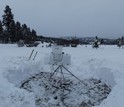
A radiometer from the University of Colorado measures how much supercooled liquid clouds contain.
Credit and Larger Version
The National Science Foundation (NSF)

Guillermo Gonzalo Sánchez Achutegui
ayabaca@gmail.com
ayabaca@hotmail.com
ayabaca@yahoo.com
Inscríbete en el Foro del blog y participa : A Vuelo De Un Quinde - El Foro!

viernes, 15 de enero de 2016

NSF : New NSF special report: Let It Snow! The Science of Winter .-

Hola amigos: A VUELO DE UN QUINDE EL BLOG., Nieve - ese icono de invierno - mantas de la tierra con un hermoso silencio. El amor o el odio, todos dependemos de nieve. Nuestro suministro de agua durante todo el año viene en gran parte de la nieve derretida.
Pero no somos los únicos que necesitan nieve.
Especies de hongos microscópicos y 800 libras-alces requieren como mucho, si no más. Sobreviven el invierno viviendo en iglú de la naturaleza: la nieve.
Y profusión de primavera de flores? Están fertilizados por nutrientes en la nieve.
Si usted está planeando para patinar en un lago congelado o río este invierno, a pie en una pendiente de nieve, o, cuando llega la primavera, dependerá de deshielo para llenar su depósito, puede que tenga que pensar dos veces.
El invierno está cambiando, cada vez menos como las estaciones frías podemos recordar. El "nuevo invierno" tiene consecuencias mucho más allá de diciembre a marzo. Afecta la primavera y el verano, también, incluyendo fechas de floración de plantas '- y especies como los colibríes que dependen de los tiempos de floración de precisión para el néctar.
More information...

Report reveals inner worlds of snow and winter, and their importance to humans and ecosystems

screenshot of website showing a snowflake and text let it snow the science of winter
Love it, hate it, we all depend on snow. In many areas, the year-round water supply depends on snow.
Credit and Larger Version
January 13, 2016
Snow -- that icon of winter -- blankets the land with a beautiful silence. Love it or hate it, we all depend on snow. Our year-round water supply largely comes from snowmelt.
But we're not the only ones who need snow.
Species from microscopic fungi to 800-pound-moose require it as much, if not more. They survive the winter by living in nature's igloo: snow.
And spring's profusion of flowers? They're fertilized by nutrients in snow.
If you're planning to skate on a frozen lake or river this winter, ski on a snowy slope, or, when spring arrives, depend on snowmelt to fill your reservoir, you may need to think twice.
 
A view of the new Winter


In celebration of snow and winter as we know it, and in a look at what winter may be like in the future, the National Science Foundation (NSF) has launched a new special report: Let It Snow! The Science of Winter.
The report focuses on projects supported largely by NSF's Directorate for Geosciences and Directorate for Biological Sciences/Division of Environmental Biology.
Grants from these areas fund research on subjects as diverse as measuring snowfall; tracking snowstorm "bombs," as whiteouts are known in meteorology; studying animals and plants that live beneath the snow in an ecosystem called the subnivian; searching for snowmelt, or "white gold"; and the bane of winter -- dust from the atmosphere that causes snow to melt before its time.
 
Go winter storm-chasing, enter nature's igloo
 
In the report, explore such topics as winter storm-chasing, a conifer tree's view of snow, life in nature's igloo, and where our winters have gone.
Watch a video of snowflakes photographed by a new high-speed camera, and another on the water that's locked in snow and ice: a zero sum game.
As you look out your window at a snow-covered landscape, or perhaps one that has been so in the past -- and even if you live below the snowline -- find out what scientists are learning about winter.
It matters, even if you never see a snowflake.
-NSF-

Media Contacts Cheryl Dybas, NSF, (703) 292-7734, cdybas@nsf.gov


The National Science Foundation (NSF) is an independent federal agency that supports fundamental research and education across all fields of science and engineering. In fiscal year (FY) 2016, its budget is $7.5 billion. NSF funds reach all 50 states through grants to nearly 2,000 colleges, universities and other institutions. Each year, NSF receives more than 48,000 competitive proposals for funding and makes about 12,000 new funding awards. NSF also awards about $626 million in professional and service contracts yearly.
 Get News Updates by Email 
Useful NSF Web Sites:
NSF Home Page:
 http://www.nsf.gov
NSF News:
http://www.nsf.gov/news/
For the News Media:
 http://www.nsf.gov/news/newsroom.jsp
Science and Engineering Statistics:
 http://www.nsf.gov/statistics/
Awards Searches:
 http://www.nsf.gov/awardsearch/
illustration showing 3 globes of continents and the jet stream and polar vortex
Can autumn snowfall in Siberia predict winter in the U.S. and Europe? Yes, say researchers.
Credit and Larger Version
illustration showing a satellite, mountains, forest and water
Scientists at NSF's Critical Zone Observatories study snowmelt and water resources.
Credit and Larger Version
illustration showing plants and animals under snow
A secret world, unseen by most humans, is alive beneath the surface of winter's snow.
Credit and Larger Version
a willow ptarmigan
The willow ptarmigan is one of many species that use snow as an insulating blanket.
Credit and Larger Version
frozen frog
How do wood frogs survive being frozen in winter? By living under the snow surface.
Credit and Larger Version

The National Science Foundation (NSF)
Guillermo Gonzalo Sánchez Achutegui
ayabaca@gmail.com
ayabaca@hotmail.com
ayabaca@yahoo.com
Inscríbete en el Foro del blog y participa : A Vuelo De Un Quinde - El Foro!

jueves, 14 de enero de 2016

NSF: Discovery Peering into the secret world of life beneath winter snows .- Mirando en el mundo secreto de la vida bajo las nieves del invierno

Hola amigos: A VUELO DE UN QUINDE EL BLOG.,  la Fundación de Ciencias de los Estados Unidos de América, the National Science Foundation (NSF), ha hecho un gran descubrimiento como viven la fauna y la flora, durante le crudo invierno en el Hemisferio Norte.
NSF, nos dice : La nieve cubre alrededor del 40 por ciento de las masas de tierra años de la Tierra tras año. Y, como los científicos están descubriendo, la nieve es crítica para los animales y plantas que viven en las latitudes del norte, así como aquellos en latitudes muy lejos del sur, como la Patagonia en la punta de América del Sur. Asegura su - y nuestra - la supervivencia.

"Sin la nieve, la vida vegetal y animal sería completamente diferente", dice el biólogo Jonathan Pauli de la Universidad de Wisconsin-Madison.

Pauli y científicos como Ben Zuckerberg, también de la Universidad de Wisconsin-Madison, son miembros de una nueva generación de investigadores llamados ecologistas invierno. El campo, que se centra en las relaciones entre los animales, plantas y sus entornos nevados, es relativamente nuevo.

"En comparación con otros hábitats, ecosistemas de nieve han sido escasamente explorado", dice Pauli. "Eso es un descuido importante, teniendo en cuenta la importancia de la nieve es en la vida de tantas especies."
More information.....

Snow sustains species from frogs to birds to mammals in winter and beyond
illustration showing plants and animals under snow
A secret world, unseen by most humans, is alive just beneath the winter snow.
Credit and Larger Version
January 5, 2016
Snow covers some 40 percent of Earth's land masses year in and year out. And, as scientists are discovering, snow is critical to animals and plants that live in northern latitudes, as well as those in far southern latitudes like Patagonia at the tip of South America. It ensures their -- and our -- survival.
"Without snow, plant and animal life would be completely different," says biologist Jonathan Pauli of the University of Wisconsin-Madison.
Pauli and scientists such as Ben Zuckerberg, also of the University of Wisconsin-Madison, are members of a new breed of researchers called winter ecologists. The field, which focuses on relationships among animals, plants and their snow-covered environments, is relatively new.
"Compared to other habitats, snow ecosystems have been barely explored," Pauli says. "That's a major oversight, considering how important snow is in the lives of so many species."
That list of species includes humans. Our spring and summer water resources depend heavily on meltwater from winter snows.
 
Nature's igloo
 
With a grant from the National Science Foundation (NSF)'s MacroSystems Biology Program, Pauli and Zuckerberg conduct research on what's called the subnivium, a seasonal and sensitive refuge beneath the snow's surface that's insulated and maintains a constant temperature. It's nature's igloo.
"We know very little about plants and animals that survive winter beneath the snow," says Liz Blood, a program director in NSF's Directorate for Biological Sciences. "This research is taking an innovative approach to studying the consequences of climate change on overwintering success of plants and animals in the subnivium."
What will happen if snow disappears in a warmer world?
Pauli and colleagues believe warming winters caused by climate change reduce the subnivium's duration, depth and insulation.
As a result of these altered conditions, they report in the journals Frontiers in Ecology and the Environment and PLOS One, the subnivium is showing more temperature variability and decreased -- not increased -- temperatures. Without enough snow, temperatures fall due to loss of insulation.
"In a warmer world with less snow, winter soils would be colder because the insulating snow layer on top is reduced," says Henry Gholz, a program director in NSF's Division of Environmental Biology. "That has implications for farmers planting crops in spring, as well as for the many burrowing mammals, microbes and insects that overwinter in snow."
The changes will have important implications for species that need the subnivium to survive, Zuckerberg says, "and will lead to large-scale shifts in their ranges."
Everything depends, adds Pauli, on having enough snow.
 
No two snowflakes, nor snows, alike
 
As children learn, no two snowflakes form in quite the same way. And, as northern peoples like the Inuit of Alaska know, nor are there two snows, nor snowfalls, exactly alike.
Annui, api, pukak. Qali, siqoq, kimoagruk. Upsik, qamaniq, siqoqtoaq -- these are the snow-words of the Inuit of northwestern Alaska. They've also become terms for snow used by many winter ecologists.
  • Perhaps you're reading this article nestled by a roaring fire, protected from the elements in a warm den or living room. Outside your icicle-laden window, you notice falling snow: annui.
  • Should you awaken one morning to snow covering the ground, you're seeing api.
  • Pukak is the layer at the bottom of a snow bank, "which is critical to the small mammals that live there in winter," Pauli says. "There's an entire world going on beneath the snow that we can't see."
  • Qali snow, nature's paintbrush, frosts the limbs of trees, and is no less ecologically important, providing shelter to birds and other animals seeking escape from the cold. The golden-crowned kinglet, for example, a tiny songbird of northern forests, survives winter's frigid nights because it can huddle under qali on conifer branches.
  • Trees whose branches are iced-over are said to be covered with kanik, and snow that swirls in whorls is siqoq. When those snows form drifts, they're known as kimoagruk.
  • Winter winds may eventually compact snow into a hard surface, called upsik, which offers a highway to animals like deer and moose that navigate best on hard-packed surfaces.
  • Qamaniq leaves hollows around the bases of trees; it offers shelter to birds such as ruffed and spruce grouse, and to snowshoe hares.
  • As spring arrives, it brings siqoqtoaq, "the sun crust" in the surface layer of snow that melts by day and re-freezes by night. In siqoqtoaq, microbes called snow algae, dormant during early winter months, bloom bright red and green.
Species need snow
 
Gazelles in the Gobi Desert in northern China and southern Mongolia rely on "snow mines," oases of water from melting snows buried beneath the sand. Other species use snow in ways that are just as resourceful.
Tiny mammals like shrews don't migrate but spend their winters in the subnivium. River otters slide down snowbanks and through openings in ice-covered waters to find fish. Gangly moose use snow as a footstools, to better reach tender shoots at the ends of branches. And some of the tiniest forms of life -- fungi and other microorganisms that live in and under the snow -- remain active throughout the winter.
Without fungi, wildflowers' summer bloom in mountain environments wouldn't happen. Fungi increase their metabolism as winter progresses, releasing nutrients from their by-products as snow melts in spring.
 
Snow research in a greenhouse
 
Since plants and animals depend on snow cover in winter, what lies ahead when the global climate's increased warmth has reduced snow levels?
"We should be very concerned about these changes," Pauli says.
He, Zuckerberg, Warren Porter of the University of Wisconsin-Madison and Brian McMahon of Operation Fresh Start are working to assess climate change effects on the sensitive subnivian habitat.
Using micro-greenhouses placed at sites in Wisconsin, Minnesota and Michigan, the ecologists mimic climate conditions predicted for the Great Lakes region by 2050. The micro-greenhouses automatically open when it snows, allowing a subnivium to form inside.
The research reveals how future subnivium conditions will affect the physiology, survival and distribution of species dependent on this realm-beneath-the-snow.
To date, micro-greenhouse experiments show that although ambient temperature within a micro-greenhouse is set at 5 degrees Celsius warmer than the temperature outside the greenhouse, "the natural daily minimum subnivium temperature drops significantly lower inside," Pauli says.
Translation: less snow is falling.
Without snow cover and its insulation, the greenhouse interior -- and its subnivian inhabitants such as hibernating amphibians -- are exposed to the winter cold.
"Our findings suggest climate change could have considerable effects on the refuge quality of the subnivium," Pauli says.
The future for plants and animals, including us, say Pauli and Zuckerberg, looks brightest as a white, not green, winter.
-- Cheryl Dybas, NSF (703) 292-7734
 cdybas@nsf.gov
Related Programs MacroSystems Biology
Related WebsitesNSF Grant: Warming Winters and Regional Implications for the Subnivean Climate: http://www.nsf.gov/awardsearch/showAward?AWD_ID=1340632&HistoricalAwards=false
NSF Discovery: The Search for White Gold: Snowmelt:
http://nsf.gov/discoveries/disc_summ.jsp?cntn_id=127580
NSF Discovery: The Depths of Winter: How Much Snow Is In Fact On the Ground?: http://www.nsf.gov/news/news_summ.jsp?cntn_id=123106
NSF Discovery: Dust-on-Snow: On Spring Winds, Something Wicked This Way Comes: http://www.nsf.gov/discoveries/disc_summ.jsp?cntn_id=116707
NSF Discovery: Inside a Snowstorm: Scientists Obtain Close-Up Look at Old Man Winter: http://www.nsf.gov/news/news_summ.jsp?cntn_id=118365
NSF Discovery: A Tree Stands in the Sierra Nevada: The Link Among Conifers, Snowmelt and Water Resources:
 http://www.nsf.gov/discoveries/disc_summ.jsp?cntn_id=125091&org=NSF
Video: Snow in warming winters:
 https://vimeo.com/134676387
a willow ptarmigan
The willow ptarmigan is a common resident of the subnivium; it uses snow as an insulating blanket.
Credit and Larger Version
frozen wood frog on snow
How do wood frogs survive being frozen in winter? By living under the snow surface.
Credit and Larger Version
A winter ecologist peers beneath the subnivium and into the den of a porcupine living there.
A winter ecologist peers beneath the subnivium and into a porcupine den.
Credit and Larger Version
map of north america showing snwo cover
The depth and extent of snow cover in North America are rapidly decreasing, affecting the subnivium.
Credit and Larger Version
A micro-greenhouse and research equipment in the field with snow
A micro-greenhouse can reproduce climate change's effects on the world under snow.
Credit and Larger Version
the National Science Foundation (NSF)
Guillermo Gonzalo Sánchez Achutegui
ayabaca@gmail.com
ayabaca@hotmail.com
ayabaca@yahoo.com
Inscríbete en el Foro del blog y participa : A Vuelo De Un Quinde - El Foro!

domingo, 9 de noviembre de 2014

NASA : Early Snow on the Great Smokies .- Nieve temprana en las Grandes Montañas Humeantes

Hola amigos: A VUELO DE UN QUINDE EL BLOG., la Agencia Espacial NASA, nos informa sobre la temprana caía de nieve en diferentes lugares de las grandes montañas de Los Estados Unidos y Canadá.............." Un sistema meteorológico potente con orígenes en Manitoba, Canadá se trasladó al sur a través de los Grandes Lagos en Halloween y voló todo el camino a la Florida, trayendo nieve y las heladas difícil regiones, que o bien no se pueden  ver en algunos inviernos. A continuación, el sistema de tormenta se movió de nuevo hasta la costa este de los Estados Unidos y Nueva Inglaterra golpeó con un Noreste....................
Esta imagen muestra el sur de cordillera de los Apalaches, a lo largo de la frontera de Tennessee, Carolina del Norte y Carolina del Sur, el color de la caída se convirtió a blanco invierno. La imagen de color natural fue adquirida por el Visible Infrared Imaging Suite de radiómetro en el satélite Suomi NPP el 2 de noviembre de 2014.....................
Seis pulgadas de nieve cayeron en Asheville, Carolina del Norte, donde la nieve no cae lo general antes de Navidad. Superior en las montañas, cerca de Gatlinburg, Tennessee, Leconte Logia (elevación 6.400 pies) reportó 22 centímetros de nieve y temperaturas de 9 grados Fahrenheit. En Columbia, Carolina del Sur, la nieve mensurable cayó nueve días antes de que se haya registrado para Que la ciudad................."


Early Snow on the Great Smokies
A potent weather system with origins in Manitoba, Canada moved south across the Great Lakes on Halloween and blew all the way to Florida, bringing snow and hard frost to regions that do not see either in some winters. The storm system then moved back up the U.S. East Coast and pounded New England with a Nor'easter.
This image shows the southern Appalachian Mountain range, along the border of Tennessee, North Carolina, and South Carolina, as fall color was turned to winter white. The natural-color image was acquired by the Visible Infrared Imaging Radiometer Suite on the Suomi NPP satellite on Nov. 2, 2014.
Six inches of snow fell in Asheville, North Carolina, where snow usually doesn't fall before Christmas. Higher in the mountains, near Gatlinburg, Tennessee, LeConte Lodge (elevation 6400 feet) reported 22 inches of snow and temperatures of 9 degrees Fahrenheit. In Columbia, South Carolina, measurable snow fell nine days earlier than ever recorded for that city.
Image Credit: NASA Earth Observatory
NASA
Guillermo Gonzalo Sánchez Achutegui
Inscríbete en el Foro del blog y participa : A Vuelo De Un Quinde - El Foro!

domingo, 28 de abril de 2013

nsf.gov - Discovery - Trail of Fire Leads to Less Snow, Threatened Water Resources

Hi My Friends: A VUELO DE UN QUINDE EL BLOG., We have received information of the scientific of the National Science Foundation(NSF) about the origin of the forest fires, which happened in New Mexico's Jemez River Basin on June 26, 2011, at 1 p.m. local time......
They said........."The following is part seven in a series on the National Science Foundation's Critical Zone Observatories (CZO) Network. Visit part one, part two, part three, part four, part five and part six.
If a tree falls in a forest and no one is around to hear it, does it make a sound?
The answer is yes, if it happened in New Mexico's Jemez River Basin on June 26, 2011, at 1 p.m. local time.
The tipping of one tree as it creaked and fell hinted at a crackle soon to come, a fast-burning wildfire. Ultimately, the fire blazed through a large part of a 1.5 million-acre national forest...."
Also they said......."To find out, scientists at the National Science Foundation (NSF) Jemez River Basin and Santa Catalina Mountains Critical Zone Observatory (CZO), one of six such NSF CZOs in watersheds across the country, lit out for the hills.
The Jemez River Basin and Santa Catalina Mountains CZO is formed by twin sites: one in the Jemez River Basin in the Valles Caldera National Preserve north of Albuquerque, N.M., in the greater Rio Grande Basin; the other in the Santa Catalina Mountains northeast of Tucson, Ariz., in the Colorado River Basin....."
 I invite them to read the original version in its entirety............

 Photo of smoke from a forest fire going up in to the sky

New Mexico's 2011 Las Conchas Fire as it races down the flanks of the Jemez Mountains.
Credit: Wikimedia Commons
Download the high-resolution JPG version of the image. (247 KB)
 Burned tress at NSF's Jemez River Basin CZO and the Valles Caldera National Preserve.

Ghosts of the forest stand guard over NSF's Jemez River Basin Critical Zone Observatory and the Valles Caldera National Preserve.
Credit: Valles Caldera National Preserve
Download the high-resolution JPG version of the image. (690 KB)

 On Rabbit Mountain, N.M., scientists ski through the healthy forest
On Rabbit Mountain, N.M., scientists survey slopes with unburned healthy forests.
Credit: Paul Brooks
Download the high-resolution JPG version of the image. (157 KB)
 
Scientist skis through the burned forest

A comparison survey of Rabbit Mountain's badly burned forests.
Credit: Paul Brooks
Download the high-resolution JPG version of the image. (102 KB)
 Scientist Adrian Harpold digs out an instrument used to measure snowmelt chemistry.
Scientist Adrian Harpold digs out an instrument used to measure snowmelt chemistry.
Credit: Allison Peterson
Download the high-resolution JPG version of the image. (27 KB)
 Paul Brooks collects snow samples
Paul Brooks collects samples for snow density, chemistry, and physical structure.
Credit: Brian Chaszar
Download the high-resolution JPG version of the image. (1 MB)

The following is part seven in a series on the National Science Foundation's Critical Zone Observatories (CZO) Network. Visit part one, part two, part three, part four, part five and part six.
If a tree falls in a forest and no one is around to hear it, does it make a sound?
The answer is yes, if it happened in New Mexico's Jemez River Basin on June 26, 2011, at 1 p.m. local time.
The tipping of one tree as it creaked and fell hinted at a crackle soon to come, a fast-burning wildfire. Ultimately, the fire blazed through a large part of a 1.5 million-acre national forest.
On the day the fire started, strong, unpredictable winds blew through the trees, rustling leaves and creaking dead wood. Perhaps in a gust, a lone tree fell. On the way down, it took out a power line and sparked a fire that--by high noon the next day--had burned 43,000 acres, an acre every two seconds.
At sundown that next day, the Las Conchas Fire, as it came to be called, still ran wild. The toll had climbed to more than 61,000 acres of forest. Egged on by north winds, it jumped the trails of Pajarito Mountain Ski Area. Then it turned and raged south, threatening the town of Cochiti, N.M.
Within four days, it had singed more than 103,000 acres, making it the largest fire in New Mexico history at the time.
The forest and the watershed--the critical zone--left behind
What happened to the forests, rivers and streams the Las Conchas Fire left behind?
To find out, scientists at the National Science Foundation (NSF) Jemez River Basin and Santa Catalina Mountains Critical Zone Observatory (CZO), one of six such NSF CZOs in watersheds across the country, lit out for the hills.
The Jemez River Basin and Santa Catalina Mountains CZO is formed by twin sites: one in the Jemez River Basin in the Valles Caldera National Preserve north of Albuquerque, N.M., in the greater Rio Grande Basin; the other in the Santa Catalina Mountains northeast of Tucson, Ariz., in the Colorado River Basin.
In addition to the Jemez River Basin and Santa Catalina Mountains site in New Mexico and Arizona, NSF CZOs are located in the Southern Sierra Nevada, Christina River Basin on the border of Delaware and Pennsylvania, Susquehanna Shale Hills in Pennsylvania, Boulder Creek in the Colorado Rockies, and Luquillo National Forest in Puerto Rico.
CZO scientists provide a new understanding of the critical zone--the thin veneer of Earth that extends from the top of the forest canopy to the base of weathered bedrock.
At the Jemez River and Santa Catalina Mountains CZO, researchers are asking questions such as: How does climate variation affect arid and semi-arid ecosystems? And, how do feedbacks between critical zone structure and the cycling of water and carbon alter short-term hydrology and long-term landscape evolution?
The water cycle, the breakdown of rocks and the eventual formation of soil, the evolution of rivers and valleys, the patterns of plant growth and landforms, all result from processes that take place in the critical zone.
"The critical zone is our living environment," says Enriqueta Barrera, program director in NSF's Division of Earth Sciences, which funds the CZO network. "The CZOs offer us new knowledge about this important zone and its response to climate and land-use change."
The CZOs are the first systems-based observatories dedicated to understanding how Earth's surface processes are coupled, she says. "They will help us predict how the critical zone affects the ecosystem services on which society depends."
Fire burns long after it's out
Water is at the top of that list of ecosystem services.
The freshwater supplies of the American West rely, for the most part, on snow.
As snow melts into water, it begins a journey that starts in the mountains and ends in faucets. When people turn on the shower or the sprinkler, they're watering themselves, lawns and food crops with melted snow.
The Colorado River, the Rio Grande and other rivers in the intermountain west are the main sources of water for some of the driest parts of the country, say Jemez River Basin and Santa Catalina Mountains CZO scientists Jon Chorover and Paul Brooks of the University of Arizona and Adrian Harpold of the University of Colorado.
"Their flows are predominantly fed by snowmelt from high-elevation forests and meadows," says Brooks.
Snow-covered forests are "a critical source of water in the western U.S.," agrees Chorover. "Forests' ability to 'hold snow' can be affected by fires, tree diseases, insect-caused die-offs and other factors."
The Las Conchas Fire provided a unique opportunity to "evaluate how forest fires interact with a changing climate," says Harpold, first author of a recent paper on the fire's effects on winter snow and spring snowmelt published in the journal Ecohydrology. Brooks and other scientists are co-authors.
"Forest fires have been increasing in size and severity for the last several decades," Harpold says. "Drier and warmer than average conditions in New Mexico in 2011 contributed to fires like Las Conchas.
"When the fire removed the forest canopy, more water vapor was lost from the snow surface to the dry atmosphere, reducing the amount of water stored in the snowpack and released the following spring."
In essence, the scientists found, areas not burned in the fire retained more snow--and snowmelt water.
Into the Valles Caldera
The Valles Caldera National Preserve, it's called, a parkland that surrounds the Valles Caldera, a 13.7 mile wide volcanic caldera in the Jemez Mountains of northern New Mexico. The preserve overlaps the Jemez River Basin CZO.
Valles Caldera National Preserve was the site of the scientists' study; their research was conducted on Rabbit Mountain near the park's southern boundary.
In November 2011, the researchers placed instruments in several catchments, or river basins, on Rabbit Mountain. The resulting information is being used to better understand the effects of fire on the water, carbon and energy cycles of the entire Jemez River Basin.
"The Jemez River Basin CZO is perfectly situated to learning how fire affects water resources," says Brooks.
In the winter and spring of 2012, Brooks and Harpold, along with other researchers and students, collected and analyzed thousands of data points on snow depth and density in burned and unburned forests on Rabbit Mountain.
"We obtained one of the most complete data sets to date on snow hydrology and fire," says Brooks.
Spruce-fir forests dominate Rabbit Mountain's heights; ponderosa pines and oak scrublands cover the lower mountain.
Whether in spruce-fir or pine-oak, the Las Conchas Fire left much of Rabbit Mountain with severe burns. Dead, limbless trees, ghosts of the forest, line the horizon.
In unburned forests, about one-third of the fresh snow that fell in the winter of 2012 was caught in trees before it reached the ground. There shade and wind protection allowed it to accumulate over the winter.
Where trees were lost to the fire, more fresh snowfall made it to the ground. In the end, however, that was a double-edged sword: lack of shelter from the forest canopy resulted in more of the snowpack disappearing over the winter.
"Such changes in snowpack depth have important ramifications," says Chorover, "for ecological health and for downstream water resources."
After the Las Conchas Fire, if a tree falls in the forest and no one is around to hear it, does it make a sound?
If you're listening for burbling spring brooks or streaming kitchen faucets, you may hear nothing but drip, drip, drip. Or silence.
--  Cheryl Dybas, NSF (703) 292-7734   cdybas@nsf.gov
Related Websites
NSF Critical Zone Observatory Network:
 http://criticalzone.org/national/
NSF Jemez River Basin and Santa Catalina Mountains CZO:
 http://criticalzone.org/jemez-catalina/
NSF News Release: How Is Earth's Water System Linked With Land Use, Climate Change and Ecosystems?:
 http://www.nsf.gov/news/news_summ.jsp?cntn_id=125434&org=NSF&from=news
NSF Publication: Discoveries in Sustainability:  
 The National Science Foundation (NSF)
Guillermo Gonzalo Sánchez Achutegui
ayabaca@gmail.com
ayabaca@hotmail.com
ayabaca@yahoo.com
Inscríbete en el Foro del blog y participa : A Vuelo De Un Quinde - El Foro!

Mi lista de blogs