sábado, 12 de mayo de 2012

La Historia del Amor Cruel: Capítulo L.- Mónica recibe asesoramiento del ginecólogo para su entrevista con las autoridades unviversitarias sobre su enfermedad

Hola amigos: A VUELO DE UN QUINDE EL BLOG., continuando con la Historia del Amor Cruel entre Iarma y Olzagon, y como informamos en el capítulo anterior Mónica se enteró por medio de su amiga Simone de todo el proceso de su Cuadro Clínico, que lamentablemente terminó con un Legrado, perdiendo su feto en formación y del apoyo recibido por el ginecólogo, y como se presume, quien además se ha enamorado de ella; al menos así lo ha demostrado al ocultar muy secretamente el motivo de la intervención quirúrgica que me sometida Mónica.


Aquí en la imagen observamos una típica representación de la terrible situación que muchos hogares atraviesan en el transcurso de existencia por que siempre hay la existencia de un tercer elemento (amante tanto para él como para ella) que como una tentación tenebrosa carcomen las consistencias del matrimonio, y más si los esposos viven solamente la apariencia y no la triste realidad de que no son felices. Fuente: Archivos del blog. Obra Literaria reconocida con Derechos de Autor, según Partida Registral No. 00855-2012, Asiento: 01; con fecha: 10 de Agosto de 2012, por : INDECOPI.

Mónica, abandonó su hospitalización después de 8 días de recuperación y con la ayuda del ginecólogo, a quien vamos a llamar: Jacques Mitter; éste Galeno se acercó a la oficina de la madrona para pedirle su autorización para visitar a la paciente Mónica, y poder finalizar con los últimos chequeos médicos que se harán en su dormitorio; incluso dándole seguridades, le pidió que ella presencie la atención médica; era una desmesurada cortesía del Galeno, por que la madrona rehusó aceptar, ya que ella conocía el profesionalismo de todos los médicos asignados al tópico de la Universidad, justamente él necesitada no tenerla presente y lo logró.
Jacques, teniendo el camino libre, fue llevado por la madrona hasta el dormitorio 69, que era el hospicio  de Mónica, los visitantes tocaron la puerta y la huésped quien les abrió y ella tuvo mucha sorpresa al ver al médico y su madrona, se saludaron y la madrona le informó que el médico iba atenderla por última vez y en privado.
Mónica, sintió un tremendo remezón en todo su cuerpo como reacción al suponer  que la noticia del aborto ya era pública - pensamientos falsos-; por que sólo el Galeno y Simone lo sabían. En seguida la madrona se retiró y dejó al médico con su paciente.
Mónica, hizo  pasar al médico a su dormitorio lo invitó a sentarse sobre la silla y empezó el diálogo, comenzando el médico,quien dijo:
--- Mónica, mañana temprano tienes que asistir a: Departamento de Asistencia Social para Estudiantes, es una oficina llena de burócratas que sólo les gusta fisgonear la vida privada de los estudiantes con el fin dizque: "Prestar la ayuda en sus necesidades apremiantes", que incluye naturalmente la asistencia médica en todos los niveles y estados de salud. Eso es justamente lo que nos concierne a nosotros, y como tu caso es muy delicado por los mojigatos reglamentos universitarios, que en vez de ayudar, mortifican y hasta degradan la reputación del paciente, por que dejan al libre albedrío del inspector en su ejecución, que en muchos de los casos obra por reacción y no por la acción según las normas.- entonces - para ellos es inaceptable que una joven estudiante   que acaba de llegar a la sede universitaria se vea afectada por un aborto, siendo soltera......
El médico, sabiendo lo delicado del asunto y que estaba avergonzando a Mónica, sin proponérselo, sino que tenía que hablar sobre el incidente incómodo y agregó: 
--- Como médico te atendí, hice lo correcto y en ningún momento estuvo en peligro tu vida, ahora lo preocupante para mi y tal vez lo más correcto en fundamentar mis hipótesis es argumentar que fuiste víctima de una : "fecundación non coito", es un caso muy raro, pero es posible que suceda y consiste en que estuviste en una cama que antes hubo una pareja haciendo al amor y dejaron residuos de espermatozoides y tu después te acostaste desnuda en la misma cama y sin saberlo tu vulva rozó con estos residuos y atrapó a un espermatozoides aún vivo y se introdujo al ovario y te fecundó.......
El Galeno hizo una pausa y continuó:
--- La segunda hipótesis es que al sufrir el desmayo en el baño caíste de bruces sobre algo duro que en ese momento te involucró tus genitales que te ocasión hemorragia vaginal. Estos dos argumentos los he pensado muy bien por lo que deseo colaborar contigo y evitar las sorpresas de los "sabuesos burócratas", y si todo esto no expone por lo contrario se mantendrá el "informe inicial" que la desmayarte, tu cabeza sufrió un duro golpe que te privó del conocimiento y con hemorragias vaginales y  necesitabas un largo reposo para tu recuperación final.
Mónica, en efecto estaba avergonzada escuchando al médico y como él, la miraba con ternura y ella empezó a verlo como un hombre; en aquel instante recordó al causante de sus apuros en París y también le vino a la mente que le otorgó total libertad para que ella decida lo mejor que pueda hacer en París, insistió que ella deje de pensar en el romance que dejó en Cunante.
Mónica, sopesó en aquel instante que se le abría una puerta que ella no quería que se cierre en momentos que tanto necesitaba el apoyo para solucionar los hechos embarazosos que le acontecían y contestó:
--- Doctor Jacques, creo que nunca estuve mejor protegida en momentos álgidos para mi vida, sino hubiese estado usted allí; aprecio sobremanera su atención médica y sobretodo el delicado asunto que presentó mi cuadro clínico, en todo caso tengo que hablar la verdad a usted: ... días antes de viajar a este país, tuve encuentros amorosos con  un joven que cautivó mi corazón que hasta ese momento yo sentía odio a los hombres por que fui víctima de una violación a la edad de 15 años de edad con el claro consentimiento de mis padres, por el individuo causante pertenece a su círculo social.......
Mónica, hace una pausa y continuó:
.... Dado el furor que disfruté junto a Olzagon, olvidé tomar mis precauciones para evitar el embarazo; al mismo tiempo en aquellos instantes hubo un concurso en mi universidad para estudiar un post grado en La Sorbona y lo gané, todo se juntó al mismo tiempo, sin darme un lapso para razonar; que sin embargo, sentí la mayor felicidad que haya tenido en toda mi existencia junto a mi amado, con la clara oposición de mis padres que lo odiaban como mi pareja; él me felicitó por la emigración y fue tan generoso que me otorgó libertad absoluta para que yo decida mi vida afectiva en esta ciudad, y es más, me pidió que olvidara para siempre nuestro romance; aún así le prometí escribirle, carta que aún no termino por que me enfermé....
Mónica, se tomó un nuevo descanso... y prosiguió:.........
... Realmente no estuve consciente de mi fecundación, no había seguridad que eso hubiese sucedido, por que lo tomé con un retraso menstrual, y como usted está viendo estuve muy equivocada en mi "regla", por lo que estoy en deuda con usted doctor y le prometo enmienda total en esta universidad, si usted llega salvar la estadía de mi persona;  en estos momentos solo tengo palabras  de mi eterno agradecimiento y mi gratitud por siempre para usted: "Gracias Doctor"
Jacques, quien era un médico muy profesional en su trabajo, pero también tenía su corazón que estaba huérfano de amor; por que tanto tiempo lo dedicó al estudio, que "olvidó" buscar a alguien que abrigue a su corazón con afecto y dulzura amorosa y justo al conocer a Mónica, se le presentó la oportunidad que tanto había esperado, por que además, de ser soltera, ella era una estudiante muy centrada y sobretodo "Liberada de traumas psíquicos" y estaba en plena maduración como mujer; pues bien valía la pena intentar iniciar un romance que tendría que desarrollarse con mucho tino, por que, él, era el profesional que ayudaba a su paciente a superar sus dolencias y no aparecer como un interesado en lograr sacar ventaja para seducirla como su pareja.
Todo indica, que se avecinan nuevos tiempos para Mónica en París y con esta reflexión terminamos este ardoroso amorío y dejamos que Mónica rehaga nuevos romances y nosotros regresamos a Cunante, para pulsar en que situación se encuentra Olzagon.....
Continuaremos.......
Guillermo Gonzalo Sánchez Achutegui
ayabaca@gmail.com
ayabaca@hotmail.com
ayabaca@yahoo.com

viernes, 11 de mayo de 2012

Ciencia: Una gran ceremonia marina anuncia la Expo de Yeosu 2012

Hola amigos: A VUELO DE UN QUINDE EL BLOG.,Unas 2.400 personas asistieron hoy a una colorida ceremonia frente al mar en la ciudad surcoreana de Yeosu previa a la apertura mañana, sábado, de la Exposición Internacional 2012, dedicada a la conservación de las costas y océanos.
Foto: EFE/JEON HEON-KYUN

Tras el concierto tomó el escenario la bandera de Corea del Sur, a lo que siguió un desfile de las banderas nacionales de los países presentes en la Expo 2012, que lleva el lema “Por unos océanos y costas vivas”.
El discurso de bienvenida estuvo a cargo del secretario general de la Oficina Internacional de Exposiciones (BIE), el español Vicente Loscertales, que deseó el éxito del evento celebrado en esta ciudad de poco más de 300.000 habitantes.
Posteriormente, el presidente surcoreano, Lee Myung-bak, declaró inaugurada la Expo de Yeosu 2012, y a sus palabras siguió un espectáculo de fuegos artificiales sobre el mar que desató calurosas ovaciones, igual que las actuaciones posteriores de grupos del llamado “K-pop”, el popular pop coreano.Noticias 24
(Yeosu, 11 mayo. EFE) Entre música en vivo y fuegos artificiales, la Exposición Internacional de Yeosu 2012 celebró hoy su ceremonia inaugural para marcar el comienzo mañana, sábado, de tres meses dedicados a la conservación de las costas y océanos.
El evento tuvo lugar en un gran escenario flotante de 250 hectáreas sobre las aguas marinas que bañan el espacio ferial, donde se levantan los pabellones de los 104 países que participan en la cita de Yeosu, heredera de la Expo de Zaragoza (España) en 2008.
Una muestra de veleros y acrobacias marinas abrió la ceremonia ante unos 2.400 espectadores, que desde las gradas disfrutaron después de un recital de música clásica a cargo de la Orquesta Viento del Océano (“Ocean Wind Orchestra”) que comenzó con el emblemático sonido de un órgano imitando a un barco que zarpa. Noticias 24

Visitantes del acuario de la Exposición Internacional de Yeosu, en Corea, a 300 kilómetros de Seúl, este miércoles 9 de mayo de 2012. La Expo, cuyo lema es "Por unos océanos y costas vivas", apunta a la recuperación de la zonas marinas y ecosistemas oceánicos depauperados, su integración racional a un sistema productivo sostenible y al intercambio de conocimiento científico sobre el Cambio Climático. Yeosu 2012 abre sus puertas el 12 de mayo y se extenderá hasta el 12 de agosto, periodo durante el que espera recibir cerca de diez millones de visitantes de todo el mundo, especialmente Japón y China. EFE/YONHAP .
 
Yeosu (Corea del Sur), 11 may (EFEverde).- Unas 2.400 personas asistieron hoy a una colorida ceremonia frente al mar en la ciudad surcoreana de Yeosu previa a la apertura mañana, sábado, de la Exposición Internacional 2012, dedicada a la conservación de las costas y océanos.

Por un gran escenario instalado en la costa de esta ciudad portuaria desfilaron a última hora de hoy grupos musicales, bailarines y artistas, con coreografías que evocaban los océanos y costas, cuya conservación es el tema principal de la exposición.
La gala de Yeosu, a unos 450 kilómetros de Seúl, estuvo presidida por el jefe del Gobierno surcoreano, Lee Myung-bak, quien en una cena oficial antes del evento expresó su confianza en que la feria sirva para dar a conocer la belleza del litoral surcoreano.
La cita, que toma el testigo de la Exposición Internacional celebrada en Zaragoza (España) en 2008, tiene el lema de "Por unos océanos y costas vivas" y busca impulsar el desarrollo de un crecimiento económico "verde" sustentado en los recursos del mar y su explotación y protección cooperativa.
El objetivo de los organizadores es atraer en los próximos tres meses a unos ocho millones de visitantes, en buena parte provenientes de Japón y China, a las 25 hectáreas sobre las que se asientan los pabellones de 104 países y 10 organizaciones participantes.
Cuidado medioambiental y energías limpias 
interior del pabellón de españa en la expo de Yeosu (Corea del Sur)
Foto/EFE/Atahualpa Amerise
Para las instalaciones de la feria se han invertido cerca de 1.900 millones de dólares, sin contar el gasto e infraestructuras de comunicaciones, y en su construcción se han seguido guías de prácticas medioambientales que aseguran el origen de los materiales, controlan el gasto de recursos y favorecen las energías limpias.
En la Expo 2012 España participa con un pabellón de unos 1.000 metros cuadrados que busca impactar a los visitantes con una combinación de imágenes, colores y luces que describen la estrecha relación histórica y científica entre España y el mar.
Entre los 12 participantes latinoamericanos se encuentran países como Argentina, México, Uruguay y Perú, cuyo pabellón será inaugurado mañana, sábado, por el presidente Ollanta Humala, que se encuentra de visita oficial en Corea del Sur. EFEverde
Guillermo Gonzalo Sánchez Achutegui
ayabaca@gmail.com
ayabaca@hotmail.com
ayabaca@yahoo.com
Inscríbete en el Foro del blog y participa : A Vuelo De Un Quinde - El Foro!

jueves, 10 de mayo de 2012

Astronomy: NASA Spacecraft Detects Changes in Martian Sand Dunes

Hi My Friends: A VUELO DE UN QUINDE EL BLOG., NASA's Mars Reconnaissance Orbiter has revealed that movement in sand dune fields on the Red Planet occurs on a surprisingly large scale, about the same as in dune fields on Earth.
Ripple Movement on Sand Dune in Nili Patera, Mars
Back-and-forth blinking of this two-image animation shows movement of ripples covering a sand dune on Mars. The images are part of a study published by Nature on May 9, 2012, reporting movement of Martian sand dunes at about the same flux (volume per time) as movement of dunes in Antarctica on Earth.

The before-and-after images were taken 15 weeks apart by the High Resolution Imaging Science Experiment (HiRISE) camera on NASA's Mars Reconnaissance Orbiter. The scale bar is 85 meters (279 feet). The site is part of a dune field inside the summit caldera of Nili Patera, an ancient volcano, at 8.7 degrees north latitude, 67.3 degrees east longitude.

The images show a dark, rippled sand dune overlying bright-toned rock. They have been "orthorectified," that is, adjusted such that they appear as if viewed from directly overhead. They were then positionally tied together by registering fixed features on the bedrock seen in one image to the same features seen in the other. When the images are blinked back and forth, ripple motion during the intervening period of 105 days is clearly seen.

The first image, in which the side of the dune toward the bottom of the frame looks paler due to lighting effects, was taken on June 30, 2007. It is one image product of HiRISE observation PSP_004339_1890. Other image products from the same observation are at http://hirise.lpl.arizona.edu/PSP_004339_1890 . The "after" image was taken on Oct. 13, 2007. Other image products from the same HiRISE observation are at http://hirise.lpl.arizona.edu/PSP_005684_1890 .

HiRISE is one of six instruments on NASA's Mars Reconnaissance Orbiter. The University of Arizona, Tucson, operates the orbiter's HiRISE camera, which was built by Ball Aerospace & Technologies Corp., Boulder, Colo. NASA's Jet Propulsion Laboratory, a division of the California Institute of Technology in Pasadena, manages the Mars Reconnaissance Orbiter Project for the NASA Science Mission Directorate, Washington.

Image Credit: NASA/JPL-Caltech/Univ. of Arizona/JHU-APL


PASADENA, Calif. -- NASA's Mars Reconnaissance Orbiter has revealed that movement in sand dune fields on the Red Planet occurs on a surprisingly large scale, about the same as in dune fields on Earth.
This is unexpected because Mars has a much thinner atmosphere than Earth, is only about one percent as dense, and its high-speed winds are less frequent and weaker than Earth's.
For years, researchers debated whether sand dunes observed on Mars were mostly fossil features related to past climate, rather than currently active. In the past two years, researchers using images from Mars Reconnaissance Orbiter's High Resolution Imaging Science Experiment (HiRISE) camera have detected and reported sand movement.
Now, scientists using HiRISE images have determined that entire dunes as thick as 200 feet (61 meters) are moving as coherent units across the Martian landscape. The study was published online today by the journal Nature.
"This exciting discovery will inform scientists trying to better understand the changing surface conditions of Mars on a more global scale," said Doug McCuistion, director, NASA's Mars Exploration Program, Washington. "This improved understanding of surface dynamics will provide vital information in planning future robotic and human Mars exploration missions."
Researchers analyzed before-and-after images using a new software tool developed at the California Institute of Technology (Caltech) in Pasadena, Calif. The tool measured changes in the position of sand ripples, revealing the ripples move faster the higher up they are on a dune.
The study examined images taken in 2007 and 2010 of the Nili Patera sand dune field located near the Martian equator. By correlating the ripples' movement to their position on the dune, the analysis determined the entire dunes are moving. This allows researchers to estimate the volume, or flux, of moving sand.
"We chose Nili Patera because we knew there was sand motion going on there, and we could quantify it," said Nathan Bridges, a planetary scientist at Johns Hopkins University Applied Physics Laboratory in Laurel, Md., and lead author of the Nature paper. "The Nili dunes also are similar to dunes in places like Antarctica and to other locations on Mars."
The study adds important information about the pace at which blowing sand could be actively eroding rocks on Mars. Using the new information about the volume of sand that is moving, scientists estimate rocks in Nili Patera would be worn away at about the same pace as rocks near sand dunes in Antarctica, where similar sand fluxes occur.
"Our new data shows wind activity is indeed a major agent of evolution of the landscape on Mars," said Jean-Philippe Avouac, Caltech team leader. "This is important because it tells us something about the current state of Mars and how the planet is working today, geologically."
Scientists calculate that if someone stood in the Nili Patera dunes and measured out a one-yard (one-meter) width, they would see more than two cubic yards (1,500 liters) of sand pass by in an Earth year, about as much as in a child's sand box.
"No one had estimates of this flux before," said Bridges. "We had seen with HiRISE that there was dune motion, but it was an open question how much sand could be moving. Now, we can answer that."
Scientists will use the information to understand broader mysteries on Mars, like why so much of the surface appears heavily eroded, how that occurred, and whether it is a current process or it was done in the past. Scientists can now point to sand flux as a mechanism capable of creating significant erosion today on the Red Planet.
The HiRISE camera provides unprecedented resolution in studying the Martian landscape. NASA's Jet Propulsion Laboratory, Pasadena, Calif., a division of Caltech, manages the Mars Reconnaissance Orbiter for NASA's Science Mission Directorate in Washington. Lockheed Martin Space Systems, Denver, built the spacecraft. HiRISE is operated by the University of Arizona and was built by Ball Aerospace & Technologies Corp., Boulder, Colo.
For related images and more information about Mars Reconnaissance Orbiter, visit: http://www.nasa.gov/mro .
Guillermo Gonzalo Sánchez Achutegui
ayabaca@gmail.com
ayabaca@hotmail.com
ayabaca@yahoo.com
Inscríbete en el Foro del blog y participa : A Vuelo De Un Quinde - El Foro!

Astronomy: Overfed Black Holes Shut Down Galactic Star-Making

Hi My Friends: A VUELO DE UN QUINDE EL BLOG., The Herschel Space Observatory has shown galaxies with the most powerful, active black holes at their cores produce fewer stars than galaxies with less active black holes. The results are the first to demonstrate black holes suppressed galactic star formation when the universe was less than half its current age. He
rschel is a European Space Agency-led mission with important NASA contributions.

This artistically modified image of the local galaxy Arp 220, captured by the Hubble Space Telescope, helps illustrate the Herschel results. Image credit: NASA/JPL-Caltech     › Full image and caption

Download Image

› Full Size
› 1600 x 1200
› 1024 x 768
› 800 x 600

Artist's Concept - Active Black Hole Squashes Star Formation

The Herschel Space Observatory has shown that galaxies with the most powerful, active, supermassive black holes at their cores produce fewer stars than galaxies with less active black holes.

Supermassive black holes are believed to reside in the hearts of all large galaxies. When gas falls upon these monsters, the materials are accelerated and heated around the black hole, releasing great torrents of energy. In the process, active black holes often generate colossal jets that blast out twin streams of heated matter.

Inflows of gas into a galaxy also fuel the formation of new stars. In a new study of distant galaxies, Herschel helped show that star formation and black hole activity increase together, but only up to a point. Astronomers think that if an active black hole flares up too much, it starts spewing radiation that prevents raw material from coalescing into new stars.

This artistically modified image of the local galaxy Arp 220, captured by the Hubble Space Telescope, helps illustrate the Herschel results. The bright core of the galaxy, paired with an overlaid artist's impression of jets emanating from it, indicate that the central black hole's activity is intensifying. As the active black hole continues to rev up, the rate of star formation will, in turn, be suppressed in the galaxy. Astronomers want to further study how star formation and black hole activity are intertwined.
Image credit: NASA/JPL-Caltech

PASADENA, Calif. -- The Herschel Space Observatory has shown galaxies with the most powerful, active black holes at their cores produce fewer stars than galaxies with less active black holes. The results are the first to demonstrate black holes suppressed galactic star formation when the universe was less than half its current age. He
rschel is a European Space Agency-led mission with important NASA contributions.
"We want to know how star formation and black hole activity are linked," said Mathew Page of University College London's Mullard Space Science Laboratory in the United Kingdom and lead author of a paper describing these findings in this week's journal Nature. "The two processes increase together up to a point, but the most energetic black holes appear to turn off star formation."
Supermassive black holes, weighing as much as millions of suns, are believed to reside in the hearts of all large galaxies. When gas falls upon these monsters, the material is accelerated and heated around the black hole, releasing great torrents of energy. Earlier in the history of the universe, these giant, luminous black holes, called active galactic nuclei, were often much brighter and more energetic. Star formation was also livelier back then.
Studies of nearby galaxies suggest active black holes can squash star formation. The revved-up, central black holes likely heat up and disperse the galactic reservoirs of cold gas needed to create new stars. These studies have only provided "snapshots" in time, however, leaving the overall relationship of active galactic nuclei and star formation unclear, especially over the cosmic history of galaxy formation.
"To understand how active galactic nuclei affect star formation over the history of the universe, we investigated a time when star formation was most vigorous, between eight and 12 billion years ago," said co-author James Bock, a senior research scientist at NASA's Jet Propulsion Laboratory in Pasadena, Calif., and co-coordinator of the Herschel Multi-tiered Extragalactic Survey. "At that epoch, galaxies were forming stars 10 times more rapidly than they are today on average. Many of these galaxies are incredibly luminous, more than 1,000 times brighter than our Milky Way."
For the new study, Page and colleagues used Herschel data that probed 65 galaxies at wavelengths equivalent to the thickness of several sheets of office paper, a region of the light spectrum known as far-infrared. These wavelengths reveal the rate of star formation, because most of the energy released by developing stars heats surrounding dust, which then re-radiates starlight out in far-infrared wavelengths.
The researchers compared their infrared readings with X-rays streaming from the active central black holes in the survey's galaxies, measured by NASA's Chandra X-ray Observatory. At lower intensities, the black holes' brightness and star formation increased in sync. However, star formation dropped off in galaxies with the most energetic central black holes. Astronomers think inflows of gas fuel new stars and supermassive black holes. Feed a black hole too much, however, and it starts spewing radiation into the galaxy that prevents raw material from coalescing into new stars.
"Now that we see the relationship between active supermassive black holes and star formation, we want to know more about how this process works," said Bill Danchi, Herschel program scientist at NASA Headquarters in Washington. "Does star formation get disrupted from the beginning with the formation of the brightest galaxies of this type, or do all active black holes eventually shut off star formation, and energetic ones do this more quickly than less active ones?"
Herschel is a European Space Agency cornerstone mission, with science instruments provided by consortia of European institutes and important participation by NASA. NASA's Herschel Project Office is based at JPL. JPL contributed mission-enabling technology for two of Herschel's three science instruments. The NASA Herschel Science Center, part of the Infrared Processing and Analysis Center at Caltech, supports the United States astronomical community. Caltech manages JPL for NASA.
For NASA's Herschel website,
visit http://www.nasa.gov/herschel . For ESA's Herschel website, visit http://www.esa.int/SPECIALS/Herschel/index.html .
Guillermo Gonzalo Sánchez Achutegui
ayabaca@gmail.com
ayabaca@hotmail.com
ayabaca@yahoo.com
Inscríbete en el Foro del blog y participa : A Vuelo De Un Quinde - El Foro!

Astronomía: Cygnus-X: Herschel nos muestra al ‘cisne’ en todo su esplendor

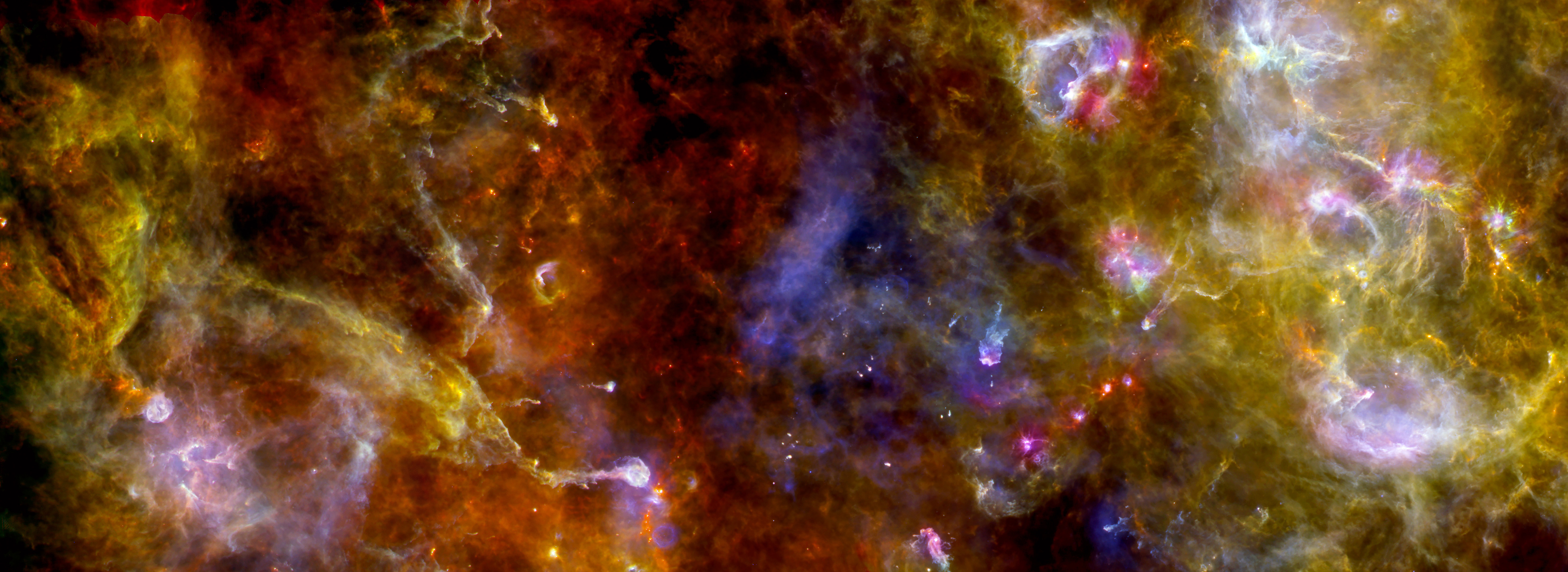
Hola amigos: A VUELO DE UN QUINDE EL BLOG., Una caótica maraña de filamentos de polvo y gas conforma la matriz donde se está formando una nueva generación de estrellas masivas, tal y como se puede ver en esta impresionante imagen de Cygnus-X, tomada por el telescopio espacial Herschel de la ESA.

Download:
 HI-RES JPEG (Size: 2381 kb)


This new view of the Cygnus-X star-formation region by Herschel highlights chaotic networks of dust and gas that point to sites of massive star formation.
The image combines data acquired with the PACS instrument at 70 micron (corresponding to the blue channel) and 160 micron (corresponding to the green channel) and with the SPIRE instrument at 250 micron (corresponding to the red channel). The observations were made on 24 May 2010 and 18 December 2010. North is to the lower-right and east to the upper-right.

Credits: ESA/PACS/SPIRE/Martin Hennemann & Frédérique Motte, Laboratoire AIM Paris-Saclay, CEA/Irfu – CNRS/INSU – Univ. Paris Diderot, France.

Una caótica maraña de filamentos de polvo y gas conforma la matriz donde se está formando una nueva generación de estrellas masivas, tal y como se puede ver en esta impresionante imagen de Cygnus-X, tomada por el telescopio espacial Herschel de la ESA.
http://www.esa.int/SPECIALS/Herschel/SEMCOITWT1H_0.html
Cygnus-X es una región de formación de estrellas extremadamente activa, ubicada a unos 4,500 años-luz de la Tierra, en la constelación de Cygnus, el Cisne.
Gracias a la capacidad de Herschel para captar luz en la banda del infrarrojo lejano, los astrónomos pueden estudiar regiones como ésta, en las que las estrellas fueron calentando lentamente el polvo que las rodeaba, agrupándolo en densos cúmulos en los que se continuarán forjando nuevas estrellas.
Los tonos blancos marcan aquellas zonas en las que no hace mucho que se formaron nuevas estrellas a partir de nubes turbulentas de polvo y gas, como las que se pueden ver en la mitad derecha de la imagen.
En esa región, los filamentos de polvo y gas se entrelazan y colapsan, dando lugar a densos nudos en los que se formarán nuevas estrellas. Por otra parte, la inmensa radiación emitida por las estrellas recién nacidas es capaz de arrastrar el material que las rodea, creando una burbuja a su alrededor.
En el centro de la imagen, la intensa radiación y los fuertes vientos emitidos por las estrellas, que permanecen ocultas a estas longitudes de onda, han calentado y despejado parcialmente el medio interestelar, que brilla en un tono azulado.
La parte izquierda de la imagen está dominada por un gran pilar de gas, cuya forma recuerda al cuello de un cisne.  

Download:
 HI-RES JPEG (Size: 7952 kb)


An annotated version of Herschel’s view of Cygnus-X highlighting numerous dense sites of new star formation in the right-hand complex, and the swan-like structure in the left-hand portion of the scene. Powerful radiation and winds from thousands of stars in the OB2 complex undetected at Herschel’s long wavelengths have partly cleared and heated surrounding material, visible as the diffuse blue glow in the centre of the image. A supergiant star identified as G79.29+0.46 has likely ejected the ring of material seen at the bottom of the image.
Credits: ESA/PACS/SPIRE/Martin Hennemann & Frédérique Motte, Laboratoire AIM Paris-Saclay, CEA/Irfu – CNRS/INSU – Univ. Paris Diderot, France.

Cerca de la esquina inferior derecha se puede distinguir una inmensa burbuja de polvo y gas, que parece haber sido expulsada por una estrella súper masiva que se encuentra en su centro, aunque no se pueda ver directamente en esta imagen.
Las hileras de objetos rojos y compactos esparcidas por toda la imagen se corresponden con las semillas, todavía frías, de lo que terminará convirtiéndose en una nueva generación de estrellas.
Esta imagen demuestra la extraordinaria capacidad de Herschel para estudiar el proceso de formación de las estrellas masivas, y de su influencia sobre el medio interestelar que las rodea, con un nivel de detalle sin precedentes en la banda del infrarrojo lejano.
ESA.
Guillermo Gonzalo Sánchez Achutegui
ayabaca@gmail.com
ayabaca@hotmail.com
ayabaca@yahoo.com
Inscríbete en el Foro del blog y participa : A Vuelo De Un Quinde - El Foro!

miércoles, 9 de mayo de 2012

Astronomía: VISTA nos muestra una enorme concentración de estrellas

Hola amigos: A VUELO DE UN QUINDE EL BLOG., En esta nueva imagen de Messier 55, obtenida con el telescopio infrarrojo de sondeo VISTA, podemos ver decenas de miles de estrellas apelmazadas cual enjambre de abejas. Además de estar concentradas en un espacio relativamente pequeño, estas estrellas son de las más viejas del universo. Los astrónomos estudian Messier 55 y otros objetos antiguos, llamados cúmulos globulares, para estudiar cómo evolucionan las galaxias y cómo envejecen las estrellas.

VISTA infrared image of the globular star cluster Messier 55
This striking view of the globular star cluster Messier 55 in the constellation of Sagittarius (The Archer) was obtained in infrared light with the VISTA survey telescope at ESO’s Paranal Observatory in Chile. This vast ball of ancient stars is located at a distance of about 17 000 light-years from Earth.

Credit:

ESO/J. Emerson/VISTA. Acknowledgment: Cambridge Astronomical Survey Unit
The globular star cluster Messier 55 in the constellation of Sagittarius
This chart shows the location of the globular star cluster Messier 55 within the constellation of Sagittarius (The Archer). This map shows most of the stars visible to the unaided eye under good conditions and the cluster itself is marked with a red circle. This globular cluster can be easily seen with a very small telescope or binoculars.

Credit:

ESO, IAU and Sky & Telescope


Wide-field view of the sky around the globular star cluster Messier 55
This visible light wide-field image of the region around Messier 55 was created from photographs taken through blue and red filters and forming part of the Digitized Sky Survey 2. The globular cluster appears at the centre. The field of view is approximately 2.7 degrees across.

Credit:

ESO and Digitized Sky Survey 2
http://www.eso.org/public/videos/eso1220a/

Los cúmulos globulares se mantienen unidos en un estrecho espacio de forma esférica debido a la gravedad. En Messier 55, las estrellas están especialmente apretadas: aproximadamente cien mil estrellas se “hacinan” en una esfera con un diámetro de tan solo 25 veces la distancia entre el Sol y el sistema estelar más cercano, Alpha Centauri.
Se han detectado alrededor de 160 cúmulos globulares rodeando nuestra galaxia, la Vía Láctea, la mayor parte hacia la protuberancia central. Los dos últimos descubrimientos, llevados a cabo utilizando VISTA, fueron anunciados recientemente (eso1141). Las galaxias más grandes pueden tener miles de estos grupos de estrellas orbitando a su alrededor.
Observando las estrellas de estos cúmulos globulares, se ha descubierto que se originaron en la misma época —hace más de diez mil millones de años — y de la misma nube de gas. Dado que este periodo formativo tuvo lugar unos pocos miles de millones de años tras el Big Bang, la composición de casi todo el gas a mano era la más simple, ligera y común del cosmos: hidrógeno, junto con algo de helio y cantidades muy pequeñas de elementos químicos más pesados como oxígeno y nitrógeno.
El hecho de estar compuestas principalmente de hidrógeno distingue a las residentes en los cúmulos globulares de las estrellas nacidas en épocas posteriores, como nuestro Sol, que cuenta con elementos más pesados creados en generaciones de estrellas más jóvenes. El Sol se encendió hace unos 4.600 millones, con lo cual tiene la mitad de la edad de las estrellas más viejas que habitan la mayor parte de los cúmulos globulares. La composición química de la nube de la cual se formó nuestro Sol se refleja en la abundancia de elementos encontrados en nuestro Sistema Solar — en los asteroides, en los planetas y en nuestros propios cuerpos.
Los observadores del cielo pueden encontrar a Messier 55 en la constelación de Sagitario (El arquero). El enorme cúmulo aparece con cerca de dos tercios del ancho de la Luna llena, y, pese a estar a una distancia de alrededor de 17.000 años luz de la Tierra, no resulta difícil verlo con un pequeño telescopio.
El astrónomo francés Nicolas Louis de Lacaille fue el primero en documentar esta agrupación estelar alrededor de 1752 y, unos 26 años más tarde, otro astrónomo francés, Charles Messier, la incluyó en su conocido catálogo astronómico como entrada número 55. El objeto también se conoce como NGC 6809 en el Nuevo Catálogo General (New General Catalogue), un catálogo astronómico más extenso y muy citado, creado a finales del siglo diecinueve.
Esta nueva imagen fue obtenida en luz infrarroja por el telescopio de 4,1 metros VISTA (Visible and Infrared Survey Telescope for Astronomy, eso0949) ubicado en el Observatorio Paranal de ESO, en el norte de Chile.
Además de las estrellas de Messier 55, esta imagen de VISTA también muestra numerosas galaxias que se encuentran más allá del cúmulo. Una prominente galaxia espiral especialmente alejada aparece en el centro de la imagen, hacia la parte superior derecha.

Información adicional

El año 2012 marca el 50 aniversario de la creación del Observatorio Europeo Austral (European Southern Observatory, ESO). ESO es la principal organización astronómica intergubernamental de Europa y el observatorio astronómico más productivo del mundo. Quince países apoyan esta institución: Alemania, Austria, Bélgica, Brasil, Dinamarca, España, Finlandia, Francia, Holanda, Italia, Portugal, el Reino Unido, República Checa, Suecia y Suiza. ESO desarrolla un ambicioso programa centrado en el diseño, construcción y operación de poderosas instalaciones de observación terrestres que permiten a los astrónomos hacer importantes descubrimientos científicos. ESO también desarrolla un importante papel al promover y organizar la cooperación en investigación astronómica. ESO opera tres sitios únicos de observación de categoría mundial en Chile: La Silla, Paranal y Chajnantor. En Paranal, ESO opera el Very Large Telescope, el observatorio óptico más avanzado del mundo, y dos telescopios de rastreo. VISTA trabaja en el infrarrojo y es el telescopio de rastreo más grande del mundo, y el VST (sigla en inglés del Telescopio de Rastreo del VLT) es el telescopio más grande diseñado exclusivamente para rastrear el cielo en luz visible. ESO es el socio europeo de un revolucionario telescopio, ALMA, el proyecto astronómico más grande en desarrollo. Actualmente ESO está planificando el European Extremely Large Telescope, E-ELT, el telescopio óptico y de infrarrojo cercano de categoría 40 metros, que llegará a ser “el ojo más grande del mundo para mirar el cielo”.

Enlaces

Guillermo Gonzalo Sánchez Achutegui
ayabaca@gmail.com
ayabaca@hotmail.com
ayabaca@yahoo.com
Inscríbete en el Foro del blog y participa : A Vuelo De Un Quinde - El Foro!

martes, 8 de mayo de 2012

Astronomy: NASA's Spitzer Sees the Light of Alien 'Super Earth'

Hi My Friends: A VUELO DE UN QUINDE EL BLOG., NASA's Spitzer Space Telescope has detected light emanating from a "super-Earth" planet beyond our solar system for the first time. While the planet is not habitable, the detection is a historic step toward the eventual search for signs of life on other planets.

Download Image

› Full Size

› 1024 x 768

› 800 x 600
First-of-Its-Kind Glimpse at a Super Earth
Super Earths are exotic planets unlike any in our solar system. They are more massive than Earth yet lighter than gas giants like Neptune, and they can be made of gas, rock or a combination of both. There are about 70 known to circle stars beyond our sun, and NASA's Kepler mission has detected hundreds of candidates. These planets' relatively small sizes make them very hard to see.

NASA's Spitzer Space Telescope was able to detect a super Earth's direct light for the first time using its sensitive heat-seeking infrared vision.

Seen here in this artist's concept, the planet is called 55 Cancri e. It's a toasty world that rushes around its star every 18 hours. It orbits so closely -- about 25 times closer than Mercury is to our sun -- that it is tidally locked with one face forever blisters under the heat of its sun. The planet is proposed to have a rocky core surrounded by a layer of water in a "supercritical" state, where it is both liquid and gas, and then the whole planet is thought to be topped by a blanket of steam.

Spitzer was able to see the light of the planet by watching it slip behind its star in what is called an occultation. Because the planet is brighter relative to its star when viewed in infrared light, Spitzer was able to measure the slight drop in total brightness that occurred as the planet disappeared from view. This technique, pioneered by Spitzer in 2005, has since been performed by other telescopes, including NASA's Hubble and Kepler space telescopes. The method can be used to obtain information about a planet's temperature, and in some cases, its composition.

In this current study, the Spitzer data revealed that 55 Cancri e is very dark and that its sun-facing side is blistering hot at 2,000 kelvins or 3,140 degrees Fahrenheit.

Image credit: NASA/JPL-Caltech

Download Image

› Full Size

› 1600 x 1200

› 1024 x 768

› 800 x 600

Magician of a Planet Disappears to Reveal Itself

This plot of data from NASA's Spitzer Space Telescope reveals the light from a "super Earth" called 55 Cancri e. The planet is the smallest yet, beyond our solar system, to reveal its direct light. Super Earth's are more massive than Earth but lighter than gas giants like Neptune. While this planet is not habitable, the observations are an important milestone toward being able to eventually perform a similar technique on even smaller, potentially Earth-like planets.

The plot shows how the infrared light from the 55 Cancri system, both the star and planet, changed as the planet passed behind its star in what is called an occultation. When the planet disappeared, the total light dropped, and then increased back to normal levels as the planet circled back into view. The drop indicated how much light came directly from the planet itself. This type of information is important for studying the temperatures and compositions of planetary atmospheres beyond our own.
Image credit: NASA/JPL-Caltech/MIT


PASADENA, Calif. – NASA's Spitzer Space Telescope has detected light emanating from a "super-Earth" planet beyond our solar system for the first time. While the planet is not habitable, the detection is a historic step toward the eventual search for signs of life on other planets.
"Spitzer has amazed us yet again," said Bill Danchi, Spitzer program scientist at NASA Headquarters in Washington. "The spacecraft is pioneering the study of atmospheres of distant planets and paving the way for NASA's upcoming James Webb Space Telescope to apply a similar technique on potentially habitable planets."
The planet, called 55 Cancri e, falls into a class of planets termed super Earths, which are more massive than our home world but lighter than giant planets like Neptune. The planet is about twice as big and eight times as massive as Earth. It orbits a bright star, called 55 Cancri, in a mere 18 hours.
Previously, Spitzer and other telescopes were able to study the planet by analyzing how the light from 55 Cancri changed as the planet passed in front of the star. In the new study, Spitzer measured how much infrared light comes from the planet itself. The results reveal the planet is likely dark, and its sun-facing side is more than 2,000 Kelvin (3,140 degrees Fahrenheit), hot enough to melt metal.
The new information is consistent with a prior theory that 55 Cancri e is a water world: a rocky core surrounded by a layer of water in a "supercritical" state where it is both liquid and gas, and topped by a blanket of steam. "It could be very similar to Neptune, if you pulled Neptune in toward our sun and watched its atmosphere boil away," said Michaël Gillon of Université de Liège in Belgium, principal investigator of the research, which appears in the Astrophysical Journal. The lead author is Brice-Olivier Demory of the Massachusetts Institute of Technology in Cambridge.
The 55 Cancri system is relatively close to Earth, at 41 light-years away. It has five planets, with 55 Cancri e the closest to the star and tidally locked, so one side always faces the star. Spitzer discovered the sun-facing side is extremely hot, indicating the planet probably does not have a substantial atmosphere to carry the sun's heat to the unlit side.
NASA's James Webb Space Telescope, scheduled to launch in 2018, likely will be able to learn even more about the planet's composition. The telescope might be able to use a similar infrared method to Spitzer to search other potentially habitable planets for signs of molecules possibly related to life.
"When we conceived of Spitzer more than 40 years ago, exoplanets hadn't even been discovered," said Michael Werner, Spitzer project scientist at NASA's Jet Propulsion Laboratory in Pasadena, Calif. "Because Spitzer was built very well, it's been able to adapt to this new field and make historic advances such as this."
In 2005, Spitzer became the first telescope to detect light from a planet beyond our solar system. To the surprise of many, the observatory saw the infrared light of a "hot Jupiter," a gaseous planet much larger than the solid 55 Cancri e. Since then, other telescopes, including NASA's Hubble and Kepler space telescopes, have performed similar feats with gas giants using the same method.
In this method, a telescope gazes at a star as a planet circles behind it. When the planet disappears from view, the light from the star system dips ever so slightly, but enough that astronomers can determine how much light came from the planet itself. This information reveals the temperature of a planet, and, in some cases, its atmospheric components. Most other current planet-hunting methods obtain indirect measurements of a planet by observing its effects on the star.
During Spitzer's ongoing extended mission, steps were taken to enhance its unique ability to see exoplanets, including 55 Cancri e. Those steps, which included changing the cycling of a heater and using an instrument in a new way, led to improvements in how precisely the telescope points at targets.
JPL manages the Spitzer Space Telescope mission for NASA's Science Mission Directorate in Washington. Science operations are conducted at the Spitzer Science Center at the California Institute of Technology (Caltech) in Pasadena. Data are archived at the Infrared Science Archive housed at the Infrared Processing and Analysis Center at Caltech. Caltech manages JPL for NASA.
For more information about Spitzer,
and http://spitzer.caltech.edu/ . More information about exoplanets and NASA's planet-finding program is at http://planetquest.jpl.nasa.gov/ .
NASA
Guillermo Gonzalo Sánchez Achutegui
ayabaca@yahoo.com
Inscríbete en el Foro del blog y participa : A Vuelo De Un Quinde - El Foro!

lunes, 7 de mayo de 2012

Cambio Climático: Científico advierte de delicada situación de la Tierra por cambio climático

Hola amigos: A VUELO DE UN QUINDE EL BLOG., El director de la Unidad de Cultural Científica y subdirector de Relaciones Instituciones del Instituto Nacional de Técnica Aeroespacial, Javier Cacho, ha advertido que la Tierra está en una "situación delicada".

Soria, 28 abr (EFE).- El director de la Unidad de Cultural Científica y subdirector de Relaciones Instituciones del Instituto Nacional de Técnica Aeroespacial, Javier Cacho, ha advertido que la Tierra está en una "situación delicada".
Scott alcanzó el Polo Sur el 17 de enero de 1912, un mes después que el explorador noruego Roald Amundsen, pero en el regreso pereció, junto con sus cuatro compañeros, durante una tormenta. EFE
1010772
Guillermo Gonzalo Sánchez Achutegui
ayabaca@gmail.com
ayabaca@hotmail.com
ayabaca@yahoo.com
Inscríbete en el Foro del blog y participa : A Vuelo De Un Quinde - El Foro!
Embalse.

domingo, 6 de mayo de 2012

Bebidas: 5 Beneficios para beber una Cerveza

Hola amigos: A VUELO DE UN QUINDE EL BLOG., es cierto que beber cerveza o cualquier bebida alcohólica, puede en derivar en serios problemas para la salud. Sin embargo, algunos estudios demuestran que la cerveza, si es consumida con responsabilidad, puede ser tan saludable para el corazón como el vino.Me permito recomendarles que se debe beber una cerveza Cristal o Pilsen por lo menos una botella semanal.
Aquí en la imagen apreciamos a jóvenes peruanos bebiendo  Cerveza Cristal. Imagen de Backus.

Salud Cardiaca:
Un estudio demostró que beber una pinta de cerveza al día reduce el riesgo de contraer una enfermedad cardiaca en un 31% al incrementar la lipoproteínas de alta densidad (conocidas como "colesterol bueno").

Diabetes:
Las personas con diabetes que beben cerveza moderadamente tienen menos posibilidades de padecer una enfermedad cardíaca coronaria y también menos chance de desarrollar diabetes de tipo 2.

Salud Cerebral :
Los adultos mayores de 65 años que tomen de 1 a 6 pintas de cerveza por semana, muestran menos riesgo de contraer demencia que aquellos adultos de la misma edad que tomen en exceso o no tomen en absoluto.

Salud en general :
La gente que bebe cerveza con moderación tiende a reportar una cantidad menor de enfermedades a largo de su vida, comparada con la gente que la bebe excesivamente o no la bebe nunca.

Huesos:
En la sección salud de la Revista Forbes, se publicó que la cerveza puede ayudar a combatir la pérdida de masa ósea en hombres y mujeres jóvenes reconstruyéndola y fortaleciéndola. 
Información: Yahoo! Noticias.
Guillermo Gonzalo Sánchez Achutegui
ayabaca@gmail.com
ayabaca@hotmail.com
ayabaca@yahoo.com
Inscríbete en el Foro del blog y participa : A Vuelo De Un Quinde - El Foro!

Discovery: Nature Observation Database Receives One-Millionth Entry

Hi My Friends: A VUELO DE UN QUINDE EL BLOG., On April 30, 2012, the USA National Phenology Network (NPN), partially funded by the National Science Foundation (NSF), received its one-millionth nature observation from volunteers--many of whom are non-scientists or "citizen scientists." The observation will help understand the impacts of climate change on Earth's plants and animals.
Lucille Tower submitted the one-millionth observation; here, she examines a vine maple.
Credit and Larger Version
Vine Maple leaves and flowers are shown.
Credit and Larger Version
A monarch caterpillar is available for monitoring as part of NPN's Notebook.
Credit and Larger Version
A research technician records plant flowering in a high-elevation Colorado meadow.
Credit and Larger Version

Environmental variation can disrupt interactions between plants and their insect pollinators.
Credit and Larger Version

May 3, 2012
On April 30, 2012, the USA National Phenology Network (NPN), partially funded by the National Science Foundation (NSF), received its one-millionth nature observation from volunteers--many of whom are non-scientists or "citizen scientists." The observation will help understand the impacts of climate change on Earth's plants and animals.
Scientists and citizen volunteers contribute individual bits of data to NPN daily concerning phenology, the study of the timing of plant and animal responses--such as leafing, flowering, nesting, foliage changes, hibernation and migration--to seasonal changes.
Resource managers combine the data into an increasingly detailed record of how Earth's climate is evolving and how it might affect humans and Mother Nature down the road.
Hitting the one-millionth observation is exciting because researchers and decision-makers need more information to understand and respond to our rapidly changing planet," said Jake Weltzin, a U.S. Geological Survey scientist and executive director of NPN. "More information means better-informed decisions that ensure the continued vitality of our natural areas that we all depend on--and enjoy."
One millionth observation
Watching and reporting the flowering of a nearby vine maple, Acer circinatum, turned into the millionth observation submitted through NPN's online observation program, Nature's Notebook. Lucille Tower, an amateur scientist from Portland, Ore. submitted the record.
"Tower responded "yes" to the question on the NPN's observation submission form: "Did you see: One or more fresh open or unopened flowers or flower buds visible in the plant?" The record marked a precisely defined point in the life cycle of the vine maple, something that researchers observe while monitoring how climate change affects the start and end point of a plant's viability.
"We're excited about the quantity of observations and what it means for potentially answering the big questions," said Alyssa Rosemartin, NPN's assistant director.
"Our first records in the contemporary system are from Erin Lindquist, a professor at Meredith College, whose students collected thousands of records on deciduous tree phenology in North Carolina in the fall of 2008, and the millionth was submitted by a participant in Portland Budwatch, one of our partners that has set up several phenology trails and trained 100 observers in Portland. Look how far we've come."
Societal and economic benefits
The NPN provides a myriad of societal benefits by, for example, supporting the development of more accurate forecasts of the onset of allergy seasons; the spread of vector-borne diseases, such as lyme disease and West Nile virus; the movements of invasive plants; the development of drought conditions--information that could be used to help improve the health and welfare of large human populations, contribute to the management of water resources, wildlife and working farms and ranches, and maintain the vitality of ecosystems.
Weltzin says the NPN database also supports analyses of climate-change impacts that have important potential economic implications. Several examples:
  • NPN data is currently being used to help determine the chances of costly and destructive western wildfires.
  • The NPN recently established an Interagency Agreement with the National Oceanic and Atmospheric Administration to study patterns and trends occurring in the oceans, which could have profound implications for the multi-million-dollar U.S. fishing industry.
  • Pollination by native insects currently contributes more than $3 billion in agricultural crops each year. But climate-driven changes in the phenology of crops and native insects could change the effectiveness of insect pollination--for better or worse. NPN volunteers are currently observing insect and crop phenology together and thereby contributing to our understanding of related changes and helping to ensure the viability of crops across the United States.
  • NPN volunteers are currently tracking the leafing of sugar maple trees, which could contribute to improved predictions of sap runs and ultimately the production of maple syrup, which is important not only to pancake lovers but also to the economy of the New York/New England region.
Increasing the application of nature observations to economic analyses is a goal of the NPN, and citizen scientists have more than been up to the job. "Depending on the task at hand, trained non-scientists can produce data that is just as reliable as data produced by (professional) scientists," said Weltzin.
Steps in the journey
In addition to producing high quality data, armies of NPN volunteers also produce a high quantity of data. The NPN typically receives between 2,000 and 3,000 nature observations per day-most of which would otherwise be unobtainable.
Weltzin said that each and every one of these observations is important because they help fill a hole in our knowledge base. Moreover, a single observation can be analyzed in tandem with other observations to help create the big picture of how a particular species is responding to climate changes.
Suppose, for example, that several volunteers in a certain geographic area each alert the NPN as to the first bloom date of a dogwood tree in the spring. Those individual observations could then be analyzed as a group to determine the pattern of dogwood blooms in the area.
"So much of our improved understanding about global environmental changes is driven by varied and valuable sources of information that include ambitious networks of citizen-scientists," said John Wingfield, NSF assistant director for Biological Sciences. "Knowledge gained from their dedicated work will continue to have a lasting effect on how we understand regularly recurring biological phenomena for hundreds of plant and animal species and collectively, they contribute to the policy arena."
Changing seasons
Changes in phenology are among the most sensitive biological indicators of global change. Across the world, many springtime events are occurring earlier--and fall events happening later--than in the past. Plants and animals are responding to these changes in different ways and at different speeds. These varying responses can be damaging to the life-sustaining relationships among creatures that have been dynamically stable for thousands of years.
For example, some wildflowers that migratory hummingbirds look for when they arrive in their summer habitats are flowering earlier--even before the hummingbirds arrive. The resulting missed opportunity with the flowers can deprive the birds of an important food source. If the trend continues, populations of hummingbirds and wildflowers could precipitously decline.  In addition, some birds now remain year-round in their summer habitats instead of flying south for the winter.
Because of these types of changes, scientists need more and improved information about the pace and pattern of nature--locally to nationally--to answer important scientific and societal questions and to build the tools and models needed to help people understand and adapt to the changes at hand.
Individuals of all ages, from school children to retirees, as well as entire classes and community groups, are invited to join the NPN "army" of citizen scientists; no minimal level of commitment is required. Some volunteers submit their observations on a regular basis while others contribute occasionally, or even contribute valuable archived "shoeboxed" records that, when possible, are added to the NPN database to support analyses of long-term trends.
What could be in it for you?
Weltzin said that volunteers contribute to the NPN for varied reasons, including the opportunity to:
  • Support the environmental field and the advancement of science.
  • Receive feedback from scientists about how the data they collected is being used and helping to advance science.
  • Put to good use "shoe box" data that they have previously collected about seasonal phenomena.
  • Interact via various social media forums sponsored by NPN with non-scientists who share similar interests.
  • Connect with fellow scientists who have overlapping research interests and resources to share with colleagues in their field.
  • Use the NPN Web site to announce events, news items and festivals that would interest NPN volunteers.
-- Lily Whiteman, (703) 292-8070 lwhitema@nsf.gov

InvestigatorsSusan Mazer
Jake Weltzin
Mark Schwartz
Related Institutions/OrganizationsUniversity of Wisconsin-Milwaukee
Related Awards#0639794 RCN - USA National Phenology Network

Guillermo Gonzalo Sánchez Achutegui
ayabaca@gmail.com
ayabaca@hotmail.com
ayabaca@yahoo.com
Inscríbete en el Foro del blog y participa : A Vuelo De Un Quinde - El Foro!

Astronomía: Viaje polvoriento cerca del Cinturón de Orión

Hi My Friends: A VUELO DE UN QUINDE EL BLOG., Una nueva imagen de la región que rodea a la nebulosa de reflexión Messier 78, al norte del Cinturón de Orión, muestra cómo en su interior se enlazan, al igual que las perlas de un collar, las nubes de polvo cósmico. Las observaciones, llevadas a cabo con el telescopio APEX (Atacama Pathfinder Experiment) [1], utilizan el cálido resplandor de los granos de polvo interestelar para mostrar a los astrónomos el lugar en el cual se están formando nuevas estrellas.

Nubes de polvo cósmico en Messier 78

Esta imagen de la región que rodea a la nebulosa de reflexión Messier 78, al norte del Cinturón de Orión, muestra cómo en su interior se enlazan, al igual que las perlas de un collar, las nubes de polvo cósmico. Las observaciones en longitudes de onda submilimétricas, llevadas a cabo con el telescopio APEX (Atacama Pathfinder Experiment), y mostradas aquí en un tono anaranjado, utilizan el cálido resplandor de los granos de polvo interestelar para mostrar a los astrónomos el lugar en el cual se están formando nuevas estrellas. Esta superpuesta a una imagen de la región obtenida en el rango visible.

Crédito:

ESO/APEX (MPIfR/ESO/OSO)/T. Stanke et al./Igor Chekalin/Digitized Sky Survey 2


Messier 78: una nebulosa de reflexión en Orión.
Este mapa muestra la ubicación de Messier 78 en la conocida constelación de Orión (El cazador). La mayor parte de las estrellas pueden verse a simple vista con buenas condiciones atmosféricas, y en esta imagen hemos destacado a Messier 78 con un círculo rojo. Esta nebulosa de reflexión es bastante brillante y puede verse con facilidad utilizando telescopios de aficionados de tamaño medio.

Crédito:

ESO, IAU and Sky & Telescope

Viaje polvoriento cerca del Cinturón de Orión (datos)

Esta imagen de la región que rodea a la nebulosa de reflexión Messier 78, al norte del Cinturón de Orión, muestra cómo en su interior se enlazan, al igual que las perlas de un collar, las nubes de polvo cósmico. Las observaciones en longitudes de onda submilimétricas, llevadas a cabo con el telescopio APEX (Atacama Pathfinder Experiment), y mostradas aquí en un tono anaranjado, utilizan el cálido resplandor de los granos de polvo interestelar para mostrar a los astrónomos el lugar en el cual se están formando nuevas estrellas. Esta superpuesta a una imagen de la región obtenida en el rango visible. Las observaciones de APEX están delimitadas con unas líneas rojas. No aparecerá la emisión en longitudes de onda submilimétricas que se encuentre fuera de esta delimitación.

Crédito:

ESO/APEX (MPIfR/ESO/OSO)/T. Stanke et al./Igor Chekalin/Digitized Sky Survey 2

El polvo — la superficie sucia que oculta la belleza de un objeto- puede parecer aburrido y poco interesante. Pero esta nueva imagen de Messier 78 y sus alrededores, en la que podemos ver la radiación de los granos de polvo del espacio en longitudes de onda submilimétricas, demuestra que el polvo puede deslumbrarnos. El polvo es importante para los astrónomos, ya que las nubes densas de gas y polvo constituyen el lugar de nacimiento de nuevas estrellas.
En el centro de la imagen vemos a Messier 78, también conocida como NGC 2068. Vista en el rango visible, esta región es una nebulosa de reflexión, es decir, vemos el brillo azul pálido de la luz de las estrellas reflejado desde las nubes de polvo.
En esta imagen de APEX, las observaciones llevadas a cabo en el rango visible están marcadas con un color naranja. Al ser sensibles a longitudes de onda más largas, muestran el brillo suave de densas formaciones frías de polvo, algunas de las cuales están por debajo de los -250ºC. En el rango de luz visible, este polvo es oscuro y opaco, motivo por el cual telescopios como APEX son tan importantes para el estudio de estas nubes de polvo en las cuales nacen las estrellas.
También podemos ver un filamento, detectado por APEX en luz visible, como un sendero oscuro de polvo que atraviesa Messier 78. Esto nos dice que el polvo denso se encuentra frente a la nebulosa de reflexión, bloqueando su luz azulada. Otra región destacada de polvo brillante vista por APEX solapa la luz visible de Messier 78 en su margen inferior. En la imagen obtenida en el rango visible, la falta de un rastro de polvo oscuro que se corresponda, nos dice que esta densa región de polvo debe estar detrás de la nebulosa de reflexión.
Al observar el gas de estas nubes, vemos cómo algunas de estas densas formaciones expulsan flujos de gas a gran velocidad, los cuales son eyectados desde estrellas jóvenes mientras estas están aún formándose a partir de la nube que la rodea. Su presencia es, por tanto, evidencia de que en esas formaciones se están creando estrellas de manera activa.
En la parte superior de la imagen hay otra nebulosa de reflexión, NGC 2071. Mientras que las regiones inferiores de esta imagen contienen solo estrellas jóvenes de baja masa, NGC 2071 contiene una estrella joven más masiva, con una masa estimada de cinco veces la masa del Sol, situada en los picos más brillantes de las observaciones de APEX.
Las observaciones de APEX utilizadas en esta imagen fueron dirigidas por Thomas Stanke (ESO), Tom Megeath (Universidad de Toledo, EE.UU.), y Amy Stutz (Instituto Max Planck de Astronomía, Heidelberg, Alemania). Para más información sobre esta región vista en el rango visible, incluyendo la recientemente descubierta — y altamente variable — Nebulosa McNeil’s, ver eso1105.
NOTAS:
[1] APEX es una colaboración entre el Instituto Max Planck de Radioastronomía (MPIfR), el Observatorio Espacial de Onsala (OSO), y ESO, que se hace cargo de sus operaciones en el llano de Chajnantor. APEX es el proyecto de exploración previo a ALMA, el Atacama Large Millimeter/submillimeter Array, la próxima generación de telescopio submilimétrico, que también está siendo construido y operado en el llano de Chajnantor.
Información Adicional:
El año 2012 marca el 50 aniversario de la creación del Observatorio Europeo Austral (European Southern Observatory, ESO). ESO es la principal organización astronómica intergubernamental de Europa y el observatorio astronómico más productivo del mundo. Quince países apoyan esta institución: Alemania, Austria, Bélgica, Brasil, Dinamarca, España, Finlandia, Francia, Holanda, Italia, Portugal, el Reino Unido, República Checa, Suecia y Suiza. ESO desarrolla un ambicioso programa centrado en el diseño, construcción y operación de poderosas instalaciones de observación terrestres que permiten a los astrónomos hacer importantes descubrimientos científicos. ESO también desarrolla un importante papel al promover y organizar la cooperación en investigación astronómica. ESO opera tres sitios únicos de observación de categoría mundial en Chile: La Silla, Paranal y Chajnantor. En Paranal, ESO opera el Very Large Telescope, el observatorio óptico más avanzado del mundo, y dos telescopios de rastreo. VISTA trabaja en el infrarrojo y es el telescopio de rastreo más grande del mundo, y el VST (sigla en inglés del Telescopio de Rastreo del VLT) es el telescopio más grande diseñado exclusivamente para rastrear el cielo en luz visible. ESO es el socio europeo de un revolucionario telescopio, ALMA, el proyecto astronómico más grande en desarrollo. Actualmente ESO está planificando el European Extremely Large Telescope, E-ELT, el telescopio óptico y de infrarrojo cercano de categoría 40 metros, que llegará a ser “el ojo más grande del mundo para mirar el cielo”.

Enlaces

Guillermo Gonzalo Sánchez Achutegui
ayabaca@gmail.com
ayabaca@hotmail.com
ayabaca@yahoo.com
Inscríbete en el Foro del blog y participa : A Vuelo De Un Quinde - El Foro!

Mi lista de blogs