lunes, 26 de noviembre de 2012

ESA Portal - Fostering Curiosity: Mars Express relays rocky images


 ESA's Mars Express relays Rocknest3 images from NASA Curiosity
Download:
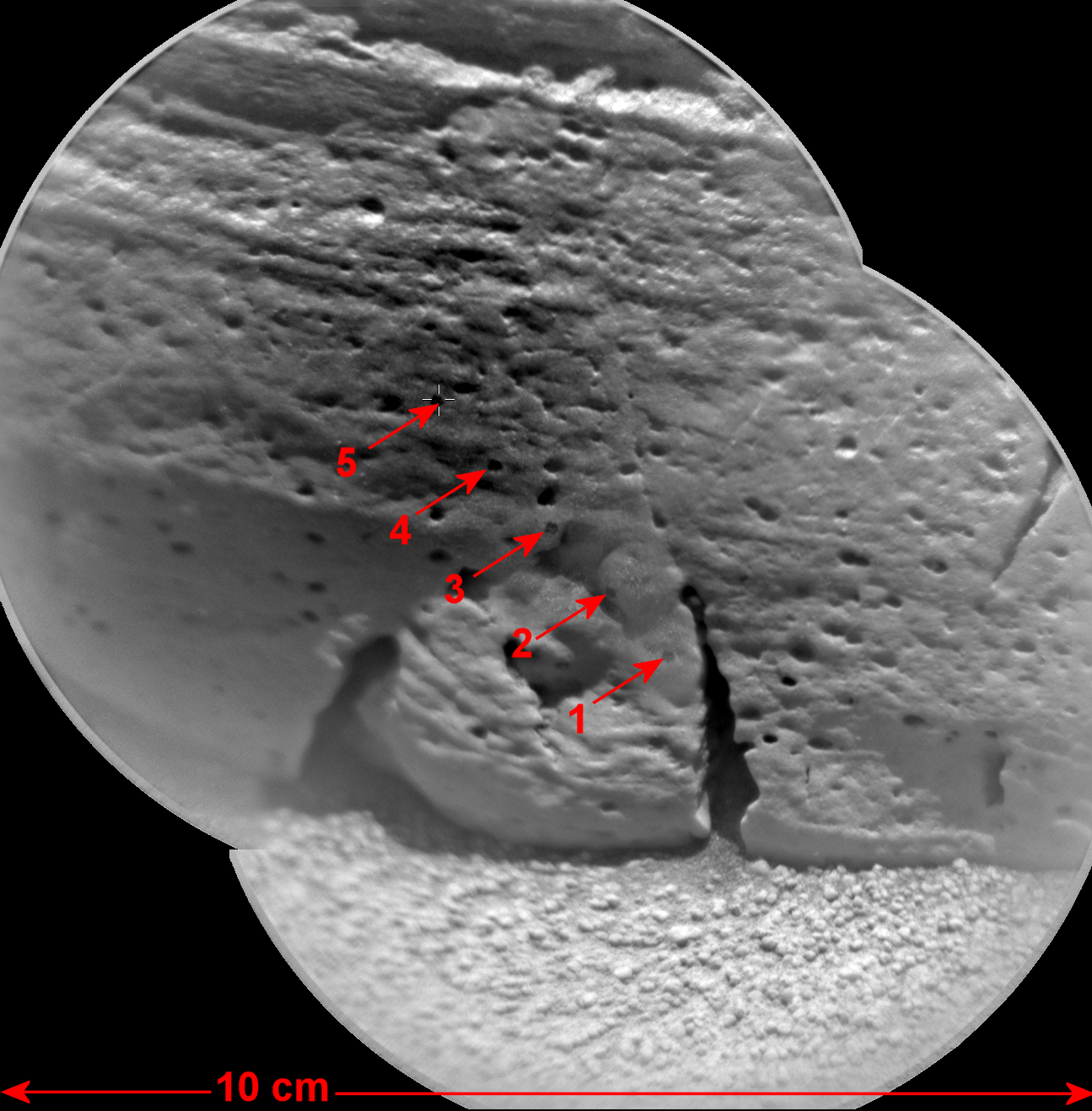
 This was taken on Sol 57 (4 October 2012) of target Rocknest3 using the ChemCam Remote Micro-Imager (RMI) on the NASA Curiosity rover at a distance of 3.7 m. The image was downlinked to Earth by ESA's Mars Express orbiter via the 35m deep space ESTRACK station in New Norcia, Australia. This image was taken before a series of five ChemCam Laser-Induced Breakdown Spectrometer (LIBS) observations. Rocknest is the name of the area where Curiosity stopped for a month to perform its first mobile laboratory analyses on soil scooped from a small sand dune. Rocknest3 was a convenient nearby target of which ChemCam made more than thirty observations overall consisting of 1,500 laser shots; it was also interrogated by the arm-mounted Alpha Particle X-ray Spectrometer (APXS) instrument.
Credits: NASA/JPL-Caltech/LANL/CNES/IRAP

For the first time, ESA’s Mars orbiter has relayed scientific data from NASA’s Curiosity rover on the Red Planet’s surface. The data included detailed images of ‘Rocknest3’ and were received by ESA’s deep-space antenna in Australia.

It was a small but significant step in interplanetary cooperation between space agencies.

Early on the morning of 6 October, ESA’s Mars Express looked down as it orbited the planet, lining up its lander communication antenna to point at Curiosity far below on the surface.
For 15 minutes, the NASA rover transmitted scientific data up to the ESA satellite. A few hours later, Mars Express slewed to point its high-gain antenna toward Earth and began downlinking the precious information to the European Space Operations Centre in Darmstadt, Germany, via the Agency’s 35 m-diameter antenna in New Norcia, Australia.  

The data were immediately made available to NASA’s Jet Propulsion Laboratory in California for processing and analysis, proving again that NASA’s amazing new rover can talk with Europe’s veteran Mars orbiter.
 

Curiosity’s ChemCam images Rocknest3

The information included a pair of tremendously interesting images acquired on 4 October by Curiosity’s ChemCam Remote Micro-Imager camera.
 

ChemCam comprises the camera together with a Laser-Induced Breakdown Spectrometer, which fires a laser at targets and analyses the chemical composition of the vaporised material.
The laser zaps areas smaller than 1 mm across on the surface of martian rocks and soils, and then the spectrometer provides information on the minerals and microstructures in the rocks.  
 ESA's Mars Express relays Rocknest3 images from NASA Curiosity

Download:
This was taken on Sol 57 (4 October 2012) of target Rocknest3 using the ChemCam Remote Micro-Imager (RMI) on the NASA Curiosity rover at a distance of 3.7 m. The image was downlinked to Earth by ESA's Mars Express orbiter via the 35m deep space ESTRACK station in New Norcia, Australia. This image was taken after a series of five ChemCam Laser-Induced Breakdown Spectrometer (LIBS) observations. Rocknest is the name of the area where Curiosity stopped for a month to perform its first mobile laboratory analyses on soil scooped from a small sand dune. Rocknest3 was a convenient nearby target of which ChemCam made more than thirty observations overall consisting of 1,500 laser shots; it was also interrogated by the arm-mounted Alpha Particle X-ray Spectrometer (APXSI instrument. 
Credits: NASA/JPL-Caltech/LANL/CNES/IRAP 
For the first time, ESA’s Mars orbiter has relayed scientific data from NASA’s Curiosity rover on the Red Planet’s surface. The data included detailed images of ‘Rocknest3’ and were received by ESA’s deep-space antenna in Australia.


Outstanding image quality

The first image (at top of article) was taken before a series of five ChemCam laser blasts and the second image (at right) was taken after. The image is centred on the fifth observation point.
“The quality of these images from ChemCam is outstanding, and the mosaic image of the spectrometer analyses has been essential for scientific interpretation of the data,” says Sylvestre Maurice, Deputy Principal Investigator for ChemCam at France’s Research Institute in Astrophysics and Planetology (IRAP).
“This combination of imaging and analysis has demonstrated its potential for future missions.”
ESA's Mars Express relays Rocknest3 images from NASA Curiosity
Download:
 This mosaic combines the multiple RMI images and indicates the locations of the LIBS laser observations. Credits: NASA/JPL–Caltech/LANL/CNES/IRAP/LPGN/CNRS

ChemCam laser targets

A third image, relayed separately by NASA, indicates the locations of the laser target points on Rocknest3, as seen by the RMI camera. ‘Rocknest’ is the area where Curiosity stopped for a month to perform its first mobile laboratory analyses on soil scooped from a small sand dune. Rocknest3 was a convenient nearby target where ChemCam made more than 30 observations using 1500 laser shots.
 

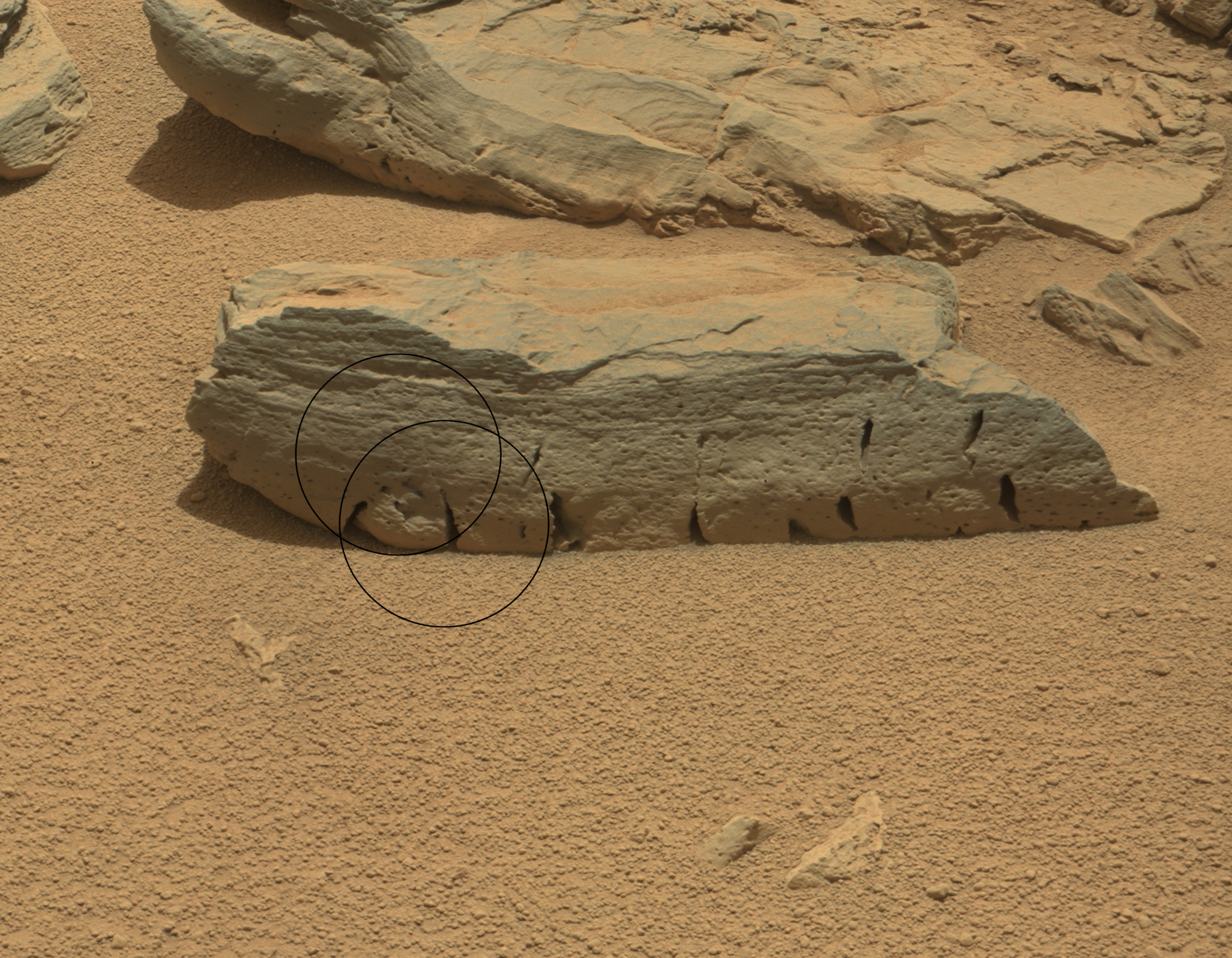
A wide-angle context image was acquired by Curiosity’s MastCam and shows Rocknest3 as targeted by ChemCam. Rocknest3 is about 10 x 40 cm, or roughly the size of a shoe box.

 ESA's Mars Express relays Rocknest3 images from NASA Curiosity

Download:
 Context image: The Mastcam 100 colour image shows Rocknest3 targeted by ChemCam and later by APXS; the fields of view of the RMI images are indicated. Rocknest3 is approximately 10 x 40 cm or roughly the size of a shoebox. 
Credits: NASA/JPL–Caltech/Malin Space Science Systems


ESA’s Mars orbiter has also relayed data for NASA’s other surface missions – Phoenix, Spirit and Opportunity – since 2004, and it relayed Curiosity’s radio signal during its arrival at Mars last August.

During the Curiosity mission, Mars Express is set to provide additional relay slots, while maintaining its own scientific observation programme, under an ESA-NASA support agreement.
It can also rapidly provide relay services in case of unavailability of NASA’s own relay orbiter or if there is a problem on the rover itself.
 

Interplanetary cooperation

“ESA–NASA cooperation at Mars is a continuing success, and comes after both sides have worked diligently for a number of years to set technical and engineering standards to enable sharing data between spacecraft, networks and ground stations,” says Mars Express Spacecraft Operations Manager Michel Denis.
“Exploring Mars is a huge challenge, and space agencies are working to boost cooperation and mutual support for current and upcoming missions. It’s the way of the future.”
ESA
Guillermo Gonzalo Sánchez Achutegui
ayabaca@gmail.com
ayabaca@hotmail.com
ayabaca@yahoo.com 

 Inscríbete en el Foro del blog y participa : A Vuelo De Un Quinde - El Foro!

NASA - Commander Kelly on the Station

 
 NASA astronaut Scott Kelly, Expedition 25 flight engineer, is pictured in the Cupola of the International Space Station on Oct. 14, 2010.

Download Image

› Full Size 

Guillermo Gonzalo Sánchez Achutegui
ayabaca@hotmail.com
ayabaca@gmail.com
ayabaca@yahoo.com
Inscríbete en el Foro del blog y participa : A Vuelo De Un Quinde - El Foro!

ESA - Space Science - Revisiting an old friend

http://esamultimedia.esa.int/images/giotto002.jpg
Download:
 HI-RES JPEG (Size: 70 kb)
The Giotto spacecraft, launched in 1985 on an Ariane 1 V14 launcher, brushed past the hidden nucleus of Comet Halley in 1986. 
Credits: ESA
 
 Comet Halley close up
Download:
Comet Halley as seen by ESA’s Giotto spacecraft in 1986, the last time the comet visited the inner Solar System. Giotto was ESA’s first deep mission, and obtained the first close-up images of a comet. This image was taken from a distance of about 2000 km from Comet Halley. The Sun is located towards the left of the image, provoking outbursts of gas and dust from the comet’s nucleus. 
Credits: ESA/MPS
 Comet Halley, the originator of the Orionids meteor shower that lit up our skies last month – as they do every October – is seen here up close by ESA’s Giotto probe as it flew past the famous comet on 13–14 March 1986.
Giotto was ESA’s first deep-space mission. It swept within 600 km of Halley, obtaining the first close-up images of a comet.
Comets are considered to be the primitive building blocks of the Solar System and likely helped to ‘seed’ Earth with water.
This milestone mission showed for the first time the nucleus of a comet and revealed jets of gas and dust streaming out into space.
The flyby also revealed the first evidence of organic material in a comet, boosting the idea that comets might have delivered some of the building blocks needed for life on Earth.
Comet Halley is visible to observers on Earth every 75–76 years and will not return to the inner Solar System until 2061. Its presence makes itself known every year, however, in the form of the Orionids meteor shower.
As the icy comet is warmed by the Sun, parts of it transform directly into a gas, dragging its dusty component along, which streams out in a long tail. These fragments continue along the trajectory of the comet, which Earth crosses on its yearly trip around the Sun.
Although only tiny grains of cometary debris, these fragments produce spectacular trails as they burn up in Earth’s atmosphere as ‘shooting stars’.
The Orionids are so-called because meteors appear to originate close to the constellation of Orion. Halley’s comet is also thought to be responsible for the Eta Aquariids meteor shower, which occurs every year in May.
After visiting Comet Halley, Giotto went on to make a flyby of Comet 26P/Grigg-Skjellerup in July 1992.
Meanwhile, ESA’s new Rosetta comet-chasing spacecraft is en route to rendezvous with Comet 67P/Churyumov-Gerasimenko in 2014, where it will make the most detailed study of a comet ever attempted as it follows it on its journey around the Sun.
The mission will also be the first to land on a nucleus to ‘taste’ the surface ingredients, providing key details about the role of comets in the evolution of the Solar System.  
 

Comet Halley's nucleus as seen by Giotto
In 1986, Giotto's encounter with Comet Halley provided the first ever opportunity to take images of a comet nucleus. The images were obtained with the Halley Multicolour Camera on Giotto. Credits: Halley Multicolor Camera Team, Giotto Project, ESA 
 
Twenty-five years ago, ESA's Giotto probe swept within 600 km of Comet Halley, obtaining the first close-up images of a comet. It revealed the first evidence of organic material in a comet and, still today, much of what we know about comets comes from the pioneering mission.

Launched on 2 July 1985 by Ariane 1, Giotto was ESA's first deep-space mission, part of an ambitious international effort to solve the mysteries surrounding Comet Halley.
It was also the first deep-space mission to change orbit by returning to Earth from an interplanetary trajectory for a gravity-assist.

http://esamultimedia.esa.int/images/Science/giotto003.jpg
Download:
 The Giotto space probe, launched in 1985 on an Ariane 1 V14 launcher, brushed past the hidden nucleus of Halley's comet in 1986.Its camera recorded many images that gave scientists an unique opportunity ( the comet would not pass close to the Earth again until 2061) to increase their knowledge of Halley,and in particular to determine the consistency of its matter through the analyses made by the probe as it passed through the comet's tail. Though damaged by the multiple impacts, Giotto carried on with its mission. After a period of hibernation, it was reactived in 1990 for a fresh task - overflying the comet Grigg-Skjellerup on 10 July 1992. Giotto is thus the first probe that has ever met two comets.

Mission
Giotto was ESA’s first deep-space mission. In 1986, it passed closest to the nucleus of a comet, Halley. Its images showed for the first time the shape of a comet nucleus and found the first evidence of organic material in a comet. In 1992, after a long cruise through space, Giotto was directed to Comet Grigg-Skjellerup. It sent back a lot of information, passing just 200 kilometres from the nucleus.
 
What’s special?

Giotto had a number of very impressive ‘firsts’ and achievements to its credit:
It was Europe's first deep-space mission.
It photographed the first close-up images of a comet nucleus (Halley). It discovered the size and shape of Halley's nucleus and discovered that the surface is very dark and that bright jets of gas and dust spring out of its nucleus.
It was the first deep-space mission to change orbit by returning to Earth for a gravity-assist manoeuvre.
Giotto made the closest comet fly-by to date by any spacecraft (about 200 kilometres from Comet Grigg-Skjellerup) and studied the interaction between the solar wind, the interplanetary magnetic field, and the comet itself.
It was the first spacecraft to encounter two comets and in doing so measured the size, composition, and velocity of dust particles and measured the composition of those two comets.
 

Spacecraft

Giotto was based on the GEOS Earth-orbiting research satellites, which were built by British Aerospace at Bristol, United Kingdom. The most significant modification was the addition of a shield to protect it from a battering by high-speed dust particles during the comet encounter.
By spacecraft standards, the 960-kilogram Giotto was small in size. Its main body was a short cylinder about 2 metres in diameter by about 1 metre in height. It contained three interior platforms: the top platform, a main platform, and an experiment platform. Each of these consisted of a disc within the cylinder on which were mounted various subsystems and science experiments. On top of the cylinder was a 1.5-metre diameter high-gain dish antenna and gave the spacecraft a total height of about 3 metres. The main rocket motor was positioned in the centre of the cylinder with the nozzle protruding from the bottom.
The most difficult problem to overcome was how to ensure that Giotto survived long enough to snap its close-up pictures of the nucleus when the spacecraft and the comet were heading towards each other at a combined speed of 245 000 kilometres per hour (equivalent to crossing the Atlantic Ocean in 11 minutes!). At this speed, a 0.1 gram dust particle would be able to penetrate 8 centimetres of solid aluminium. Since it was out of the question to equip Giotto with a 600-kilogram aluminium shield, engineers turned to a more subtle, sandwich design first proposed by American astronomer Fred Whipple back in 1947 — long before the beginning of the Space Age.
The spacecraft's dust shield consisted of two protective sheets, 23 centimetres apart. At the front was a sheet of aluminium (1 millimetre thick), which would vaporise all but the largest of the incoming dust particles. A 12-milimetre thick sheet of Kevlar at the rear would absorb any debris that pierced the front barrier. Together they could withstand impacts from particles up to 1 gram in mass and travelling 50 times faster than a bullet.
Electrical power came from a solar array made of about 5000 silicon cells wrapped around Giotto’s cylindrical exterior. These provided 190 Watts of power during the first comet encounter. Four silver-cadmium batteries were carried as back up and for use when the spacecraft was in shadow.
The spacecraft was spin-stabilised as it rotated at 15 revolutions per minute. During the encounter with Halley’s Comet, the spacecraft approached with its dust shield and spin axis pointing towards the nucleus. Its dish antenna continually pointed at the Earth to ensure non-stop communications.
 

Journey

Giotto was initially injected into a geostationary transfer orbit. After three revolutions around the Earth, the on-board motor was fired to inject into an interplanetary orbit. After a cruise phase of 8 months, Giotto encountered Comet Halley on 14 March 1986. For its (initially unscheduled) visit to the second comet, Grigg-Skjellerup, Giotto was flown back to the direction of Earth for a gravity-assist to reach its new target.
To add more detail, the adventure began with Giotto almost 150 million kilometres from Earth. On 12 March 1986, the spacecraft's instruments first detected hydrogen ions 7.8 million kilometres from Comet Halley. 22 hours later, Giotto crossed the bow shock of the solar wind (the region where a shock wave is created as the supersonic solar particles slow to subsonic speed) and entered the densest part of the dusty coma. At this point, the camera was switched to tracking mode to follow the brightest object (the comet nucleus) in its field of view and began to send the first, fuzzy images back to Earth.
Excitement rose at the European Space Operations Centre in Darmstadt, Germany, as the stream of pictures and data came in. Located in adjacent rooms, each of the ten experiment teams scrutinised the latest information and struggled to come up with a preliminary analysis.
The first of 12 000 dust impacts were recorded 122 minutes before closest approach. Images were transmitted as Giotto closed in to within a distance of 1372 kilometres, but the rate of dust impacts rose sharply as the spacecraft passed through a jet of material that streamed away from the nucleus. At that time the spacecraft was travelling at a speed of 68 kilometres a second relative to the nucleus of Halley. Only 7.6 seconds before closest approach, the spacecraft was sent spinning by an impact from a ‘large’ (one gram) particle. Monitor screens went blank as contact with the Earth was temporarily lost. TV audiences and anxious Giotto team members feared the worst, but, to everyone’s amazement, occasional bursts of information began to come through. Giotto was still alive. Over the next 32 minutes, the sturdy spacecraft's thrusters stabilised its motion and contact was fully restored. By then Giotto had passed within 596 kilometres of the nucleus and was heading back into interplanetary space.
The remarkably resilient little spacecraft continued to return scientific data for another 24 hours on the outward journey. The last dust impact was detected 49 minutes after closest approach. The historic encounter ended 15 March when Giotto’s experiments were turned off.
However, the spacecraft still had 60 kilograms of fuel available, so the option was open to continue Giotto’s voyage of exploration. A series of three small orbital corrections ensured that it would return to Earth almost exactly five years after launch. On 2 April 1986, the spacecraft was placed into hibernation in the hope that it could be successfully revived and dispatched on another mission. 1419 days later, in February 1990, the signal was sent to reawaken Giotto. After such a long period without contact, controllers had no idea whether the harsh environment of space had damaged its systems. Another unknown was the direction in which the main antenna was pointing. The only hope was that an omni-directional low-gain antenna would detect the wake-up signal. Two hours later, a weak answer from Giotto was received at the NASA Deep Space Network ground station near Madrid, Spain. Within a week, full control was regained and the ESA team was able to assess its condition. Three science instruments proved fully operational, while four more were partially damaged but usable. Although the remaining three instruments, including the camera, were disabled, it was decided to redirect the spacecraft towards a second comet.
On 2 July 1990, Giotto's orbit was altered as it flew past the Earth, just 22 730 kilometres above the cloud tops. This was the first time a spacecraft coming from deep space had used the Earth for a gravity-assist. During the fly-by, observations were made of the Earth’s magnetic field and energetic particle environment.
After another prolonged hibernation, Giotto's payload was switched on in the evening of 9 July 1992. The Grigg-Skjellerup fly-by took place the following day, about 215 million kilometres from Earth. Giotto crossed the bow shock and entered the dust coma about 17 000 kilometres from the comet. Aimed directly at the nucleus, Giotto missed by a mere 100 to 200 kilometres — the closest ever cometary fly-by.
 

History

Giotto was originally put forward as part of a joint NASA/ESA comet mission, but at a later stage the United States pulled out. Then ESA took the bold decision to proceed alone on this once-in-a-lifetime venture. There was little leeway for delays if this fly-by opportunity was missed, Halley's Comet would disappear into the depths of the Solar System, to be hidden from view for the next 75 years!
Giotto was ESA's first deep space mission, part of an ambitious international effort to solve the mysteries surrounding Comet Halley. The plan was to send an armada of five space probes — two Soviet, two Japanese and one European — towards the comet on its return to the inner Solar System in 1986. While the Japanese spacecraft made long distance measurements, the Soviet Vegas would act as pathfinders, passing close enough to locate the comet's nucleus. The information they sent back would allow Giotto to home in with great accuracy on Halley's solid heart.
After the mission was given the go-ahead by ESA in 1980, it was put together very quickly. Originally envisaged as part of a dual launch by a powerful Ariane 3 rocket, it was eventually launched by an Ariane 1 rocket (flight V14) on 2 July 1985.
 

Partnerships

The following organisations built the various scientific instruments on board Giotto: University of Cologne (Germany), MPI (Lindau, Germany), University of Kent (Canterbury, United Kingdom), CESR (Toulouse, France), Mullard Space Science Laboratory (Holmbury St Mary, United Kingdom), MPI (Heidelberg, Germany), CNRS (Verrières-le-Buisson, France), St. Patrick's College (Maynooth, Ireland), University of Bern (Switzerland) and the Ruhr University (Bochum, Germany).
Last update: 21 April 2004
ESA
Guillermo Gonzalo Sánchez Achhutegui
ayabaca@gmail.com
ayabaca@hotmail.com
ayabaca@yahoo.com 
 Inscríbete en el Foro del blog y participa : A Vuelo De Un Quinde - El Foro!

domingo, 25 de noviembre de 2012

BURT RUTAN: Entrepreneur of de Year

http://burtrutan.com/burtrutan/BurtRutan.php
http://upload.wikimedia.org/wikipedia/commons/2/21/Burt_Rutan_-_Cropped.JPG
Elbert Leander "Burt" Rutan (born June 17, 1943) is an American aerospace engineer noted for his originality in designing light, strong, unusual-looking, energy-efficient aircraft. He designed the record-breaking Voyager, which was the first plane to fly around the world without stopping or refueling, and the sub-orbital spaceplane SpaceShipOne, which won the Ansari X-Prize in 2004 for becoming the first privately funded spacecraft to enter the realm of space twice within a two week period. He has five aircraft on display in the National Air and Space Museum: SpaceShipOne, the Virgin Atlantic GlobalFlyer, Voyager, Quickie, and the VariEze.[1] Wikipedia.
BIOGRAPHICAL SKETCH FOR BURT RUTAN

Burt Rutan was raised in Dinuba, California. He received his Bachelor of Science degree in Aeronautical Engineering at California Polytechnic University in 1965. His course work also included classes at the Space Technology Institute, California Institute of Technology at Cal Tech, marketing and personnel management courses in business administration courses from Golden Gate College, and classes in the Aerospace Research Pilot’s School at Edwards Air Force Base. Mr. Rutan holds, in addition, the honorary degree of Doctor of Science from California Polytechnic State University, San Luis Obispo, dated 13 June 1987; Doctoral of Science, honoris causa, from Daniel Webster College, 17 May 1987; Doctoral of Humanities, honoris causa, from Lewis University, 22 May 1988 and Doctorate of Technology, honoris causa, from Delft University of Technology, 12 January 1990.

Mr. Rutan worked for the U.S. Air Force from 1965 until 1972 as Flight Test Project Engineer at Edwards Air Force Base, California. Then in March 1972, he became director of the Bede Test Center for Bede Aircraft in Newton, Kansas.

In June of 1974, at Mojave, California, Mr. Rutan formed the Rutan Aircraft Factory (RAF) to develop light homebuilt aircraft, and to market technical and educational documents. Through this company, the VariViggen, VariEze, NASA AD-1, Quickie, Defiant, Long-EZ, Grizzly, scaled NGT trainer, Solitaire, Catbird, and the world-flight Voyager aircraft were developed.

In April 1982, Mr. Rutan founded Scaled Composites, Inc. (Scaled) to develop research aircraft. The company currently employs 95 people at the Mojave, California airport. For 14 yearsSince its founding,, Scaled has been the world’s most productive aerospace prototype development company. Most of Scaled’s current projects are proprietary to the customer. Past projects include the 85% scale Starship 1 for Beech Aircraft Corporation, the Predator agricultural aircraft for ATAC, the CM-44 UAV for California Microwave, the Scarab Model 324 reconnaissance drone for Teledyne Ryan Aeronautical, the Advanced Technology Tactical Transport (ATTT) for DARPA, the 1988 America’s Cup wing sail, the Triumph light executive jet for Beechcraft, the ARES close air support attack turbofan, the Pond Racer, the Pegasus Space launch vehicle flying surfaces, the Model 191 general aviation single, a 40% scale B-2 bomber RCS model, General Motor’s 1992 show car (the GM Ultralite), the Bell Eagle Eye prototype tilt rotor RPV, the Earthwinds pressurized gondola, the McDonnell Douglas DC-X single stage rocket structure, the Raptor and Raptor D-2 high altitude RPVs for BMDO and the NASA ERAST program, a 40-meter wind generator for Zond, the X-35 for NASA and a tilt-body UAV for Freewing. Scaled developed the full-scale flying prototype for the VisionAire Vantage business jet, built three NASA X-38 crew return vehicle structures, and designed and developed the aerodynamics, structures and manufacturing methodsflight tests for the Williams, Intlernational. V-Jet II. The Rotary Rocket Roton atmospheric test vehicle airframe was manufactured at Scaled. Scaled’s latest flying prototypes are is the multi-mission, high-altitude Proteus aircraft and the Adam Model 309 business aircraft. Scaled is currently developing new composite manufacturing processes for application to general aviation, fighters, and new space launch vehicles.

In June 1985, Scaled was sold to Beech Aircraft Corporation, then acquired by Wyman-Gordon Company in January 1989. Mr Rutan was retained as President/CEO.

A few of the awards which Mr. Rutan has received include:


• EAA Outstanding New Design, 1975, 1976 and 1978.

• Presidential Citizen’s Medal presented by Ronald Reagan, December 29, 1986.

• Grand Medal of the Aero Club of France, January 29, 1987.

• National Medal of the Aero Club of France, January 29, 1987.

• Society of Experimental Test Pilots, 1987 J.J. Doolittle Award.

• Royal Aeronautical Society, British Gold Medal for Aeronautics, December 1987.

• Design News Engineer of the Year for 1988.

• Western Reserve Aviation Hall of Fame, Meritorious Service Award, 2 September 1988.

• The International Aerospace Hall of Fame Honoree, 24 September 1988 .

• Member, National Academy of Engineering, 1989.

• 1987 Collier Trophy for ingenious design and development of the Voyager and skillful execution of the first non-stop, non-refueled flight around the world, 15 May 1987.

• National Aviation Hall of Fame Honoree, 21 July 1995.

• SAMPE George Lubin Award, 9 May 1995.

• EAA Freedom of Flight Award, 3 August 1996

• Chrysler Award for Innovation in Design, 1 October 1997

• EAA Homebuilders Hall of Fame, 23 October 1998

• Designer of the Year, Professional Pilot Magazine, 13 March 1999

• Proteus Aircraft included in the list of the "100 Best of the Century", Time Magazine, April 1999

• Proteus

• Clarence L. "Kelly" Johnson "Skunk Works" award by the Engineers Council, February 2000

• 2000 Lindbergh Award by the Lindbergh Foundation, May 20, 2000


Model of Voyager

Download Image

› Full Size

Remarks by the Honorable Sean O'Keefe NASA Administrator AIAA ...


VIRGIN ATLANTIC’S GlobalFlyer will take off from the Shuttle Landing Facility for an aircraft world record attempt.
World record attempt to begin at Shuttle Landing Facility.-
http://www.nasa.gov/pdf/470838main_The_Apollo_of_Aeronautics.pdf

Voyager

Rutan was approached by his brother Dick about designing an airplane that could fly nonstop, unrefueled around the world, something that had never been done before.[20] Around-the-world flights had been accomplished by military crews using in-flight refueling.[21]
Rutan developed a twin-engined (piston engines, one pusher and one tractor) canard-configured design, the Rutan model 76 Voyager. The pusher engine ran continuously, the tractor engine was used for take-off and initial climb to altitude, then was shut down.[22][23]
The aircraft was first flown with two Lycoming O-235 engines. After development work, it was reengined with a Continental O-200 (modified to include liquid cooling) as the pusher engine and a Continental O-240 as the tractor engine.[citation needed]
As a proving flight, Dick and his partner Jeana Yeager made a record setting endurance flight[clarification needed] off the coast of California. In December 1986, they took off from Edwards Air Force Base in California and flew around the world (westward) in nine days, fulfilling the aircraft's design goals. The Voyager was retired and now has the honor of hanging in the Milestones of Flight exhibit in the National Air and Space Museum (NASM) main exhibit hall,[24] with the Wright Flyer, Spirit of St. Louis and Bell X-1.
Spacecraft

SpaceShipOne now hangs in the National Air and Space Museum in Washington D.C. with the Spirit of Saint Louis and Bell X-1"Glamorous Glennis"
Rutan made headlines again in June of 2004 with SpaceShipOne, which became the first privately built, flown, and funded manned craft to reach space. On October 4, SpaceShipOne won the Ansari X Prize, completing two flights within two weeks, flying with the equivalent weight of 3 persons, and doing so while reusing at least 80% of the vehicle hardware. The project team was honored with the 2004 Collier Trophy, awarded by the National Aeronautic Association for "greatest achievement in aeronautics or astronautics in America." The craft embodies Rutan's unique style, and is another of the "icons of flight" displayed in the NASM Milestones of Flight exhibit.[32]
Virgin Galactic, an offshoot of Sir Richard Branson's Virgin Group, announced that it would begin space tourism flights in 2008 using craft based on the designs of SpaceShipOne. Dubbed SpaceShipTwo, these new craft, also designed by Burt Rutan, are intended to allow six "experience optimized" passengers to glimpse the planet from 70–80 miles up in suborbital space. Production of the first of five planned SpaceShipTwo craft has started, but commercial flights did not begin in 2008 as planned. An explosion at the Scaled Composite factory at the Mojave Spaceport on July 26, 2007, which killed three engineers and seriously injured three others, may have contributed to the delay. They were testing components for SpaceShipTwo, but as of August 2007 Scaled Composites remained dedicated to perfecting the design of SpaceShipTwo.[33] Virgin continues to work on developing SpaceShipTwo, but it has stopped predicting when commercial spaceflights will begin. [34]
Burt Rutan is also working with t/Space in the development of an air launched, two-stage-to-orbit, manned spacecraft. It is intended to have a taxi capacity to carry passengers to the International Space Station. In June 2005, air drop tests of quarter scale mockups verified the practicality of air release and rotation to vertical.[35]
Wikipedia
NASA
Guillermo Gonzalo Sánchez Achutegui
ayabaca@gmail.com
ayabaca@hotmail.com
ayabaca@yahoo.com
Inscríbete en el Foro del blog y participa : A Vuelo De Un Quinde - El Foro!

ESA Portal - EDRS space network ready to go ahead

 
 http://www.esa.int/images/edrs_impro3_1024.jpg
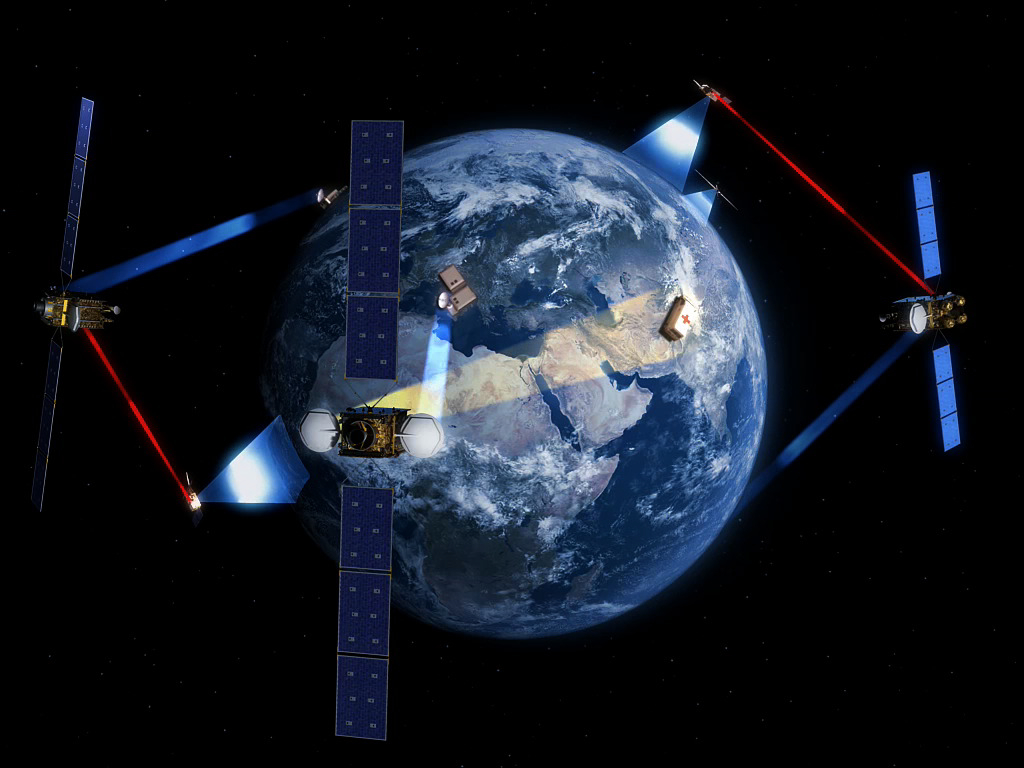
Artist impression of European Data Relay Satellite (EDRS) system
Download:
 HI-RES JPEG (Size: 358 kb)  Credits: ESA

 Europe’s data relay satellite system – EDRS - has been completed and approved. This marks the moment when it moves ahead with a green light from its first customer, the Global Monitoring for Environment and Security initiative from the European Union (GMES).

EDRS will provide a telecommunications network that is fast, reliable and seamless, making real-time information from satellites available on demand.
EDRS will be the first commercially operated data relay system to deliver services to the Earth observation community.
It is being built through a Public–Private Partnership (PPP) between ESA and Astrium Services, using payloads carried by two satellites in geostationary orbit, hovering 36 000 km above the Equator, where their speed matches Earth’s rotation.
Data transmitted from satellites in lower orbits to either of these EDRS payloads can then be relayed to the ground.
The payload includes a laser terminal developed by TESAT of Germany to transmit up to 1.8 gigabits per second over distances in excess of 40 000 km, between the lower satellites and EDRS in geostationary orbit.
A design review board of senior members from ESA, Astrium and the DLR German Aerospace Center approved the entire system design: from the satellites to the support that will be required from the ground.
The industrial organisation is fully in place with all subcontracts negotiated and ESA’s partner Astrium Services ready to begin production.
“EDRS is a fantastic breakthrough for Europe, from the innovative laser communication terminal technology, which is the heart of EDRS, to the provision of operational services by 2014 through a PPP that combines the best from European space companies with the national and European space institutions,” says Magali Vaissiere, director of ESA’s Telecommunications and Integrated Applications Directorate.
The first of the two EDRS payloads will be carried on the Eutelsat-EB9B satellite, starting operation in 2014, built by Astrium and positioned at 9°E over the Equator.
The second satellite, planned for launch in 2016, will carry the second EDRS payload as well as the Hylas-3 payload from the UK’s Avanti Communications. This satellite will be built by Germany’s OHB using the SmallGEO platform, currently under development by OHB under ESA contract.  

For further information, please contact:

ESA Media Relations Office
Communication Department
Tel: +33 1 53 69 72 99
Fax: +33 1 53 69 76 90
Email: media@esa.int
  ESA
Guillermo Gonzalo Sánchez Achutegui
ayabaca@hotmail.com
ayabaca@gmail.com
ayabaca@yahoo.com
 Inscríbete en el Foro del blog y participa : A Vuelo De Un Quinde - El Foro!

sábado, 24 de noviembre de 2012

ESO - Eso1246es-cl.- El planeta enano Makemake pierde su atmósfera

Los astrónomos han utilizado tres telescopios de los observatorios de ESO, en Chile, para observar el planeta enano Makemake al cruzar por delante de una estrella distante, bloqueando su luz. Por primera vez, gracias a las nuevas observaciones, han podido comprobar si Makemake está rodeado por una atmósfera o no. Este mundo gélido orbita en las partes más externas del Sistema Solar y se suponía que podría tener una atmósfera similar a la de Plutón (eso0908), pero este no parece ser el caso. Los científicos también midieron por primera vez la densidad de Makemake. Los nuevos resultados se publican el 22 de noviembre en la revista Nature.


 Impresión artística de la superficie del planeta enano Makemake
 Esta impresión artística muestra la superficie del distante planeta enano Makemake. Este planeta enano tiene dos tercios del tamaño de Plutón, y viaja alrededor del Sol en una órbita distante que se encuentra más allá que Plutón, pero más cerca del Sol que la de Eris, el planeta enano más masivo conocido del Sistema Solar. Se esperaba que Makemake tuviera atmósfera, como Plutón, pero se ha demostrado que no es así.
Crédito: ESO/L. Calçada/Nick Risinger (skysurvey.org


 Camino de la sombra de Makemake al cruzarse con la Tierra el 23 de abril de 2011

Este diagrama muestra el camino que traza la sombra del planeta enano Makemake durante la ocultación de una estrella débil en abril de 2011. Desde varios sitios del sur de América, incluyendo los observatorios de La Silla y Paranal de ESO, pudo verse cómo la estrella desaparecía brevemente cuando su luz fue bloqueada por el paso de Makemake. Este planeta enano tiene dos tercios del tamaño de Plutón, y viaja alrededor del Sol en una órbita distante que se encuentra más allá que Plutón, pero más cerca del Sol que la de Eris, el planeta enano más masivo conocido del Sistema Solar. Se esperaba que Makemake tuviera atmósfera, como Plutón, pero se ha demostrado que no es así.
Crédito: ESO/L. Calçada

El planeta enano Makemake [1] tiene dos tercios del tamaño de Plutón y viaja alrededor del Sol a una órbita distante que se encuentra más allá de la de Plutón, pero más cerca del Sol que Eris, el planeta enano más masivo conocido en el Sistema Solar (eso1142). Observaciones previas del gélido Makemake mostraron que era similar a sus colegas planetas enanos, llevando a algunos astrónomos a esperar que su atmósfera, de haberla, sería similar a la de Plutón. Sin embargo, el nuevo estudio ahora muestra que, al igual que Eris, Makemake no está rodeado por una atmósfera significativa.
El equipo, liderado por José Luis Ortiz, del Instituto de Astrofísica de Andalucía (IAA-CSIC, España), combinó múltiples observaciones utilizando tres telescopios de los observatorios Paranal y La Silla, de ESO, en Chile — el VLT (Very Large Telescope), el NTT (New Technology Telescope), y el TRAPPIST (TRAnsiting Planets and PlanetesImals Small Telescope) — junto con datos de otros telescopios más pequeños ubicados en el sur del continente americano [2], observando el paso de Makemake por delante de una estrella distante [3]. 
“Cuando Makemake pasó frente a la estrella, bloqueando su luz, en lugar de apagarse y volver a brillar de forma gradual,  la estrella desapareció y reapareció de forma muy brusca. Esto significa que el pequeño paneta enano no tiene una atmósfera significativa”, afirma José Luis Ortiz. “Se pensaba que Makemake podría haber desarrollado una atmósfera — que no haya pruebas de que la tiene nos demuestra lo mucho que aún nos queda por aprender de este misterioso tipo de objetos. Descubrir, por primera vez, algunas de las propiedades de Makemake es un gran paso adelante en nuestro estudio del selecto club de los planetas enanos helados”. 
El hecho de que Makemake no tenga lunas, y la gran distancia que lo separa de nosotros, hacen que sea difícil de estudiar [4], y lo poco que sabemos sobre este cuerpo es solo una aproximación. Las nuevas observaciones del equipo arrojan luz sobre nuestra visión de Makemake al determinar su tamaño con mayor precisión, limitar las opciones sobre una posible atmósfera y al estimar, por primera vez, la densidad  del planeta enano. También han permitido a los astrónomos medir cuánta luz del Sol refleja la superficie de Makemake — su albedo [5]. El albedo de Makemake, de un 0,77, es comparable con el de la nieve sucia, mayor que el de Plutón, pero menor al de Eris. 
Fue posible observar a Makemake con tanto detalle sólo porque pasaba frente a una estrella — un evento conocido como ocultación estelar. Estas oportunidades excepcionales han permitido a los astrónomos obtener, por primera vez, mucha información sobre la, a veces, tenue y delicada atmósfera que hay alrededor de estos lejanos, pero importantes, miembros del Sistema Solar, proporcionando información muy precisa sobre otras de sus propiedades. 
Las ocultaciones son especialmente inusuales en el caso de Makemake, ya que se mueve en un área del cielo que cuenta, relativamente, con pocas estrellas. Predecir y detectar con precisión estos excepcionales acontecimientos es extremadamente complicado y la exitosa observación llevada a cabo por un equipo coordinado, repartido por varios lugares del sur de América, hace aún más valioso este logro.
“Plutón, Eris y Makemake son solo unos pocos ejemplos de los numerosos objetos helados que orbitan lejos del Sol”, afirma José Luis Ortiz. “Nuestras nuevas observaciones han impulsado en gran medida nuestro conocimiento de uno de estos objetos de mayor tamaño, Makemake — podremos usar esta información para explorar estos intrigantes objetos en esta región alejada del espacio”.

Notas

[1] Makemake era conocido en un principio como 2005 FY9. Fue descubierto unos cuantos días después de Pascua, en marzo de 2005, siendo apodado de manera informal como ”Conejito de Pascua” (Easterbunny). En Julio de 2008 fue oficialmente bautizado  con el nombre de Makemake. Makemake es el creador de la humanidad y dios de la fertilidad en la mitología de los nativos de la Isla de Pascua.
Makemake es uno de los cinco planetas enanos reconocidos por la Unión Astronómica Internacional (IAU, International Astronomical Union). Los otros son Ceres, Plutón, Haumea y Eris. Pueden encontrar más información sobre planetas enanos y planetas en la web de la Unión Astronómica Internacional.
[2] Otro de los telescopios utilizados en esta campaña de observación fue un telescopio de 0,84 metros instalado en la Universidad Católica del Norte de Chile. Este telescopio se encuentra en Cerro Armazones, la futura ubicación del E-ELT (European Extremely Large Telescope).
[3] Makemake pasó frente a una estrella débil llamada NOMAD 1181-0235723 (NOMAD se refiere al Naval Observatory Merged Astronomic Dataset) el 23 de abril de 2011. El equipo observó este evento utilizando diferentes telescopios ubicados en Brasil y Chile. Solo duró un minuto, por lo que los astrónomos aprovecharon las capacidades de una cámara ultra-rápida especializada conocida como ULTRACAM (eso0520) y de otro instrumento infrarrojo ultra-rápido llamado ISAAC para captar el acontecimiento.
[4] En el caso de objetos que tienen una o varias lunas orbitando a su alrededor, los movimientos de las lunas pueden utilizarse para deducir la masa del objeto. Esto no es posible en el caso de Makemake.
[5] Se calculó que el planeta enano tenía un albedo geométrico de 0.77 ± 0.03, mayor que el de Plutón, pero menor que el de Eris. Un albedo de 1 representa un cuerpo perfectamente reflectante, y 0 se asigna a una superficie negra que no refleja nada en absoluto. Las observaciones, junto con resultados previos, indican que Makemake tiene una densidad de 1.7 ± 0.3 gramos por centímetro cúbico, lo que a su vez permitió al equipo inferir la forma y la apariencia de un objeto esferoidal achatado — una esfera ligeramente aplanada en ambos polos — con ejes de 1430 ± 9 kilómetros y 1502 ± 45 kilómetros. Makemake no presenta una atmósfera global como la de Plutón, sino que tiene una milésima parte de la atmósfera de Plutón. Aún así, puede tener una atmósfera que cubra solo parte de su superficie. La posible existencia de esta atmósfera local, que en teoría es posible, no ha sido excluida por las observaciones.

Información adicional

Esta investigación se ha presentado en el artículo “Albedo y limitaciones atmosféricas del planeta enano Makemake a partir de una ocultación estelar (Albedo and atmospheric constraints of dwarf planet Makemake from a stellar occultation)” que aparece en la edición del 22 de noviembre de 2012 de la revista Nature.
El equipo está compuesto por J. L. Ortiz (Instituto de Astrofísica de Andalucía, CSIC, España), B. Sicardy (LESIA–Observatorio de París; CNRS; Universidad Pierre et Marie Curie; Instituto Universitario de Francia, Francia), F. Braga-Ribas (Observatorio de París; CNRS; France; Observatorio Nacional/MCTI, Brasil), A. Alvarez-Candal (Observatorio Europeo Austral, Chile; Instituto de Astrofísica de Andalucía, CSIC, España), E. Lellouch (Observatorio de París, CNRS, Francia), et al. 
Para la lista completa de autores y afiliaciones, por favor, hagan referencia al artículo de la revista Nature.
El año 2012 marca el 50 aniversario de la creación del Observatorio Europeo Austral (European Southern Observatory, ESO). ESO es la principal organización astronómica intergubernamental de Europa y el observatorio astronómico más productivo del mundo. Quince países apoyan esta institución: Alemania, Austria, Bélgica, Brasil, Dinamarca, España, Finlandia, Francia, Holanda, Italia, Portugal, el Reino Unido, República Checa, Suecia y Suiza. ESO desarrolla un ambicioso programa centrado en el diseño, construcción y operación de poderosas instalaciones de observación terrestres que permiten a los astrónomos hacer importantes descubrimientos científicos. ESO también desarrolla un importante papel al promover y organizar la cooperación en investigación astronómica. ESO opera tres sitios únicos de observación de categoría mundial en Chile: La Silla, Paranal y Chajnantor. En Paranal, ESO opera el Very Large Telescope, el observatorio óptico más avanzado del mundo, y dos telescopios de rastreo. VISTA trabaja en el infrarrojo y es el telescopio de rastreo más grande del mundo, y el VST (sigla en inglés del Telescopio de Rastreo del VLT) es el telescopio más grande diseñado exclusivamente para rastrear el cielo en luz visible. ESO es el socio europeo de un revolucionario telescopio, ALMA, el proyecto astronómico más grande en desarrollo. Actualmente ESO está planificando el European Extremely Large Telescope, E-ELT, el telescopio óptico y de infrarrojo cercano de 39 metros, que llegará a ser “el ojo más grande del mundo para mirar el cielo”.

Enlaces

 ESO
Guillermo Gonzalo Sánchez Achuegui
ayabaca@hotmail.com
ayabaca@gmail.com
ayabaca@yahoo.com
 Inscríbete en el Foro del blog y participa : A Vuelo De Un Quinde - El Foro!

NASA - Hubble Eyes a Loose Spiral Galaxy


 The NASA/ESA Hubble Space Telescope has spotted the spiral galaxy ESO 499-G37, seen here against a backdrop of distant galaxies, scattered with nearby stars.

Download Image

› Full Size 

 NASA
Guillermo Gonzalo sánchez Achutegui
ayabaca@gmail.com
ayabaca@hotmail.om
ayabaca@yahoo.com 
 Inscríbete en el Foro del blog y participa : A Vuelo De Un Quinde - El Foro!

NASA - NASA X : MEDLI and Mars Curiosity Rover


NASA's Mars rover Curiosity drove 83 feet eastward during the 102nd Martian day, or sol, of the mission (Nov. 18, 2012), and used its left navigation camera to record this view ahead at the end of the drive.

NASA's Mars rover Curiosity drove 83 feet eastward during the 102nd Martian day, or sol, of the mission (Nov. 18, 2012), and used its left navigation camera to record this view ahead at the end of the drive. Image credit: NASA/JPL-Caltech
› Full image and caption       › Latest images       › Curiosity gallery       › Curiosity videos       › Related video 

Download Image

› Full Size 

 NASA's Mars rover Curiosity drove 6.2 feet (1.9 meters) during the 100th Martian day, or sol, of the mission (Nov. 16, 2012).

Download Image

› Full Size 


Download Image

› Full Size 
Mission Status Report
PASADENA, Calif. -- NASA's Mars rover Curiosity completed a touch-and-go inspection of one rock on Sunday, Nov. 18, then pivoted and, on the same day, drove toward a Thanksgiving overlook location.
Last week, Curiosity drove for the first time after spending several weeks in soil-scooping activities at one location. On Friday, Nov. 16, the rover drove 6.2 feet (1.9 meters) to get within arm's reach of a rock called "Rocknest 3." On Sunday, it touched that rock with the Alpha Particle X-Ray Spectrometer (APXS) on its arm, and took two 10-minute APXS readings of data about the chemical elements in the rock. Then Curiosity stowed its arm and drove 83 feet (25.3 meters) eastward toward a target called "Point Lake."
"We have done touches before, and we've done goes before, but this is our first 'touch-and-go' on the same day," said Curiosity Mission Manager Michael Watkins of NASA's Jet Propulsion Laboratory, Pasadena, Calif. "It is a good sign that the rover team is getting comfortable with more complex operational planning, which will serve us well in the weeks ahead."
During a Thanksgiving break, the team will use Curiosity's Mast Camera (Mastcam) from Point Lake to examine possible routes and targets to the east. A priority is to choose a rock for the first use of the rover's hammering drill, which will collect samples of powder from rock interiors.
Although Curiosity has departed the Rocknest patch of windblown sand and dust where it scooped up soil samples in recent weeks, the sample-handling mechanism on the rover's arm is still holding some soil from the fifth and final scoop collected at Rocknest. The rover is carrying this sample so it can be available for analysis by instruments within the rover if scientists choose that option in coming days.
JPL, a division of the California Institute of Technology, Pasadena, manages the Mars Science Laboratory Project for NASA's Science Mission Directorate, Washington. JPL designed and built the rover.
More information about Curiosity is online 
You can follow the mission on Facebook 
and on Twitter 
Guy Webster 818-354-6278
Jet Propulsion Laboratory, Pasadena, Calif.
guy.webster@jpl.nasa.gov

2012-363


NASA X: MEDLI and Mars Curiosity Rover
11.20.12
› Download Vodcast (170 MB)
› Download HD (720p, 477 MB)
NASA X MEDLI - Curiosity Mission Jennifer Pulley – host
Dr. Neil Cheatwood -- NASA LaRC
Michelle Munk -- NASA LaRC
Alan Little -- NASA LaRC
Dr. Deepak Bose -- NASA ARC
Ed Martinez -- NASA ARC
Jeff Herath -- NASA LaRC
Chris Kuhl -- NASA LaRC


NASA Announcer:Main engines start. And liftoff. Atlas v, curiosity. Pulley: Mars is back in the spotlight as NASA once again focuses on unraveling The mysteries of the red planet, this time with a new rover called curiosity. During the lead up to this mission, there was a lot of talk about the so-called seven minutes of terror, which referred to edl, or the entry, descent, and landing stage. The reason the word "terror" was used is because researchers Spend years of their lives developing and perfecting a spacecraft, only to have this very short seven-minute window often determine whether the mission fails or succeeds. During these seven minutes, the spacecraft experiences enormous changes in temperatures, pressure, And speed, but surprisingly, even with the tremendous amount of data and experience we have about how to land on mars, there is still a gap in our knowledge about exactly what a spacecraft experiences during the crucial edl stage. but beginning with the curiosity mission, NASA researchers have developed A suite of instruments that will gave us a much better understanding of the edl conditions, changing that seven minutes of terror to something more like seven minutes of heightened concern.
Pulley: Coming up on this episode of NASA x, we will find out about the challenges of edl, as we follow the MEDLI team in their quest to improve Our understanding of entry descent and landing. we will follow them from some early setbacks and design challenges, all the way through to the triumphant night that curiosity landed on mars. In this small clean room at NASA langley, researchers are lovingly and carefully Putting the finishing touches on this device that is part of MEDLI, or the mars science laboratory entry, descent, and landing, instrumentation. this very device will eventually meet a fiery end more than 350 million miles away on the surface of mars. for most of us, the idea of our hard work ending up battered and destroyed so far from home wouldn't sit well, but this team is okay with the end result, because once MEDLI completes its job, our knowledge of how to land on mars will have increased dramatically. Mars is a curious place. with our modern tools we have a much better understanding of the planet, but attempting to understand mars has long been a pastime for both early humans and for us today.
Pulley:Observers from around the world have long viewed it with awe, seeing its red color As being both ominous and also a symbol of strength. the name we use today for mars comes from the roman god of battle, but the romans were not the only culture who noticed mars. ancient egyptian observers admired the planet so much that today's capital cairo comes from the ancient arabic word for mars, "al qahira." most early cultures considered mars to be aggressive or evil due to its red color, and each mission we've sent to mars has done little to dispel this perception. in addition to its cold and barren landscape, it is incredibly difficult to safely land spacecraft there. in fact, out of the first 41 mission to mars, only 15 were successful. even though difficult, when missions are successful, they provide immense amounts of data that can be used to further our knowledge for years to come. One of the most successful early NASA programs was the mars viking missions in 1976. that mission landed two stationary landers on the surface of mars, and although they were only scheduled to last for 90 days, the landers transmitted data for several years, prompting one NASA observe to say, "we found intelligent life on mars, and it was us." other missions followed-- some successful, some not-- but with each mission, our knowledge and experience delivering vehicles to mars increased significantly. Building on both the successes and failures of the past, NASA decided to send the most complex and technologically advanced mission that had ever been sent to mars, called the mars science laboratory, or the curiosity rover. the size of a small car, this rover has enough scientific firepower to unlock many of the mysteries of mars in ways we could only have dreamed of a few years ago. but getting the curiosity rover there would be tough. this vehicle is much bigger than anything we have ever tried To land on mars before. the rovers and landers of the past were all relatively small, so with minimal changes, researchers could generally fit each new payload into a similar shaped aeroshell and use an existing thermal protection system. because these factors didn't change much, researchers had a known commodity and could plan accordingly. curiosity is different. it is by far the largest and most capable rover to ever land on mars, and researchers had to completely rewrite many of the "how to land on mars" books.
Cheatwood: We're limited by how large a vehicle we can put in launch vehicle, by the launch vehicle shroud. so those other vehicles flew on smaller rockets to save costs. they weren't taking as much mass, but they then were limited to a 2.65 heat shield. with msl, we're flying The biggest one that we have to date, about 4 1/2 meters, and that's about as big as we can make it on any rocket we have. so this is a very large heat shield. well, size matters on these heat shields, because the larger the heat shield is, the more drag it produces, and that drag force is what slows you down. so the more drag you have, actually the more mass you can put in it. and so we're taking the biggest Thing we've ever taken to mars. it's like a car. it's a metric ton- 2,200 pounds, basically--of vehicle That we're gonna land. and so we needed that big heat shield to be able to slow us down to get to the surface.
Pulley: To get to the surface safely, researchers had to develop a completely new aeroshell, new thermal protection systems, new sky crane landing sequence, and so much more, leading to a lot uncertainty In the research community. because the entry into the atmosphere, the descent to the ground, and the all important landing are some of the most important elements to safely getting any vehicle to mars, especially one that is so much larger than previous vehicles, there has been a big push to better understand the specific conditions that the vehicle will face when entering the martian atmosphere.
Munk: The mars atmosphere is, you know, too thick to ignore and too thin to really help you out too much. and that's why landing on mars is so challenging. the pressure differences and the density differences, along with the chemistry differences--the mars atmosphere is mostly carbon dioxide, As opposed to our nitrogen, oxygen atmosphere here on earth-- that it's really difficult to simulate, and it's difficult to test in. nearly impossible. so we do different tests in different facilities, trying to piece together the story and validate our simulation. so if works at this point and this is the model, then we think that the model will work over at this point, which is the real flight environment. but it's a very involved, complex process to design and ensure that a vehicle will perform as we think at mars.
Little: So one of the challenges that we face is the lack of data on how vehicles perform in the martian atmosphere. so that's one of the main problems. there's been very little instrumentation on previous missions. MEDLI is the most complete instrumentation data set we'll have on an entry vehicle on Mars.
Pulley: For past missions, researchers would simply over-engineer pieces to make sure they worked as expected, Which of course added weight and complexity to each mission. but as we begin to think about landing humans on mars, we need to have more precise readings and understanding of the exact conditions spacecraft will face when they enter this alien environment. One way you can get these measurements is to place sophisticated sensors in the heat shield itself. this sounds simple in theory, but it is in fact very difficult. to do this, NASA put together a highly skilled team of engineers to tackle this looming problem. they came up with the concept called the mars science laboratory entry, descent, and landing instrument, or MEDLI, as the solution,
Munk:So MEDLI is a unique opportunity for us. we've been in the technical community wanting to instrument An entry vehicle for as long as I can remember. and finally all the stars aligned and we were able to do it. so we're pretty excited to be able to give this data set back to the engineers and the scientists. MEDLI is a serious of sensors on the mars science laboratory heat shield. so we've actually mounted pressure transducers to the inside of the aeroshell structure, and we've put plugs in the thermal protection system Material to measure the pressure and the temperature on the spacecraft as it flies down through the atmosphere.
Pulley: MEDLI consist of two unique sets of instruments to help gather this information. the first is called MEADS, Or the mars entry atmospheric data system, and the second is know as MISP, or MEDLI integrated sensor plugs. meads will measure the atmospheric pressure on the heat shield to see how well models predicted the spacecraft's real trajectory and its aerodynamics, while MISP will measure how hot the heat shield gets and how much of the heat shield burns off during entry. both of these instruments will be attached to the heat shield section of the spacecraft and will experience the highest temperatures and pressure that will be exerted on the craft. The engineers have determined that the best configuration To get the measurements would be to place the seven meads pressure transducers in a cross-shaped configuration to help calculate the vehicle's angle of attack, sideslip, and dynamic pressure.
Michelle: The other part of the MEDLI system is the thermal plug, and this is actually made of the pica heat shield material, and it's about 1 1/4 inches in diameter, and it's bonded into place, and then the wires come through the structure and again feed back to our electronics box. so with these plugs, we have four thermocouples measuring the temperature in depth in the material. this is important, because that will tell us how the material responded to the heat pulse and how it soaked through and at what rate. we also have a recession sensor which is the little dot right there off-center. it's called a heat recession sensor--pun intended--and it will sense the recession or how the material burns away as we enter the atmosphere.
Pulley: So with this plan in place, the MEDLI team began working on the problem of how to integrate these Systems into the spacecraft. immediately the team knew that they would have to drill holes in the heat shield of the msl to insert these plugs. as you can imagine with a $2.5 billion mission, there was some concern about drilling holes in a perfectly good heat shield.
Martinez: There was a lot of consternation, because it's kind of like jumping out of a perfectly good airplane. You have to keep in mind that a full-bodied heat shield, all the tps typically is a single point of failure subsystem for the entire mission. so taking a single point of failure subsystem and then putting holes in it gets people excited. and that was one of the ongoing challenges to this project, was to demonstrate At every turn, under every experience, that the holes were making pressure measurements and the holes that we would have to make in to the thermal plugs would be okay, it would be no threat to the project. and so we were very successful in doing that.
Pulley: With the go-ahead to begin, the testing phase soon followed. of course one of the main tools Used in the initial testing were computer simulations. by the time of the launch, millions of simulations Had been run to make sure everything would react as anticipated. with the computer data as a starting point, the next big step would be to test the sensors in environments that were as close to real-world as possible. at the beginning of the process, it was determined that heat shield would be made from The exact same material used for every mars mission since the viking landers. with this knowledge, the team began building the plugs and then placing them in a unique facility called an arc jet. this facility creates temperatures in excess of the temperatures that will be seen on mars. after months of successful Testing and data in hand, the team was ready. But then there was a problem. After some intense examination, it was determined that the material they were using may not be suitable for this mission, so a change would have to be made.
Martinez:the reason behind that was because the original material, and this the example of that, it's called sla-561v. it's a cork and cork-based material with a lot of other soupy kind of elements in it in a honeycomb matrix. and that material was invented for the viking program. the viking program was experiencing roughly 15 watts per square centimeter. the architecture of how that mission got to the surface of mars was completely different than msl's in that they went to orbit around mars and then gently went down to the surface, whereas msl did it in one single shot from the 13,000 miles per hour and then back down to the surface. so further calculations and experience showed us that there was A shear flow that was happening because of turbulent flow was also being predicted. and when we used The best capability that we have for ground testing, this material actually just dissipated and went away in ground tests. so then very quickly the heat shield for msl became the number one threat to the entire mission.
Pulley: With the mission hanging in the balance, the team changed to a new heat shield material called pica, or phenolic impregnated carbon ablator. this material had only been used once before on the stardust mission, but it had work phenomenally well. with this new material in hand, the team started the testing process all over again. more arc jet testing was ordered and the material passed with flying colors.
Bose: Now, this is a fairly light material. this is about-- the density would be about a tenth of a ceramic material, even much lower than a metallic heat shield. so this has a pretty high temperature capability. This can go several thousand degrees, and there is no melting.it's just sublimes. and the primary way it rejects heat from the vehicle is through re-radiation as it rises in temperature. it really gets back into space all the heat. that's the primary way it rejects heat. another way of rejecting heat is actually pyrolyzing the material, which is why it becomes black from the original color, and that's the secondary way of rejecting heat as well.
Pulley: More testing followed including calibration of the meads instrumentation on a small scale model of the craft hat was fired from a cannon at the Aberdeen Proving Ground. that test also came back in the affirmative. so with all the data in hand, it was now time to begin drilling the holes in the heat shield and placing the instruments on board. Once the MEDLI device was installed, the heat shield was attached To the vehicle and in short order would soon be on it's way to mars. On the morning of november 26, 2011, the team watched as the mars science laboratory mission launched for mars. all they could do now was wait an agonizing nine months to see if all this hard work would pay off. On the evening of august 5, 2012, the team begins to arrive at jpl. spirits are high as they moves toward the edl room. there is a lot of tension, but everyone feels confident the mission will be a success.
Herath: Maybe a little anxious, but not as nervous as we thought we'd be at this point. We've really done the testing, and looking at it, we're ready--we're ready for this thing to happen.
Pulley: As the team begins to take their seats, the tension in the air rises. with mars hundreds of millions of miles away, and the data traveling at the speed of light, it still takes about 14 minutes for the information to come back to the EDL room. as engineers and researchers watch the screens, all the data they receive has already occurred minutes before.
Kuhl:- In about an hour-- an hour and a half, we'll get our last health status, and then we'll get a few points of data, and it'll say, "okay, this is the state of the MEDLI instrument before entry," and then at 30 minutes,then we'll get the real data. so it'll be exciting.
Pulley: With the success of the mission on the line, nerves and excitement can be seen everywhere. with just minutes to go before landing, data begins to trickle in. - whoo! - go, MEDLI! [cheers and applause]
Pulley: The first data sets are good, but with about 13 minutes to go before landing, the realization sets in that the MEDLI instrumentation has already worked or failed on the martian surface.
Cheatwood: The spacecraft is actually on the surface at this point,'cause there's a 14-minute lag. so we're not gonna know for sure. it's on the surface one way or another.
Pulley: Data continues to come back.
JPL: I have the new data set. - parachute deployed. Parachute. [cheers and applause] We are in powered flight. sky crane has started. Descending out about .75 meters a second as expected. Touchdown confirmed. we're safe on mars. [cheers and applause]
Cheatwood: in a way, it's performed phenomenally the whole way through, as near as we can tell. a very good day.
Herath: I think we just accomplished something incredible as a team, NASA... This was something--many people looked at the architecture and said it couldn't be done and shouldn't be done, but we did it and successfully got the rover on the surface. So we've got a two-year mission to determine if Mars could have or even could currently support life.
Bose: You guys got it there, and now there's a wealth of data for us, and next mission we're gonna do even better.
Pulley: This has been quite a night for the team, but only a fraction of the data has been received. most of the information for the landing has been stored on board the curiosity rover. the MEDLI team will receive all the data over the following few weeks.
Martinez: everything went flawlessly. we got our data back. it's clean. we saw the sensors perform According to expectation.
Bose:We have the entire data set back, everybody is extremely happy, and we can see that all that hard work that has gone into it has really paid off, and the data set is rich, and it will be something that the community uses for literally decades to come.
Pulley: With the data back and MEDLI a huge success, MEDLI-type instrumentation may become the norm for receiving data back from future spacecraft. this type of information will become even more important as we begin to plan for human-raided missions to mars and beyond. with each small step and knowledge captured from tools like MEDLI,we will continue to get closer To that one day when humans walk on the red planet. [laughter] [cheers and applause] - we did it! [cheers and applause]

› Download Vodcast (170 MB)
› Download HD (720p, 477 MB)
 NASA
Guillermo Gonzalo Sánchez Achutegui
ayabaca@gmail.com
ayabaca@hotmail.com
ayabaca@yahoo.com

Mi lista de blogs